











By Mark Longyen, News Agency of Nigeria (NAN)
Foreign affairs analysts have postulated that West Africa, and indeed the entire Africa, is facing an existential threat triggered by a surge in terrorism on the continent.
Terrorism, violent extremism, unconstitutional changes of government, and banditry, have spiked, assuming an alarming rate, and spreading like wildfire, across Africa.
For instance, the African Center for Strategic Studies, in a recent study, said that terrorist activities in Africa have spiraled out of control by more than 100,000 per cent in the past two decades.
The center posited that in spite of the local and foreign interventions initiated over the years, more than 23,000 people were killed in 2023 by terrorists. This represents a 20 per cent increase in the number of those killed in 2022.
This terrorism threat, experts say, is fueled and exacerbated by three main causes, namely: global terrorism financing, illicit arms trade, and poor governance, with its negative offshoots of corruption, deception, and the adoption of unfair policies.
Poor governance also manifests in the pollution of the judiciary, electoral manipulation, inadequate policing, ethnic marginalisation, political exclusion, unemployment, poverty, and, above all, insecurity, rendering the country a fertile ground and conducive atmosphere for terrorists to thrive.
African leaders and other stakeholders are, therefore, of a consensus that collaboration, institution building, resource mobilisation, intelligence sharing, and social contracts, are crucial in curbing the marauding scourge.
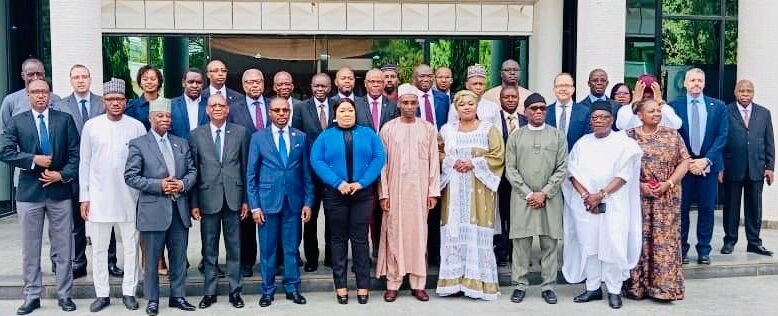
To tackle this menace, the Economic Community of West African States (ECOWAS) and the African Union (AU) a few days ago in Abuja held an inaugural joint consultation meeting of the ECOWAS Mediation and Security Council (MSC) and the AU Peace and Security Council (PSC) at the ambassadorial level.
Nigeria’s Permanent Representative to ECOWAS and Chairman of the ECOWAS Mediation and Security Council, Amb. Musa Nuhu, in his remarks at the event, called for a unified response that should go beyond national boundaries.
“We need to emphasize the critical role and the absolute necessity of collaboration and cooperation in preventing, managing, and resolving these conflicts in our region,” he stressed.
The Gambia’s Permanent Representative to the AU and Chairperson, AU-PSC, Amb. Jainaba Jagne, said that terrorism, violent extremism, and unconstitutional changes of governments were Africa’s main scourges that must be decimated.
She said that the AU PSC was working very closely with the ECOWAS MSC to address these emerging threats on the continent.
“We need to collaborate, synergise, and work to ensure that we combat all of these scourges on the continent,” she said.
ECOWAS Commissioner, Political Affairs, Peace and Security, Amb. Abdel-Fatau Musah, said that ECOWAS and AU were determined to rout out the scourge of insecurity.
He described terrorism and unconstitutional changes in government as “the two existential threats facing the continent.”
Amb. Musah disclosed that ECOWAS and the African Union were already working on a clear roadmap and joint action plan on the challenges facing West Africa.
He said that the roadmap entailed producing a framework of action, as well as raising resources together to confront the challenges to meet the exigencies of the moment.
“We have chosen terrorism and unconstitutional changes of government as the main issues to discuss because these are the two existential threats that are facing the West African region today,” he said.
Also, AU’s Commissioner, Political Affairs, Peace and Security, Amb. Bankole Adeoye, noted that foreign and local terrorism financing and sponsorship were critical terrorism enablers, adding that, “we must rid the continent of terrorism and silence the guns.”
Adeoye called for effective financial intelligence system that looks at the wider global picture and works with the UN office on counter-terrorism to track terrorists’ funds.
“Once you cut off that lifeline, most of the terrorists will not be able to survive,” Adeoye said.
To underscore the urgency and seriousness, which Africa’s leaders take the continent’s degenerating security situation, a two-day African high-level counter-terrorism summit was also held in Abuja, just a day before the AU-ECOWAS consultation meeting.
The summit aimed at precipitating “African-led and African-owned” solutions against terrorism and strengthening regional response to terrorism threats.
It also aimed at enhancing regional cooperation and producing a comprehensive framework, as well as curbing the conditions that are conducive to the spread of terrorism.
Speaking at the event, Nigeria’s President Bola Tinubu, Chairman of the Authority of ECOWAS Heads of State and Government, called for the establishment and strengthening of an African standby military force.
He explained that the force would curb the menace of terrorism and violent conflicts, as well as deter unconstitutional changes of government.
“Terrorism snaps at the very fabric of the prosperous and just society, which we seek to build for ourselves and our children.
“This violent threat seeks to frighten the farmer from his field, children from their schools, women from the marketplace, and families from their very homes.
“We must, therefore, fight this threat together, combining determined national effort with well-tailored, regional and international collaboration,” Tinubu said.
Also speaking, Ghanaian President Nana Akufo-Addo, called for urgent collaborative actions to combat terrorism, which he said, had continued to threaten Africa’s peace, security, and development.
He noted that the evolving nature of terrorism in Africa demanded a dynamic and coordinated response that would transcend national borders and individual efforts.
“These groups are exploiting grievances, and vulnerabilities and are manipulating ideologies to spread fear, division, and chaos,” he said.
President Faure Gnassingbe of Togo, in his speech, reiterated the need for African states to collaborate, and mobilise their defense and security forces to collectively, and effectively, curb the threats of terrorism, which he described as “critical.”
In her remarks, UN Deputy Secretary-General, Amina Mohammed, stressed the need to strengthen regional cooperation and institution-building to address Africa’s unprecedented threat of terrorism and violent extremism.
She said that the epicenter of terrorism had shifted from the Middle-East and North Africa into Sub-Saharan Africa’s Sahel region, with dire consequences.
According to her, Africa alone currently accounts for almost half of all deaths from terrorism globally.
“Our leaders must ensure that the institutions of the African Union and ECOWAS, who are responsible for driving integration, have the capacity and resources to do so if we are to achieve their mandates,” she said.
Vladimir Voronkov, Under-Secretary-General, United Nations Office on Counter Terrorism, UNOCT, stressed that ECOWAS, AU, and other African regional organisations had a crucial role to play in effectively countering terrorism.
According to him, the success of the United Nations in Africa hinges on the UN’s commitment to support “Africa-led solutions to African challenges.”
He lauded the efforts of the AU and ECOWAS in countering terrorism and preventing violent extremism.
“No single actor can resolve today’s threats to peace and security, instead, we need multiple actors working together with solutions grounded with strong national ownership and support of bi-funding partners,” Voronkov said.
AU Commission Chairman, Moussa Mahamat, in his remarks, said the time had come to work out a holistic and all-encompassing continental strategic plan of action to fight terrorism in Africa.
He wondered why elsewhere in the world, coalitions to fight against terrorism were established but similar efforts were not made in even one of Africa’s 5 regions, where terrorists had ravaged human lives, infrastructures, and institutions.
Mahamat then urged the international community to do more in supporting Africa’s fight against terrorism, and asked rhetorically: “Why are our voices not being heard and heeded?”
Amadu Sesay, Africa’s foremost Professor of International Relations, opines that to tackle terrorism in Africa, its leaders must first resolve the Sahel imbroglio.
He said that the way out of the Sahel quagmire was to urgently search for diplomatic solutions that could resolve the dangerous and delicate security situation there, and return Mali, Burkina Faso, and Niger to the ECOWAS family.
Sesay urged ECOWAS leaders to deploy diplomatic dexterity with the view to returning the Sahel countries to ECOWAS, adding that it was key to any collaborative efforts towards an African standing force that would repel the terrorists from spreading to West Africa’s coastal member states and beyond.
“ECOWAS leaders should look for capable, credible, and competent emissaries, especially within the membership of its Committee of the Wise and Elders, to drive the diplomatic engagements that could provide realistic and practical pathways that are acceptable to all parties, including the three countries,” he told NAN.
Dr Mohamed Ibn Chambas, pioneer ECOWAS Commission President, and AU’s High Representative for ‘Silencing the Guns in Africa,’ corroborated Sesay’s view.
“I’m aware that Nigeria’s President Bola Tinubu, Chairman of the Authority of ECOWAS Heads of State and Government, is already working actively with the ECOWAS President, Dr Omar Touré, to ensure that every diplomatic step is taken to keep ECOWAS united,” Chambas said.
Diplomatic observers are, however of the view that, notwithstanding the multilateral efforts by African and global leaders to stem the tidal wave of terrorism and violent conflicts sweeping across the continent, they must “walk the talk,” if they must achieve any meaningful success.
They advocate strongly that collaboration, cooperation, financial intelligence-sharing, especially to track terrorism financing and sponsors, institution building, resource mobilisation, good governance, and social contracts, are crucial in curbing the surging scourge of terrorism in Africa. (NANFeatures)
**If used please credit the writer and News Agency of Nigeria.