















By Mark Longyen
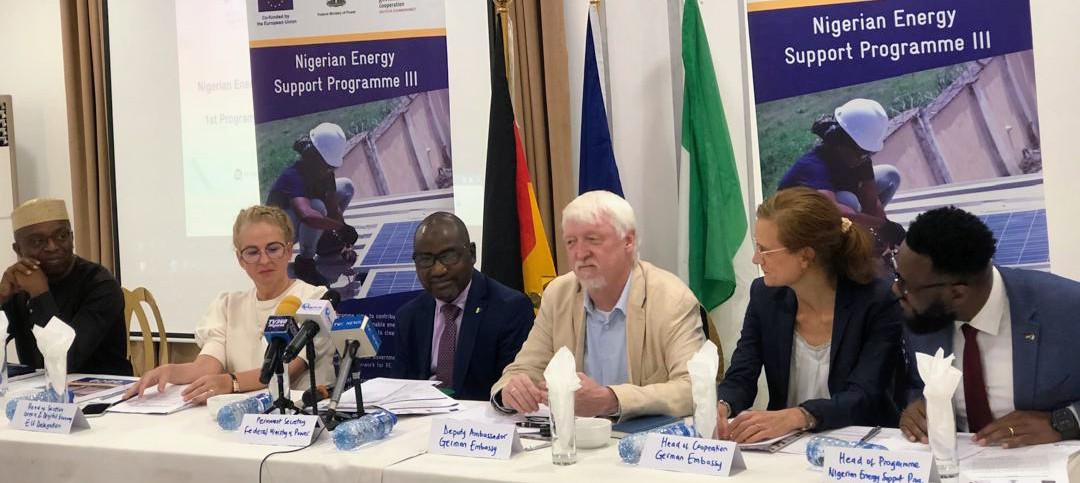
The European Union (EU), Germany and Nigeria have unveiled the third phase of the Nigerian Energy Support Programme (NESP), aimed at bolstering Nigeria’s sustainable energy sector.
The News Agency of Nigeria (NAN) reports that the programme seeks to support the federal government’s effort by fostering investments in renewable energy, energy efficiency and rural electrification.
Speaking at the event, which was also the first NESP III Steering Committee meeting, the Permanent Secretary, Ministry of Power, Mahmuda Mamman, appreciated the EU and Germany for their support.
According to him, attracting more investments in renewable energy and energy efficiency, is in accord with the objectives of Nigeria’s Electricity Act 2013, which aims at stabilising the nation’s electricity market.
“The Ministry continues to appreciate the EU and German Government for their continuous support to Nigeria, especially for ensuring energy security in the most affordable and sustainable manner.
“The third phase of the programme is “a welcome idea” that will build on the achievements of NESP Il by attracting more investments in renewable energy and energy efficiency,” Mamman said.
Ms. Inga Stefanoeicz, Head of EU Delegation to Nigeria and ECOWAS, Green and Digital Economy, said the EU would continue to support Nigeria to achieve its energy security plans.
According to her, this will go a long way to achieve a sustainable energy future for the country through the increase of renewables in its electricity mix.
Stefanoeicz said that achieving a cleaner future was the business of all stakeholders, adding that the EU would continue to support the Nigerian government to achieve its energy security plans.
“This is to also achieve a sustainable energy future through the increase of renewables in its electricity mix.
“The EU is pleased to have commissioned additional funding for the third phase of the programme to continue supporting the development of various frameworks and innovative models.
“The EU is bringing a new landscape to the concept of electricity franchising, attracting renewable energy investments and ensuring reliable power supply to its beneficiaries,” she said.
Germany’s Deputy Ambassador to Nigeria, Mr Johannes Lehne, in his remark, re-affirmed the German government’s commitment to Nigeria toward achieving its energy transition targets.
The envoy added that Germany and its partners would continue to support Nigeria’s set targets in the nation’s Energy Transition Plan(ETP).
“Technologies and investments for renewable energy and energy efficiency will be key for diversifying Nigeria’s energy mix and decarbonising the five critical sectors identified in the Energy Transition Plan (ETP).
“The third phase of NESP was commissioned by the German Federal Ministry for Economic Cooperation and Development (BMZ) with 8.9 million Euros in May this year.
“The EU has recently commissioned an additional 9 million Euros, which increases the total budget of the NESP programme to 17.9 million Euros,” he said.
Mr Duke Benjamin, Head of Programme, NESP, noted that active participation of (and collaboration with) the public and private stakeholders were critical to improve availability and reliability of energy in Nigeria.
He said NESP Ill would offer support, ranging from sustainable energy generation for rural communities, healthcare centres and businesses, efficient utilisation of energy, bridging the energy and electricity data gaps.
Benjamin added that it would also strengthen private sector investments and develop the capacities of regulatory agencies and local financial institutions.
“So far, NESP has supported the Nigerian government in creating an enabling environment for local and international investments to thrive in energy efficiency, renewable energy and rural electrification investments.
“These efforts have fostered investments in renewable energy, energy efficiency and rural electrification, as part of NESP’’s framework in Nigeria,” he said.
NAN reports that NESP, which was first commissioned in 2013, is a technical assistance programme co-funded by the EU and the German Ministry of Economic Cooperation and Development (BMZ).
The NESP is being implemented by the Deutsche Gesellschaft fur Internationale Zusammenarbeit (GIZ) in collaboration with the Nigerian Ministry of Power.(NAN)
Edited by Abiemwense Moru





[…] This article was carefully curated by Pan Africa News Agency to showcase authentic African narrative… […]