

















By Olawunmi Ashafa
Dr Akinwumi Adesina, President and Chairman of the Board of Directors of the African Development Bank (AfDB), says the bank and the World Bank Group are committing 40 billion dollars toward the Mission 300 initiative.
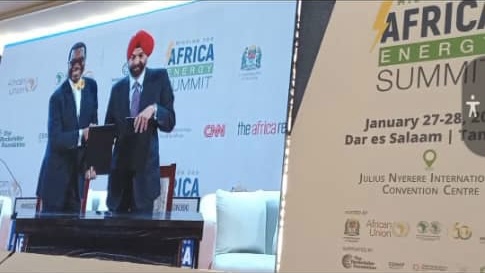
Adesina disclosed this while delivering his welcome remarks tagged,“From Ideas to Action to Accelerate Energy Access” at the Mission 300 Africa Energy Summit on Tuesday in Dar es Salaam, Tanzania.
The News Agency of Nigeria (NAN) reports that the goal of the Mission 300 is to provide electricity to 300 million Africans by 2030.
Adesina said the financial commitment to Mission 300 included 18.2 billion dollars from the AfDB and 22 billion dollars from the World Bank, respectively.
According to him, support from other partners is growing, with significant pledges from the Islamic Development Bank, Asian Infrastructure Investment Bank and the OPEC Fund.
He expressed gratitude for the technical and financial contributions of partners like the Rockefeller Foundation.
Adesina, therefore, called on African leaders to seize this moment, adding, “Together, let us decisively use Mission 300 to provide 300 million people in Africa with electricity by 2030.”
He also highlighted AfDB’s complementary Desert to Fire initiative, aimed at delivering 10,000 megawatts of solar power to 11 countries, bringing electricity to an additional 250 million people.
He emphasised that, together, these efforts could transform the continent, providing universal access to electricity for Africa.
According to him, lack of electricity reduces Africa’s Gross Domestic Product by two per cent to four per cent.
He highlighted the progress made under the AfDB’s New Deal on Energy for Africa, launched in 2016, saying, “Since its inception, the share of the African population with access to electricity has risen from 39 per cent in 2015 to 52 per cent in 2024.”
Adesina stated that over 25 million people had gained access to electricity through AfDB’s initiatives.
He larmented that in spite of these gains, significant challenges remained as 571 million Africans still lived without electricity, constituting 83 per cent of the global population without power.
“Furthermore, over a billion people lack access to clean cooking solutions, with dire consequences for women’s and children’s health.
“We must take decisive actions to further drive down these numbers,” he urged, emphasising the urgency of expanding energy access.
To address these challenges, he explained that the AfDB and its partners had launched Mission 300, an ambitious goal to provide electricity to 300 million Africans by 2030.
Adesina acknowledged the global coalition behind the initiative, including the African Union Commission, the World Bank, the Rockefeller Foundation, and others.
He said, “Mission 300 has grown into a global movement. Together, we are creating a brighter future for millions of Africans.
“This coalition represents an unprecedented alliance of financial and technical resources.”
Adesina called for increased private sector participation and critical reforms, including improved utility performance, renewable energy expansion and transparent licensing processes.
“The private sector must play a pivotal role in expanding both on-grid and off-grid systems to reach rural areas,” he emphasised.
He assured African leaders of AfDB’s support in achieving national energy compacts aligned with the broader goals.
Also, Mr Ajay Banga, President of the World Bank, emphasised the significance of collaboration to tackle energy poverty across the continent.
“Over the next decade, 360 million young people in Africa will be ready to enter the workforce, yet the current system will only offer jobs to 150 million of them.
“That leaves three out of every five young people without the opportunity for a job, not just for earning, but for dignity. Forecasts are not destiny; together, we can change this reality,” said Banga.
Reflecting on the collaborative nature of the initiative, Banga acknowledged the contributions of key partners, including the AfDB and philanthropists such as Dr Raj Shah of the Rockefeller Foundation.
He stated, “No one can do this alone. Governments cannot do it alone. Businesses cannot do it alone. Development banks cannot do it alone. But together, we can.
“This effort requires governments as architects of reform and private sector players to bring innovation, efficiency, and scale.”
Outlining the World Bank Group’s commitment, Banga announced that 30 billion dollars to 40 billion dollars would be directed towards Mission 300 over the next six years.
“This effort represents both a challenge and an opportunity for the private sector.
“We are working to eliminate regulatory barriers and create environments where investments can generate returns while delivering meaningful impact. By aligning private capital with public priorities, we can achieve results that none of us could do alone.
“Governments must drive reforms, the private sector must invest with confidence and trust, and development banks must deliver financing while upholding accountability,” the World Bank president added.
He said Mission 300 was not just about powering Africa but empowering its people to achieve their dreams.
Dr Rajiv Shah, President of the Rockefeller Foundation, explained the critical role of African leadership and global partnerships in achieving energy access for millions across the continent.
Representing both the Rockefeller Foundation and the Global Energy Alliance for People and Planet, he underscored the importance of collaboration in addressing Africa’s longstanding energy challenges.
Acknowleging the leadership of AfDB and World Bank Group, he said, “I would like to offer a very special thank you to those we seek to help, Akin, Ajay and your extraordinary teams.
“We are only here today because you have made courageous decisions to make extraordinary financial commitments at a time of genuine fiscal need across the continent.”
He noted that African leaders had made remarkable efforts to harness natural resources, develop grids and expand electricity access.
He, however, pointed out that 600 million Africans still lacked basic electricity, while another 500 million did not have reliable, affordable, always-on power, essential for job creation in the global digital economy.
“This is ultimately about creating jobs and allowing for dignity for Africa’s youth entering the labour force,” Shah stressed.
He emphasised the need to replace expensive diesel generators, currently a primary power source for many African small businesses, with affordable, consistent electricity.
“And that is what Mission 300 is all about,” he said.
He addressed skepticism about the initiative’s ambitious goals, acknowledging Africa’s 140-year struggle to achieve widespread electrification.
However, he expressed confidence in the unprecedented scope and leadership behind Mission 300.
“There are three reasons why this initiative will succeed when others have fallen short: first, it is led by you, African leaders. Your compacts, commitments and absolute determination are driving this forward,” he maintained.
Shah reaffirmed the Rockefeller Foundation’s commitment to the Mission 300 partnership, emphasising the transformative potential of collaborative action.
“By working together, we can replace doubt with progress, hope with action, and achieve the dignity and opportunity that every African deserves,” he said. (NAN)
Edited by Salif Atojoko