


















By Ijeoma Olorunfemi
The Federal Government, UNESCO and other partners have committed towards supporting groundwater management for water security.
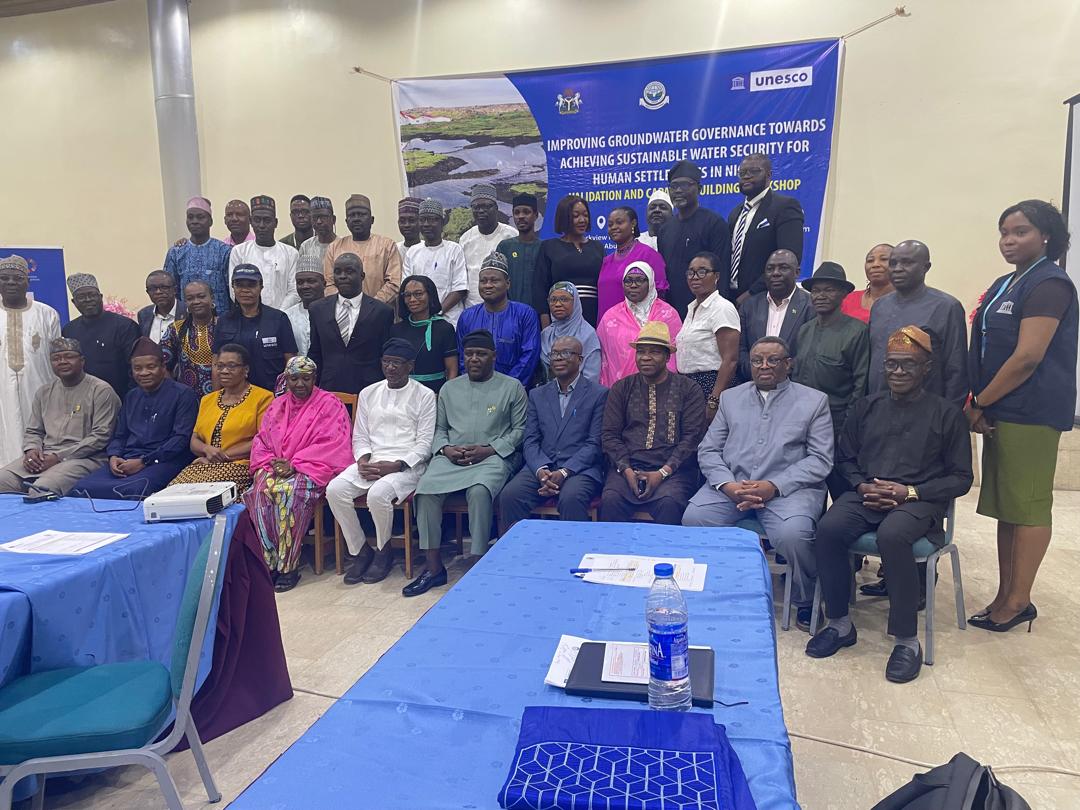
The commitment came at a two-day validation and capacity building workshop organised by UNESCO.
Groundwater is water that is found beneath the surface of the earth in conditions of 100 per cent saturation.
Groundwater can be found in aquifers. An aquifer is a body of water-saturated sediment or rock in which water can move readily.
The event, which held in Abuja, was in collaboration with the National Water Resources Institute (NWRI) and Kaduna and the Regional Centre for Integrated River Basin Management (RC-IRBM).
The workshop focused on the sub-project “Improving Groundwater Governance towards Achieving Sustainable Water Security for Human Settlements in Nigeria.”
The sub-project is being implemented within the framework of the UNESCO Korean Fund-in-Trust (K-FIT) funded project titled “Water Security for Human Settlements in Developing Countries under Climate Change.”
It aims at improving knowledge-based management and governance of groundwater resources to support Nigeria in achieving sustainable water security for human settlements and build resilience to the impacts of climate change.
Prof. Joseph Utsev, Minister of Water Resources and Sanitation, said that sustainable water solutions at the local, regional and global levels required creativity, new scientific knowledge, discoveries and innovation.
Represented by the Permanent Secretary, Dr Richard Pheelangwah, Utsev said the workshop would strengthen the capacity of groundwater experts on the tools developed by UNESCO.
“The Federal Ministry of Water Resources and Sanitation will support any effort aimed at delivering insight into modern approaches for sustainably managing our vast groundwater resources, for increased water access and coverage,” he said.
He urged that recommendations from the workshop should align with national priorities in terms of sustainable water security, adaptable to climate change for human settlement in Nigeria and groundwater quality.
Mr Albert Mendy, Head of UNESCO Abuja Office, re-echoed the crucial role groundwater played as a natural resource in supporting ecosystems, agriculture, livelihoods and the wellbeing of human communities.
Represented by Dr Enang Moma, Head of Science Sector, Mendy recalled that UN World Water Development report for 2022 revealed that groundwater made up 99 per cent of the world’s liquid freshwater.
“Most rural and urban human settlements in Africa and indeed in Nigeria are dependent on groundwater because it is locally available, drought resilient and has quality requiring minimal treatment.
“It is, therefore, crucial to prioritise the effective management of this valuable water resource through enhanced groundwater governance,” he said.
He said the event was setting Nigeria on the path of achieving sustainable water security and the Sustainable Development Goal number six which focused on ensuring the availability, sustainable management of water and sanitation for all.
The official said that the implementation of the project started in the last quarter of 2023.
Dr Idowu Lateef, Secretary-General, Nigerian National Commission for UNESCO (NatCom-UNESCO), said effective water governance recognised the value of aquifer systems aimed at achieving the sustainable provision of fresh water.
Represented by Ms Frances Ezejiofor, an official of the organisation, he said the impact was obvious with about 40 per cent of water for irrigated agriculture with one-third of the water required for industry coming from groundwater resources.
“Despite this impressive path, groundwater remains invisible and less permanent with the worsening parts of climate change.
“We need to recognise that groundwater will be a catalyst for economic and social development in Nigeria,” Lateef said. (NAN)(www.nannews.ng)
Edited by Uche Anunne