


















By Mark Longyen
The ECOWAS Court has called on West African universities’ law students participating in its inaugural Moot Court competition to deepen their jurisprudence and regional legal frameworks understanding to become better lawyers.
Justice Ricardo Gonçalves, President of the Court, represented by Dr Yaouza Ouro-Sama, the Chief Registrar, threw the challenge to the participants during the orientation session of the moot court.
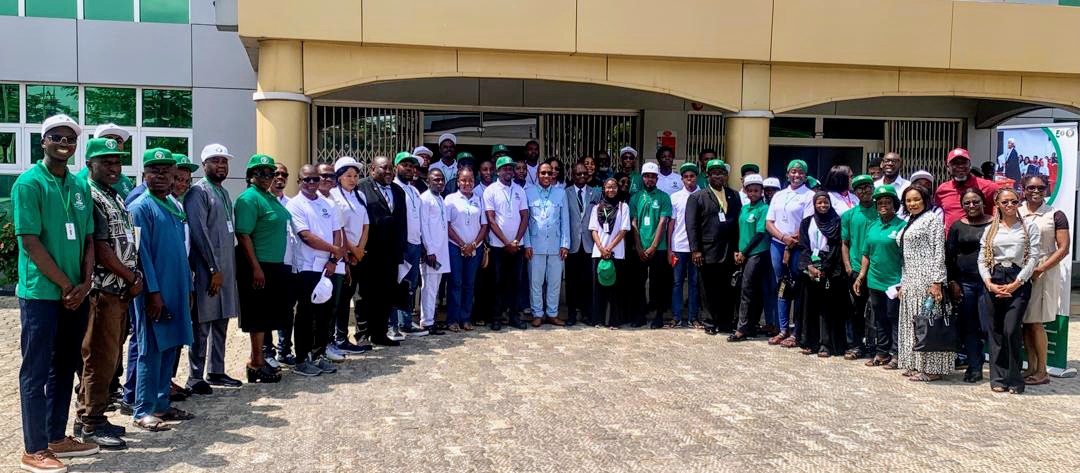
He explained that the orientation programme was an opportunity for the students to also better understand the court’s mission and mandate by interacting directly with the court’s personnel at all levels.
“It is an opportunity for you to better understand the mission and mandate of the ECOWAS Court, to deepen your engagement with regional legal frameworks, and interact directly with the Chief Registrar, the directors, the lawyers of the Community Court of Justice, the Excellencies, judges, and fellow law students.
“As future advocates, judges and policy makers, your participation in this Moot Court reflects a shared dedication to upholding justice, fostering regional cooperation, and advancing legal excellence across West Africa.
“As we commence this interactive session, may it inspire collaboration, stimulate critical thoughts, and reinforce the vital role of justice in building a peaceful and unified West Africa,” he said.
The Community Court President said that he was very impressed by the law students’ legal arguments, court cases, and all their demonstrations during the opening session of the moot court competition.
According to him, their sterling performance gives the court joy and hope that the future generation is moving forward to perhaps do more than what they are doing today.
He said the orientation session was pivotal to provide participants with more clarity about the court, while their presence demonstrated a shared commitment to excellence, dialogue and the advancement of regional jurisprudence.
“Now, we wish that you keep it up in order to ensure that you have a bright legal career after your legal studies in the university,” he added.
Also speaking, Mr Ghislain Agbozo, ECOWAS Court’s Principal Research Officer, gave a presentation to clarify the court’s Jurisdiction, Protocol, Articles, Access, and Admissibility, among others.
He explained that the ECOWAS Court has one Protocol, which was adopted on the 6th of July, 1991, and was amended on the 19th of Jan., 2005 as its Supplementary Protocol.
Agbozo said that Article 9.4 of the court’s Protocol regarding jurisdiction on human rights cases stipulates that the court has jurisdiction to determine cases of violation of human rights that occur within any member state’s territory.
He further explained that in human rights cases, the court lacks jurisdiction to entertain a dispute between individuals, that is, an individual suing another individual, as well as non-state actors like corporations.
“First, the source of human rights obligation within ECOWAS is the African Charter on Human and People’s Rights and the human rights instrument adopted under the auspices of the United Nations to which member states are parties.
“The court has jurisdiction over the member states if It has signed a supplementary protocol of 19th January 2005 and has ratified the universal or African human rights instruments invoked.
“Only member states can be brought before the Court of Human Rights violation because member states are the sole parties to the regional and the universal instruments which the court has jurisdiction over,” he said.
On admissibility, he explained that the pendency of the same suit before a domestic court or an international court of equal jurisdiction cannot oust the court’s competence to determine the case on alleged human rights violation.
“The court also has consistently held its position that there is no need to exhaust local remedy before bringing an action before the court,” Agbozo stressed.
Mr Yusuf Danmadami, ECOWAS Court’s Senior Legal Officer, described the court as the principal judicial organ of ECOWAS, which was established to ensure the interpretation and application of the ECOWAS Treaty.
He said the court represented a significant achievement in enhancing West African and African regional integration framework, having established itself as an institution for protecting human rights, and promoting the Rule of Law.
“The mission and vision of the court is to remain an independent, reliable, efficient, and accessible legal and judicial institution of the community playing a strategic role in establishing, sustaining and enabling the legal environment for the achievement of community aims and objectives.
“Now the mission of the court is to remain an independent, reliable, efficient and accessible legal and judicial institution of the community playing a strategic role in establishing a sustaining and enabling legal environment for the achievement of community aims and objectives,” he added.
The News Agency of Nigeria (NAN) reports that four Nigerian universities qualified for the semi-final round of the moot court competition which was due to take place later on Friday.
They are the Ahmadu Bello University, Zaria, the University of Jos, the Lagos State University and the University of Uyo.(NAN)
Edited by Sadiya Hamza