









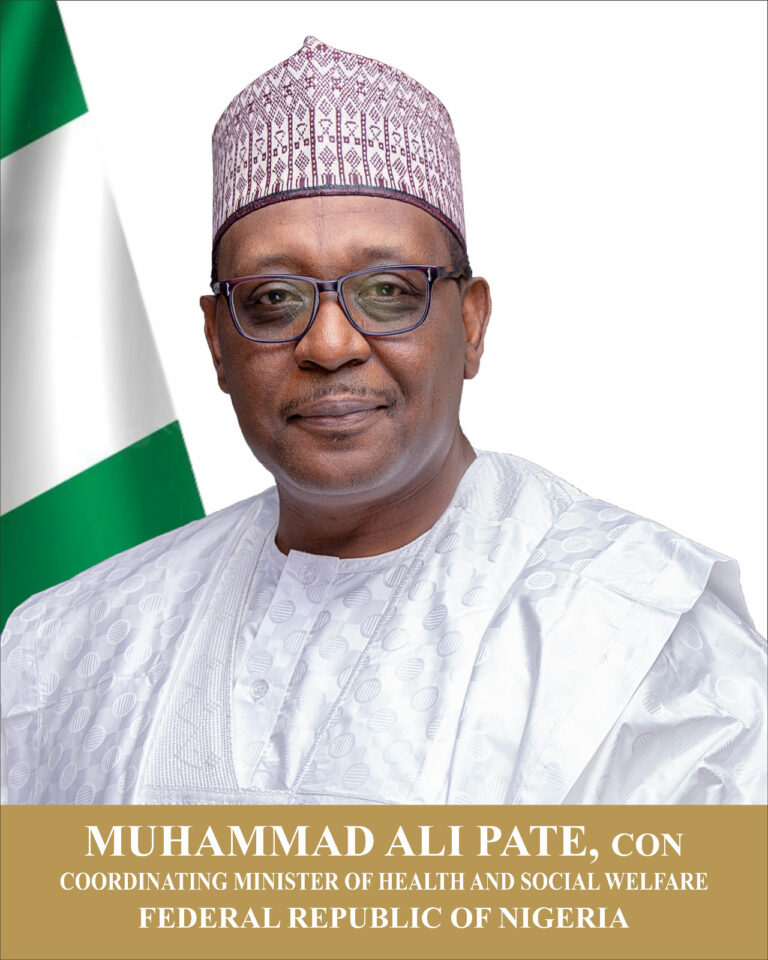










By Abujah Racheal
Prof. Muhammad Ali Pate, the Coordinating Minister of Health and Social Welfare, has called for a new vision for a global “New Public Health Order” for Africa, emphasising on domestic resource mobilisation and local manufacturing of health products.
Speaking on Tuesday at the Africa Health Sovereignty Summit in Accra, Pate challenged existing frameworks that reduced global health to a narrow set of diseases or priorities largely shaped by external narratives:
“Global health is often described through the lens of a few priority issues, diseases like HIV, malaria and tuberculosis, or through specific areas such as health financing or maternal and child health.
“Yet these issues are framed by externally driven perspectives, leaving African voices, especially from poorer countries, less acknowledged,” he said.
The minister said that most health progress in lower-income countries over the past 25 years has depended on domestic financing and local leadership, with donor support playing a complementary role.
He warned that shifting geopolitics and nationalist tendencies demand a recalibration.
“We cannot build healthier populations purely on the generosity of other nations. It is time to define our path, rooted in sovereignty and aligned with local needs,” he said.
He traced the evolution of global health to two contrasting legacies.
“The first is the positive legacy of 19th-century international sanitary cooperation, which laid the foundation for today’s collaborative institutions.
“The second is the colonial legacy, rooted in tropical medicine and Noe colonial economic structures issues that were powerfully critiqued by Ghana’s Kwame Nkrumah,” he said.
He noted the continuity of structural inequities, in spite of efforts ranging from the Bandung Conference in 1955 and the Alma-Ata Declaration of 1978, to global debt initiatives and public health commissions.
“These efforts have often faltered in delivering meaningful reform,” he said.
Among the systemic consequences we must confront,” he said, “is the continued subordination of health to commercial and strategic agendas. Producers of potentially harmful goods often evade meaningful regulation.
“Donor-driven priorities routinely undermine national agency and compromise the independence of institutions like the WHO.
“Africa’s deindustrialisation continues to weaken our production capacity.
“Too often, macroeconomic metrics prioritise short-term ‘value for money’ over the critical public health investments our people need, such as sanitation, clean water, waste management and nutrition,” he said.
In spite of these structural flaws and the emergence of over 70 global health partnerships like the Global Fund, Gavi and CEPI, he warned of fragmentation and dwindling resources.
To reclaim leadership in global health,” he said, “we must act decisively through a seven-point strategic framework.
“First, we must forge a strategic South-South alliance, uniting Africa, Asia, Latin America and the Caribbean to form a new geopolitical axis that, while mindful of global power dynamics, remains committed to equity-driven governance.
“Second, it is essential to renegotiate trade agreements. By leveraging our collective expertise, we can revise trade terms that currently restrict manufacturing capacity and limit access to essential medicines.
“Third, we must champion true country ownership and accountability. Global health initiatives should align with our national priorities and be directed toward strengthening structural health systems and community-level services.
“Fourth, we must push for a more independent and effective WHO by restructuring its funding model to emphasise predictable, unearmarked contributions that allow for impartial and equitable leadership.
“Fifth, we need to prioritise domestic financing models. This includes exploring innovative instruments such as pooled regional health funds, diaspora bonds, and blended finance approaches that reduce overreliance on foreign aid.
“Sixth, we must industrialise health trade under the African Continental Free Trade Area (AfCFTA).
“This means engaging trade and finance ministries to build infrastructure for continental markets, harmonise professional standards, and support the health value chain, from diagnostics and test kits to digital health platforms.
“Finally, we need to strengthen intellectual property protections while encouraging local innovation.
“This, requires developing contextualised IP frameworks and coordination mechanisms that promote access, equity, and technological advancement without undermining public health goals,” he said.
Pate underscored the role of private sector investment models and public-private partnerships as vital complements to government-led reforms.
He reaffirmed his ministry’s commitment: Nigeria is operationalising bold reforms in primary care, financing, and digitisation, while expanding access through community-level data systems.
“Africa must move from the sidelines to the centre of global health governance.
“This is our time to lead, boldly, justly, and collaboratively,” he said.
The News Agency of Nigeria (NAN) reports that Pate’s vision aligns with broader continental priorities focused on health resilience, economic sovereignty, and inclusive growth, a strategic roadmap emerging from recent high-level African summits. (NAN)(www.nannews.ng)
Edited by Augusta Uchediunor/Sadiya Hamza