



















By Blessing Ibegbu
Prof. Haruna Ayuba, Vice-Chancellor of Bingham University, has reaffirmed the Management’s commitment to advancing Nigeria’s development agenda by promoting critical thinking, intellectual curiosity and scholarly excellence.
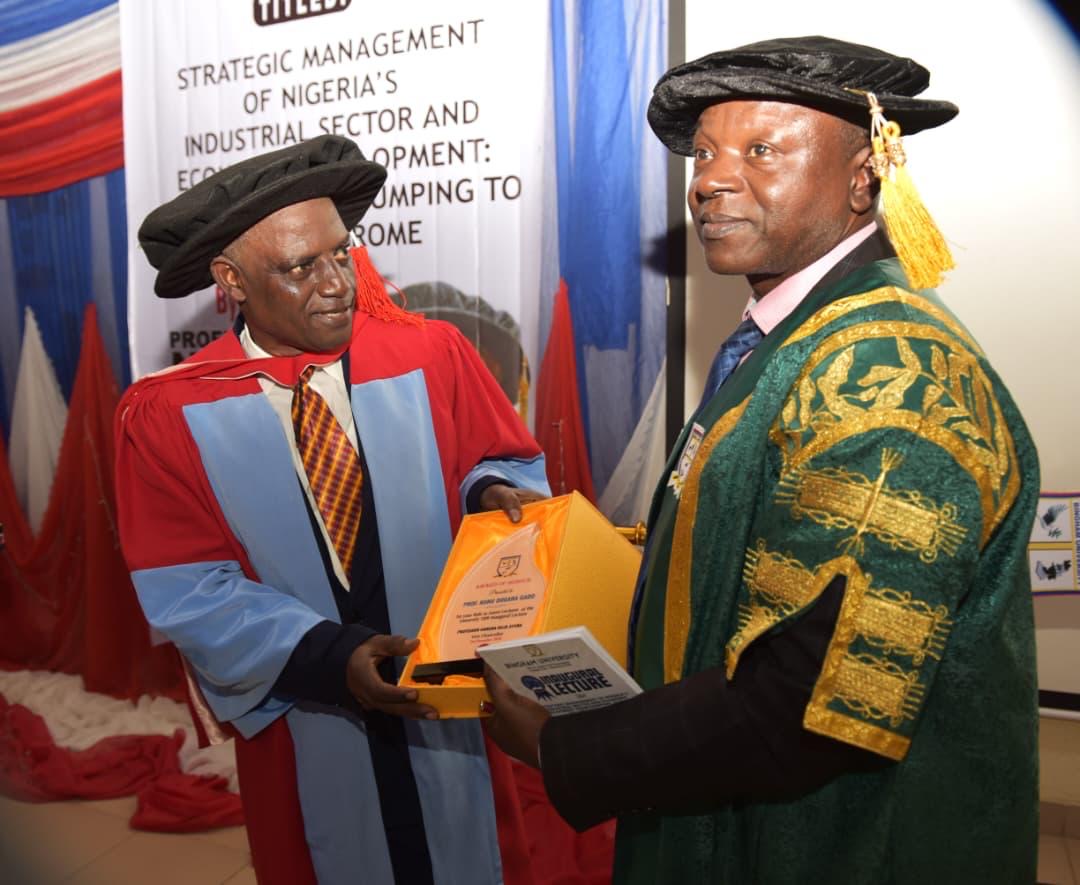
Ayuba stated this at the 10th inaugural lecture delivered by Prof. Nuhu Gado on Tuesday at the university in Karu, Nasarawa State.
The lecture, entitled “Strategic Management of Nigeria’s Industrial Sector and Economic Development: From Dumping, Slumping to Japa Syndrome”, examined the role of strategic management in repositioning the country’s industrial landscape.
He said fostering an environment where critical and innovative thinking thrive was vital to transforming national challenges into opportunities.
According to him, the topic touches the very heart of Nigeria’s economic future.
“This theme resonates deeply with our socio-economic realities, where Nigeria faces remarkable challenges yet also unprecedented opportunities,” he said.
Ayuba commended Gado for the depth of his scholarship, and the Deputy Vice-Chancellor, Prof. Musa Dankyau, for coordinating the lecture series.
He said the mass exodus of talented youth in search of greener pastures posed existential threats to Nigeria’s sustainable development agenda, noting that Gado recognised the urgency for strategic interventions.
Ayuba said the lecture would offer evidence-based strategies and governance frameworks capable of reversing adverse trends in the industrial sector.
He added that the series had reached its first milestone, and the first 10 inaugural lectures would be compiled into a single volume for the benefit of postgraduate students and researchers.
He urged professors yet to present their inaugural lectures to uphold the tradition.
Presenting the lecture, Gado, a professor of strategic management, said strategic management provides long-term direction for organisations and nations through visioning, goal-setting, strategy formulation, implementation and periodic evaluation.
He said innovative strategies backed by valuable resources often lead to superior performance among companies.
Gado noted that Nigeria’s industrial trajectory had followed patterns of import substitution and export promotion, but the business environment remained either a catalyst or a constraint to industrialisation.
He cited studies showing that electricity supply significantly affects the growth of Micro, Small and Medium Enterprises, noting that firms often spend over 20 per cent of expenditure on power generation.
He explained that Nigeria’s entry into the World Trade Organisation and removal of tariffs exposed local manufacturers to stiff competition at a time when infrastructure, institutions and technology were weak.
Gado said these challenges, alongside insecurity and policy inconsistencies, forced many companies to leave the country, including Dunlop, Michelin, Exxon, Shell and TotalEnergies.
He added that firms such as PZ Cussons, GSK, Procter & Gamble, Sanofi, Equinor, Binance, Microsoft and Bolt exited the country in 2024 due to various operational bottlenecks.
He stressed that Nigeria possesses the resources to become a developed nation but requires strategic focus, technological adoption, transparency, accountability and strong collaboration between government, industry and citizens.
He said industrialisation would drive national development, and strategic management remained a viable pathway to achieving it. (NAN)
Edited by Joseph Edeh