


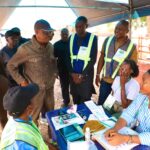






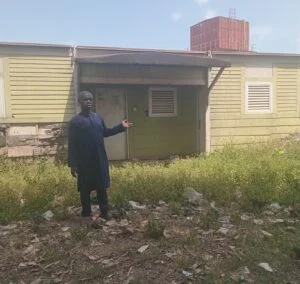











Residents of the Wassa Internally Displaced Persons (IDP) Camp in the Federal Capital Territory have appealed to the Abuja Municipal Area Council (AMAC) to reopen the Primary Health Care (PHC) centre in the camp.
The facility, which serves as the community’s only formal healthcare point, has remained closed since 2022, leaving residents, especially women and children, without access to essential medical services.
The News Agency of Nigeria (NAN) gathered that the centre, donated in 2016 by former Speaker of the House of Representatives, Mr Yakubu Dogara, originally served as the camp’s primary healthcare facility.
It was shut down after a dispute arose between residents and a doctor posted to the facility by the FCT Administration, leading authorities to withdraw the doctor and close the centre.
Residents told NAN that although they acknowledged their role in the incident and submitted letters of apology as requested, the PHC had not been reopened.
They said the closure had worsened health challenges in the camp, especially for women and children.
Findings from the 2024 Nigeria Demographic and Health Survey (NDHS) showed that only 46 per cent of births nationwide are attended by skilled health providers, while vaccination gaps are widening, with zero-dose children rising to 30 per cent.
The survey also indicated a decline in treatment-seeking for childhood illnesses, highlighting growing vulnerabilities for children, especially in underserved and hard-to-reach communities.
Residents of Wassa said the continued closure of their PHC put them at even greater risk than the national averages indicated.
Malam Usman Ibrahim, Vice Chairman of the camp, said residents had struggled to access basic healthcare since the closure.
“Lack of access to care has become a major burden for us, especially for women and children who now travel long distances for treatment or rely on unregulated providers,” he said.
He recalled that the lack of a functional PHC contributed to severe consequences during past disease outbreaks.
“Some years ago, we had cholera and lost up to 12 children. Some pregnant women also died during childbirth.
“If there is an emergency, we take them to Kabusa, but it is far, and we always contribute money for transport,” he said.

Ibrahim appealed to AMAC to reopen the facility.
“We are pleading with AMAC to help us bring back our doctor or post another one.
“They should also renovate the place and provide equipment and medicines. If they can do that, we will be happy,” he said.
He explained that the dispute that led to the closure began when a volunteer accused the AMAC-posted doctor of hoarding and selling medicines meant for camp residents.
“It resulted in an argument, and one resident slapped the doctor.
“AMAC withdrew the doctor and shut the facility. The fault is from us. They asked us to write an apology and we did. Please let them return our doctor,” he said.
Mrs Hafsatu Haman, Women Leader of the camp, said the closure had worsened the economic and health conditions of families.
“Often our children lack proper food or balanced meals. When they fall sick, there is no hospital to run to because the only one established for us is no longer operational,” she said.
She appealed to government, organisations and philanthropists to support families with livelihood opportunities to help reduce malnutrition, school dropout rates and other challenges.
Attempts by NAN to reach AMAC officials for comments on the prolonged closure of the PHC were unsuccessful.
Camp residents urged AMAC to reopen the centre or provide an alternative facility, stressing the urgency for maternal and child health.
This story was produced by the News Agency of Nigeria (NAN) Health/Gender Desk, supported by the Africa Data Hub and Orodata Science. (NAN)
Edited by Abiemwense Moru