
















By EricJames Ochigbo/Magdalene Ukuedojor
Mohammed Abdullahi a nine-year-old boy roamed the streets of Abuja scavenging cement bags around construction sites in a high brow Asokoro area.
Moving in groups, these scavengers would share ₦250 for a dozen bags collated.
Some days they couldn’t meet up and would roam aimlessly feeding on scraps around Kpaduma Hills where they reside.
Abdullahi was one of the 18.3million children estimated by UNICEF in its June 2022 report to be out of school in Nigeria until an intervention by the Not Forgotten Initiative (NFI) School, a makeshift structure right where he walked past daily, offered him a chance at education.
In Nov. 2025, the Nigerian government, in addition to other interventions to stem the tide of out-of-school children, announced plans to reintegrate over one million out-of-school children into formal education.
Moreso, individual and corporate efforts are helping to advance formal education to reduce the number of out-of-school children, which many experts believe have increased due to insecurity and economic challenges across the country.
Today, Abdullahi, now 12, in Kindergarten 2, tops Mathematics competition among his peers; his dream, to become a doctor and help his community in Kpaduma Hills.
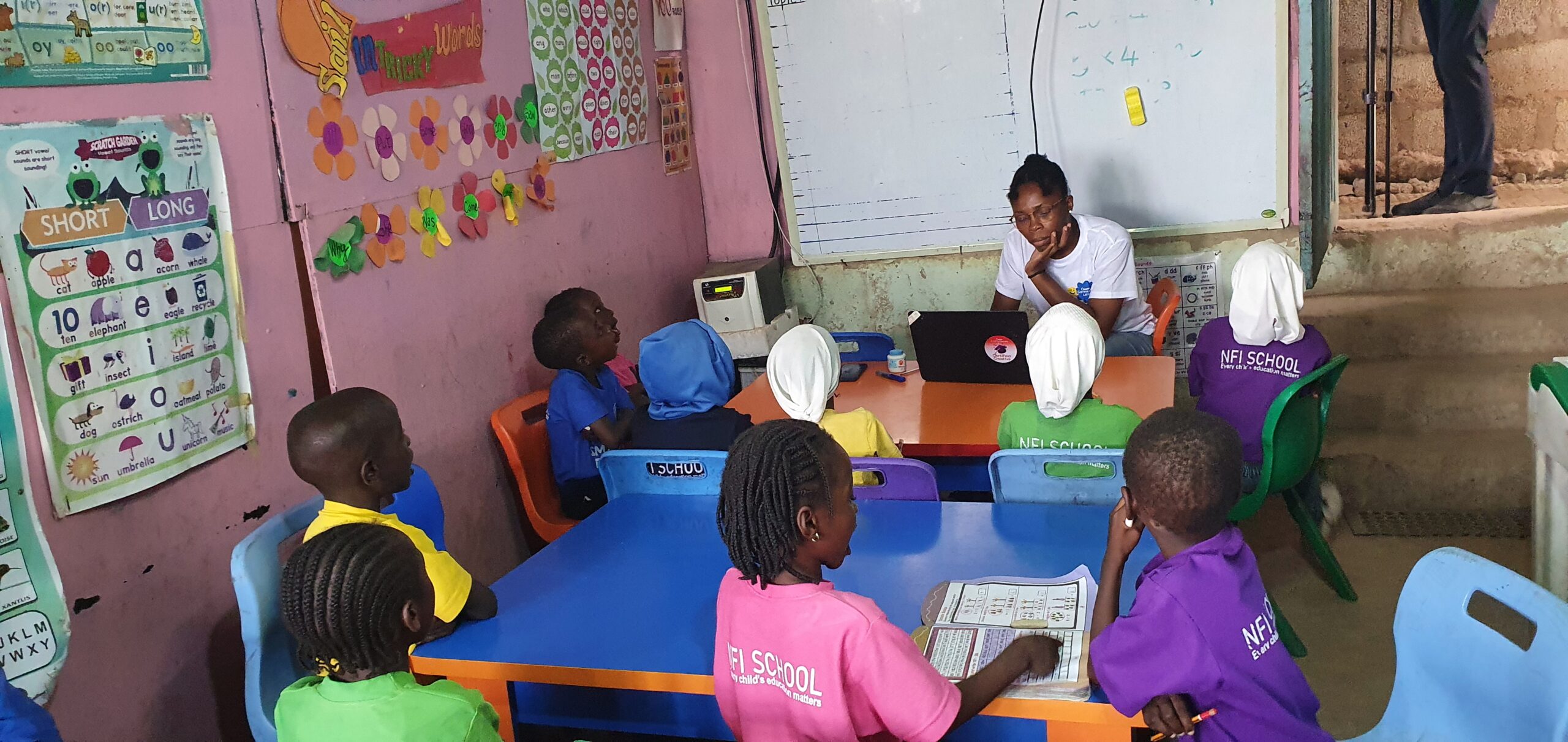
Currently, 132 pupils are housed in this structure learning on weekdays in Kindergarten 1, 2 and Grades 1-5.

Established in 2018 by a resident of the area, Mrs Oluwatosin Adeniyi, this makeshift school offers free education with sets of uniforms, sports and play wears topping it with a meal daily to keep the indigent children in school.
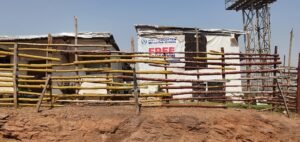
“The area was just a path from our house; my young children were all in school but the children here roamed around, with makeshift shacks built around here.
“All we could do then was to give their parents foodstuff during festive periods like Christmas and Sallah but no direct interaction with the children.
“It didn’t sit well with me knowing that children, just like mine at home, were not in school,” she said.
Having volunteered a full year as a tutor in a Catholic Church initiative, Adeniyi, using her driver as an interpreter for the predominantly Hausa-speaking community, met with a few parents who confided that they lacked the financial capacity to train their children in school.
They cut a deal — the community would build a makeshift structure just like the ones they lived in while she and her children’s tutor would coach children willing to learn.
The labour from the community, she said, ensured buy-in from parents. Soon the community also brought in a teacher.
The first set of pupils moved from under the tree to the first makeshift structure.
When the pioneer pupils also secured scholarships to secondary schools, the once education-sleeping community came alive; more out-of-school children lined in their numbers ready to gain knowledge.
Presently, NFI School has staff strength of 19. Digitally inclined, it offers visual aid programmes, computer competence lessons, arts, craft and movie hours.
The children here are happy to show up every morning. Once timid, now they boldly declare their dreams.
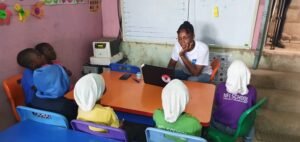
Just like Abdullahi, Faith Bande, a Grade 5 pupil also wants to be a doctor.
“I love the way the teachers teach; if we don’t understand, they keep teaching; using different methods till we get it and also do well in our exams,” Bande said.
Other students choose being scientists, engineers, teachers, nurses and a career in the Nigerian Army and Airforce to give back to their society.
Ibrahim Umar, who sits next to Bande, says he will love to be a scientist because he is inquisitive about nature and has taken a liking to solving equations.
The school’s approach to admission of pupils is getting more stable.
In its early days, Adeniyi said anyone willing to learn was admitted, therefore, the school had much more grown children as early starters learning from scratch.
Focused one-on-one learning method was applied where each child’s needs and strength were quickly identified and capitalised to bring them up to speed.
Secondly, the unconventional methods did not observe the conventional school timetable and holidays other schools enjoyed, instead it used the first term Christmas holidays, second term April break and third term August long vacations to advance in learning.
This crash programme, which lasted from 2019 to 2021, had few days break and flexible learning time for the few pupils who learnt under trees and the first makeshift structure of the school.
The school says though effective at the time for starters, the method is more time consuming and energy sapping for both pupils and teachers.
Now it accepts younger children, from 4-5 years in its Kindergarten 1, noting they assimilate better and grow with the school.
It, however, gives exceptions to pupils like Abdullahi, who show exceptional intelligence to begin in the nursery to garner more skills in reading and writing although his age mates are Grade 5 pupils.
In spite of NFI School’s obvious success, it has remained a makeshift structure for seven years as a safeguard to a land tussle which may arise if a concrete structure is built.
The community started the makeshift school on idle land awaiting the land owner’s claim. They have continued to expand with removable items in case an agreement is not reached with the original owner.
Nevertheless, inside the makeshift school are cozy classes with colourfully pasted walls, TV sets, and audio-visual aids for learning.
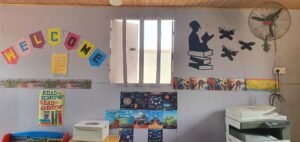
A standout vibrant library and art class is a favourite for the pupils.
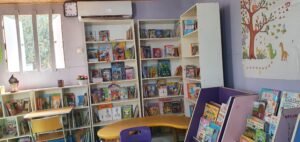
Makeshift bathrooms in this school are a great help to the pupils who struggle with convenience at home due to the hilly nature of the environment, making water hard to get.
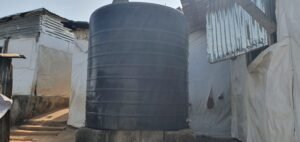
In order to ensure continuity, pupils who graduate in Grade 5 get scholarships to study in various secondary schools.
NFI School follows them up to know the government secondary schools in which they are placed after passing their primary certificate examination.
The school then pays fees for the students in the different secondary schools as part of its free education mandate, ensuring that lack of funds do not push the already groomed students out of school.
Adeniyi says 21 of its graduated pupils made it to federal secondary schools on scholarship from the school.
“We also have six that just graduated from the secondary school here in Asokoro. Two out of the six did very well in the West African Examinations Council (WAEC) and Joint Admissions and Matriculation Board (JAMB) and got admission into Ahmadu Bello University, Zaria.
“So one is going to study Mechanical Engineering, the other one is going to study Political Science and they’re all around here,” she said.
Mrs Aisha Useni, the school’s cook, says two of her children, coached in the early days of NFI School, have gained admission into tertiary institutions.
“I feel very happy. I thank God and NFI School because of my children, one has gained admission for Ordinary National Diploma (OND) in Federal Polytechnic Nasarawa while the other is in Ahmadu Bello University Zaria to study Mechanical Engineering,” Useni said.
Similarly, Aisha Musa, the pioneer Head Girl of NFI School, another beneficiary of the scholarship, is presently at Federal Government Girls’ College, Bwari.
“NFI is a great school that teaches a lot. We started with one class in Dec. 2018 but there were not many students.
“The next year another class was opened, and it was divided into two; that was Grade Two.
“Before, we didn’t have a nursery; now there are so many classes. K1, K2, Grades 1-5, library, computer class, music class, store, and kitchen.
“We moved from Grade 4 to secondary school but we’re taught in Grade 5 textbooks so many of the questions and topics we got in JS1 we already knew them,” she said.
Chinenye Okoli, Head Teacher of NFI School, says irrespective of the structure or environment, NFI School tutors are 21st century-trained in modern technology.
“We have been exposed to digital learning, digital classrooms. There is no teacher here that is not AI-inclined.
“We have transitioned from normal whiteboard to digital classroom where the children get to see and interact with children not just in their environment, but all over the world.
“So, it makes their learning easy because the visual learners are seeing it, the kinetic learners, we go out to do role play and a lot of learning methodologies.”
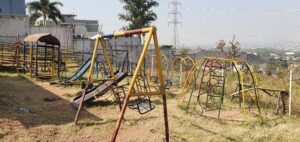
Regardless of the impact, keeping teachers on a meagre salary of ₦70,000, Adeniyi says, is a huge challenge.
“Many qualified teachers are leaving the classrooms,” she laments, adding that raising their pay to cater to rising economic needs could keep them.
More so, solar power to augment electricity, which is a key need for digital learning, is another hurdle for the school.
With a few donor support from Mayowa Dixon Foundation, the Country Director, McArthur Foundation, Metro Bakery which has ensured a meal once a week for the children for seven years and a few others, more funding and government support can meet the needs of this makeshift school.
Although a school in a makeshift structure, its fame has garnered more than 400 children on the school’s wait list with no space to accommodate them.
Experts say NFI School can be a suitable solution choice for many more out-of-school children if it has a titled land, neatly built structure with basic amenities to accommodate more children, volunteers to advance learning and better pay for teachers.
Some also suggested that some of the buildings taken over by government in embezzlement cases can be handed over to initiatives such as the NFI School to reduce the high burden of out-of-school children in Nigeria. (NAN)(www.nannews.ng)
Edited by Ismail Abdulaziz