















By Priscilla Osaje
The Nigerian Press Council (NPC) has reiterated its commitment to partner with the Nigerian Copyright Commission (NCC) in the fight against online piracy.
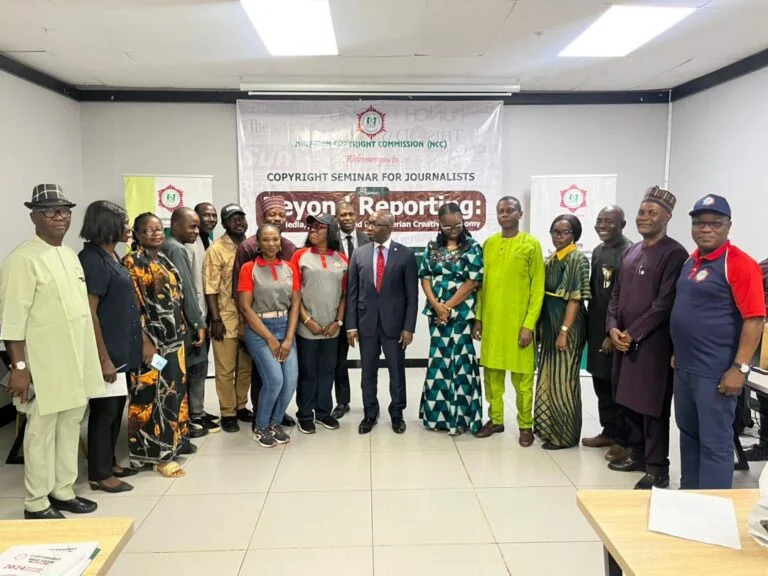
The Executive Secretary of NPC, Dr Dili Ezughah, disclosed this during a seminar organised by NCC for journalists, in Abuja.
The theme of the seminar is “Beyond Reporting: The Media, Copyright and the Nigerian Creative Economy”.
Ezughah, who was represented by Mr Jacob Atang, Director of Marketing, said the partnership with NCC would reduce online piracy to the minimum.
He said that the council has the responsibility to regulate the activities in the print media and to ensure that ethical activities are carried out by journalists in the print media.
According to him, Nigeria faces a lot of incidences of fake news, misinformation, disinformation, particularly in the online media.
He said online media has made those not trained as journalists, because they have an Android phone, decide to publish information that could cause a lot of problems in the country.
The NPC boss said they were presently working on a pre-fact checker app that would monitor people’s activities.
“The pre-fact checker will be able to identify that this thing an individual is doing is not correct. It is misinformation, disinformation, and then stops the disinformation from going public.
“We want to stem the tide of this misinformation, fake news, disinformation and other things,” he said.
He added that NPC was working on expanding its scope of operations.
“We have prepared a bill, an amendment to the existing bill, to ensure that the Press Council covers the electronic media.
“Electronic media, where we hope that the pre-fact checker app that we are presently working on will be of great use and importance to the country.
“I want to assure NCC DG that NPC will partner with the commission to fight against online piracy,” he assured.
Mr Jahman Anikulapo, Art and Culture Advocate, who spoke on the topic “The Journalist’s Guide to Effective Reportage of the Copyright Sector”, said that the role of the media was to give information and educate.
Anikulapo, who is also a seasoned journalist, said such information must be information that journalists should use to enlighten and empower the public.
According to him, when a journalist is empowered, such a reporter will manifest his or her potential.
He urged journalists to see themselves beyond reporting but see themselves as advocates.
“As a cultural reporter, you must be an advocate who will engage the public and the creative sector you are covering, as you belong to the ecosystem.
“We should be observant to see copyright abusers and advocate for it.
“Copyright is somebody`s work, infringement is stealing. We have to advocate on it and partner with NCC to ensure that people’s work is not infringed,” he said.
According to him, when you defend the rights of others as a journalist from the creative community, you are equally defending your rights as well.
“Build relationships with NCC to enable them to reinforce their work for the betterment of society,” he said.
He appreciated NCC D-G for standing firm in ensuring that the creative sector moved forward.
Mr Mike Akpan, Principal Partner Alpha-Edge, who spoke on “Copyright Basics for Journalists”, said that it is an exclusive right conferred by law on an author or creator of a work, to authourise the doing of certain acts related to the work.
According to him, what journalists produce fits into different classes of protected work because articles are literary work.
Akpan said that a person not employed as a journalist, but creating a work for publication, might retain copyright in their piece.
“A photojournalist is protected as an artistic work under the copyright act, ownership of copyright in a photograph is photographer.
“There are several forms of content creation which may include blogging, photography, website, uploading, updating and maintenance, article writing, videography, among others.
“This content may be copyright-protected depending on its nature but note that not all text materials may qualify as a literary work.
“But to qualify as a work it must be something that affords information, instructions or pleasure in the form of literary enjoyment,” he added.
He further said that journalists must find an ethical balance between reporting issues of concern to the public and respecting the intellectual Property (IP) rights of individual organisations.
“A work of an author is protected automatically upon its creation, and registration is not a requirement of protection, although there is provision for voluntary registration with NCC,” he said.
According to him, copyright and neighbouring rights play a crucial role in protecting the IP of creators and incentivising the production of new creative work.
“There is need to understand the legal framework by understanding the scope, duration and enforcing these rights so that journalists and media can respect the legal framework and contribute to a thriving creative ecosystem,” he said. (NAN)(www.nannews.ng)
Edited by Joseph Edeh