

















By Vivian Ihechu
Nigerian civic technology organisation, Orodata Science, is leading a major effort to establish a sector-specific Artificial Intelligence (AI) governance framework for Nigeria’s newsrooms, aiming to standardise practices and mitigate ethical risks.
According to Orodata Science, the initiative seeks to create clear policies for media organisations, many of which are already using AI but lack official guidelines.
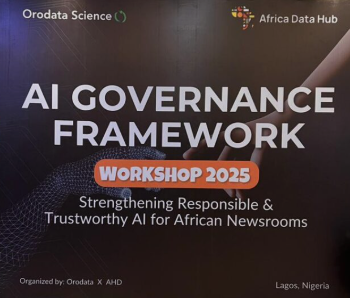
Mr John Eromosele, Country Manager for Orodata Science, spoke at a capacity-building workshop organised by Orodata Science and the Africa Data Hub.
The one-day programme, held under the Pan-Atlantic Newsroom Artificial Intelligence (PAN-AI) initiative on Thursday, aimed to equip reporters with practical knowledge on integrating AI tools into journalism while upholding ethical and governance standards.
Eromosele said the workshop was necessary to ensure that the national AI strategy “is sector-based to begin to drive to the grassroots the objectives of the AI Governance Framework.”
He noted that a central ethical mandate of the proposed framework is transparency, whereby newsrooms will be guided to mandatory disclosure.
According to him, the framework will also address risks, including the potential for “bad actors” to use the technology for “malicious intents,” creating deep fakes and escalating issues with non-real content.
Eromosele stressed that the goal is to guide newsrooms toward “responsible use” so they can declare and defend their AI-supported work.
“AI is good, however, it needs governance,” Eromosele said, emphasising the need for a process to “manage the quality assurance of the output of AI.”
“Whenever AI is in use, it should be quoted that this image or video or content is being generated by AI.”
While the adoption of AI is seen as beneficial, there is an urgent need for oversight.
Similarly, Mr Justin Aboh, also of Orodata Science, said that newsrooms must embrace artificial intelligence (AI) tools to accelerate reporting and streamline workflows but should place a premium on accuracy and editorial integrity.
Aboh made a presentation on AI tools for journalism.
“AI is about solving problems. Everyone who uses AI wants to solve problems about speed, execution, and how you do things.
“AI helps in gathering and structuring data, saving time and providing insights, but it’s not just AI doing the job—you actually have to be involved.”
He emphasised the growing importance of prompt engineering, which is the practice of writing precise instructions for AI assistants to produce high-quality content.
“Prompt engineering involves understanding AI strengths and limitations to meticulously design inputs that use pre results.
“These are the three core things, quality output, error reduction, and newsroom efficiency.”
He noted that getting effective results from AI required being specific about the task and audience.
“You have to specify. Maybe, for instance, you want AI to act as a senior and review your work.
“Now, you will have an insight into how somebody higher than you has reviewed it, and that might inform whatever next project you want to use that information for,” he said.
Also on AI-generated images, podcasts and videos, he cautioned on the need for ethics.
“There is a need for editorial honesty, never communicate scenes which aren’t truthful.
“Production for newsrooms, trust is paramount; ethics safeguards it.
“You want to make sure your brand stands as a newsroom that actually gives authentic news,” Aboh said.
He highlighted some tools that aid newsroom work to be Google Drive and Notion for data, Canva and Flourish for visuals, and Spotify’s creators platform for podcasts.
A panel session moderated by Bunmi Yekini examined the current state of AI adoption in Nigerian and African newsrooms, highlighting barriers such as limited technical capacity, infrastructural challenges, and concerns about misinformation risks.
Yekini, Broadcast Publisher, noted that AI was now an integral part of the industry, with many journalists engaging it for their works.
However, she stressed the need to use it ethically and responsibly.
Mr Lekan Otufodunrin, Executive Director of Media Career Network, said that the AI Governance Framework Workshop was important and a step toward establishing practical guidelines that supported responsible AI adoption in the media space. (NAN) www.nannews.ng
Edited by Oluwafunke Ishola