
















By Patricia Amogu
The Federal Ministry of Women Affairs, in collaboration with the Sustainable Procurement, Environmental and Social Standards Enhancement (SPESSE) project and other partners, has taken steps to address capacity gaps in social standards operations in Nigeria.
The initiative aims to strengthen professional capacity and improve standards in procurement, environmental management, and social safeguards across the country.
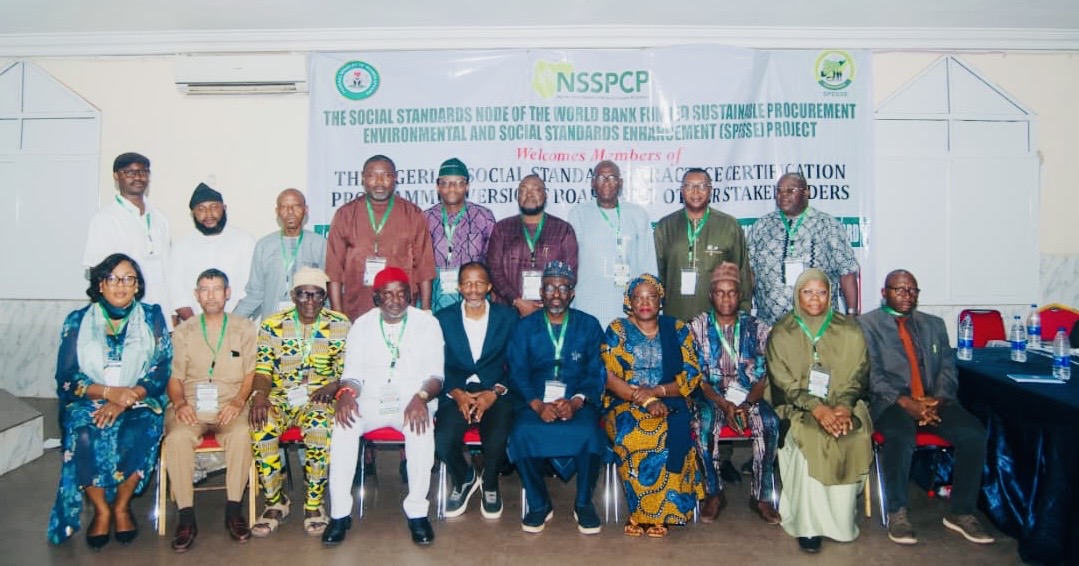
This was disclosed at a three-day regular meeting of members of the Nigerian Social Standards Practice Certification Programme (NSSPCP) Oversight Board on Tuesday.
The News Agency of Nigeria (NAN) reports that the Nigerian Social Standards Certification Programme (NSSCP) is a World Bank-supported project.
It is implemented by the Federal Ministry of Labour and Employment, the Ministry of Works and Housing (Lands Department), with the Federal Ministry of Women Affairs as the lead implementing agency.
In her opening remarks, the Minister of Women Affairs, Hajia Imaan Sulaiman-Ibrahim, said SPESSE was designed to close capacity gaps in procurement, environmental and social safeguards.
Represented by Mallam Alkali Suleman, SA- Special Duty to the Honourable Minister, she said the meeting marked a practical step towards strengthening the social standards profession in the country.
“SPESSE is the body established to govern the Social Standards Certification Scheme in Nigeria and to achieve key milestones under the Sustainable Procurement, Environmental and Social Standards Enhancement Project.
“Considering the project’s objectives, the Nigerian Social Standards Practice Certification Oversight Board has a strategic role as a gatekeeper of quality and credibility for the social standards profession in Nigeria,” he said.
Adamu noted that the board was responsible for developing and standardising the social standards curriculum, professional certification and regulation, quality assurance, and continuous professional development.
According to him, the role of the NSSPC in building sustainable capacity and strengthening controls for social safeguards across ministries and at national and sub-national levels, in line with the World Bank Environmental and Social Framework, is critical.
“As members meet over the next three days to review the outcomes of the professional certification examination and the certification framework, I urge you to be detailed, robust and strategic to ensure that the outcomes are effective, practicable and acceptable,” he added.
He commended the Social Standards Node of the project and acknowledged the support of the National Universities Commission and the World Bank, noting that efforts were ongoing to establish a Social Standards cadre within the Federal Civil Service.
“This initiative will create employment opportunities for graduates and professionals in the social standards discipline and also enhance the sustainability of the SPESSE project,” he said.
Also speaking, Mr Alabi Collins, Director of Lands and Housing Development and focal person for the Council of Housing and Urban Development on the project, said the meeting was convened to advance the certification process.
“The purpose is to assess what has been done, identify gaps and strengthen the framework to make it a nationally recognised certification.
“The Centres of Excellence have been very cooperative in this process, and I commend them,” Collins said.
A social development consultant with the World Bank, Mr Tosin Oso, said the project was designed to address capacity gaps in Nigeria’s country systems, especially in line with global best practices.
“The project began in 2020 but was delayed by COVID-19. Full implementation started in 2021, with the lending period extended to 2026 and additional financing running until 2029.
“One key component is the development of a professional certification programme to ensure practitioners are not only academically trained but also professionally certified and licensed,” he explained.
Oso added that strengthening government capacity in social safeguards would help manage risks such as gender-based violence and ensure investments and projects do not exacerbate existing inequalities.
In her remarks, Dr Joy Loma, Deputy Director, Productivity Measurement and Labour Standards Department, Federal Ministry of Labour and Employment, praised the World Bank for supporting the initiative.
“The objectives of the SPESSE project align with national priorities on human capital development, inclusivity and social justice.
“Building capacity in procurement, environmental and social safeguards is critical to strengthening institutions and promoting national growth,” she said.
Loma noted that the labour component of the project supports the ministry’s mandate to eliminate discrimination, gender inequality and unfair labour practices.
She added that the project aligns with Nigeria’s Future of Work agenda, the ILO Centenary Declaration, the Abidjan Declaration and the Federal Government’s Renewed Hope Agenda on labour administration. (NAN)
Edited by Tosin Kolade