



















By Patricia Amogu
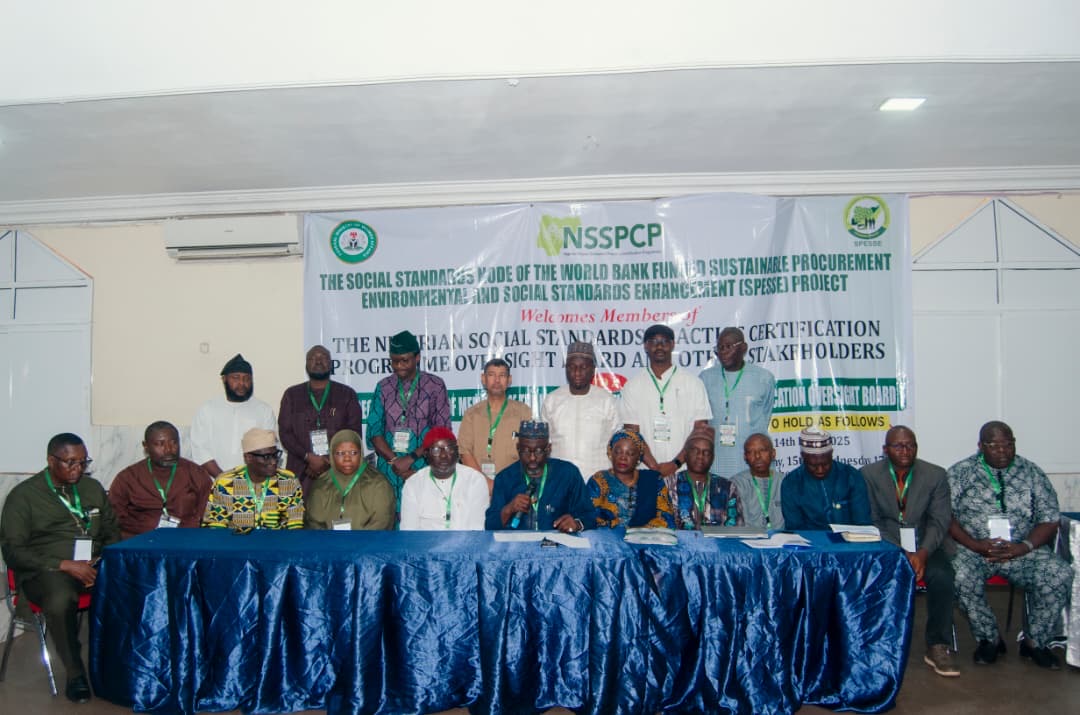
Nigeria has certified its first cohort of Social Standards Professionals and inducted a 21-member advisory board under the Nigerian Social Standards Professional Certification Programme (NSSPCP).
The News Agency of Nigeria (NAN) reports that the programme is part of a broader World Bank-supported initiative involving 11 implementing entities, including six universities, the National Universities Commission (NUC), and three federal ministries.
Dr Tosin Oso, a World Bank consultant, disclosed this at the close of a three-day meeting in Abuja.
It concluded a rigorous assessment process which began in mid-2025 for candidates seeking certification to practise social standards in Nigeria.
Oso said the certification was conducted in line with the World Bank Environmental and Social Framework and other internationally recognised standards.
“Today marks a major milestone for social risk management practice in Nigeria. The establishment of a functional certification board is highly commendable, as it will help sustain and grow the programme in the years ahead.
“We are proud to announce the emergence of Nigeria’s first cohort of certified social standards professionals,” he said.
He explained that the certification board also approved key improvements to the framework and operational procedures, covering application, examination and review processes to ensure efficiency and credibility.
According to him, the project is valued at about 80 million dollars and was initially designed to run for five years but has been extended to six years.
Oso added that the programme supports document development, training and capacity building, and has so far trained nearly 30,000 students under its Track A component, which will run until 2029.
He expressed optimism that the certification programme would continue to expand, producing qualified professionals to deliver high-quality social risk management services nationwide.
Also speaking, Prof. James Ayangunna, a social standards specialist from the University of Ibadan and member of the NSSPCP Oversight Board, said social standards was a new profession in Nigeria.
“With the approval of the National Universities Commission, in collaboration with the World Bank, SPESSE is anchored by the Federal Ministry of Women Affairs, with partners such as the Federal Ministry of Labour and Employment and the Federal Ministry of Lands and Housing,” Ayangunna said.
He noted that six centres of excellence were established across the geopolitical zones to train certified professionals.
“These include the University of Benin (South-South), University of Lagos (South-West), Tafawa Balewa University (North-East), Ahmadu Bello University (North-West), Federal University of Technology, Owerri (South-East), and Joseph Sarwuan Tarka University, Makurdi (North-Central),” he said.
Ayangunna explained that the certified professionals were trained as generalists to handle grievances arising from sectors such as road construction, housing, land disputes, health and other social development areas.
“We believe these professionals will be very useful in advancing Nigeria’s social development. This social standards node complements the environmental and procurement components of development projects,” he said.
Mr Okwesa Benjamin, Deputy Director at the Federal Ministry of Women Affairs and Project Coordinator of the Social Standards Node of the SPESSE Project, said the certification board was established to address capacity gaps in the social sector.
Benjamin, who also serves as Administrative Secretary of the Nigerian Social Standards Certification Programme, said 1,026 candidates had so far been certified.
“The essence of this meeting was to present the 1,026 certified candidates to the board for approval and licensing to practise, having passed through the centres of excellence and acquired the required competencies,” he said.
He added that a comprehensive curriculum and work plan had been developed and implemented by the centres of excellence to ensure quality service delivery.
Benjamin further disclosed that the programme was working with the Office of the Head of Service to create opportunities for certified professionals to be absorbed into government establishments.
NAN reports that a 21-member advisory board was formally inducted by the Chairman of the Board, Prof. Muhammad Nuhu. (NAN)
Edited by Tosin Kolade