
















By Kadiri Abdulrahman
A renowned Economist, Prof. Ken Ife, has advised the Federal Government to repeal the 2025 Appropriation Act and consolidate the new 2026 budget.
Ife, the Lead Consultant on Private Sector Development to the ECOWAS Commission, gave the advice in an interview with the News Agency of Nigeria (NAN) on Saturday in Abuja.
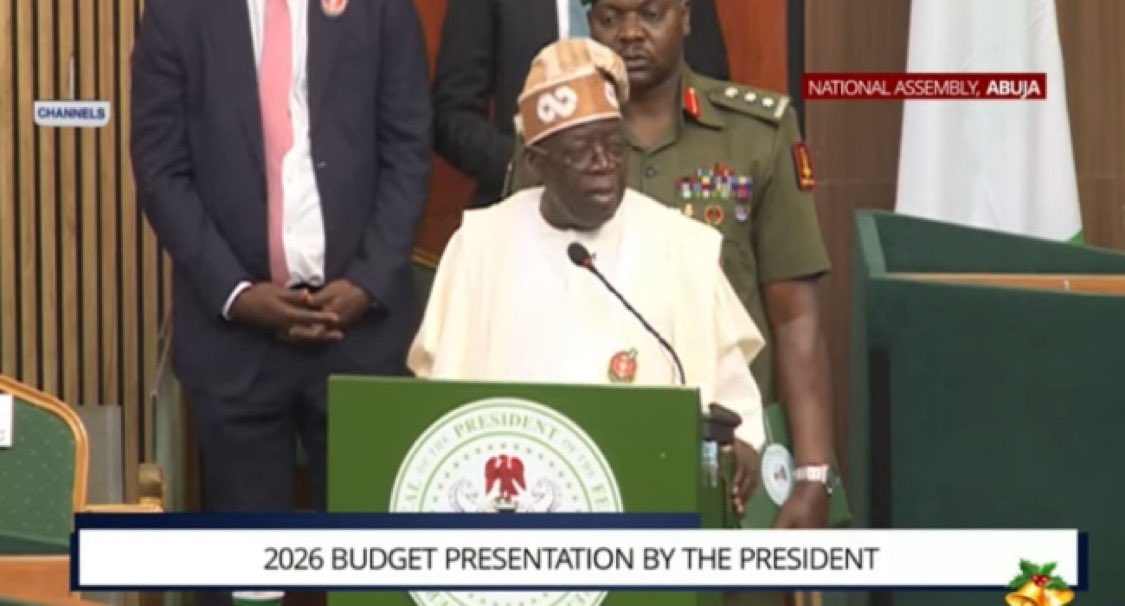
He spoke against the backdrop of the presentation of the 2026 budget to the National Assembly by President Bola Tinubu.
NAN reports that Tinubu had presented a N58.47 trillion budget for the 2026 fiscal year to a joint session of the National Assembly on Friday.
The breakdown of the budget proposal shows that Security and Defence received the highest allocation of N5.41 trillion, followed by Infrastructure with N3.56 trillion, Education with N3.52 trillion, and Health with N2.48 trillion.
The budget is anchored on projected revenue of N34.33 trillion, estimated expenditure of N58.18 trillion, and N15.52 trillion set aside for debt servicing.
According to Ife, the country will be taken 10 years back by budget indiscipline and complete disregard of the Planning Law (FRA 2007) by Federa Ministry of Budget and Economic planning and putting the President through this stress.
“I warned earlier that an unreasonable budget benchmark of 75 dollars per barrel and two million barrels per day will bloat the budget, violate budget deficit to Gross Domestic Product (GDP) ratio, and increase borrowing.
“It could also increase debt service, relegate capital expenditurs and crowd out private sector investment,” he said.
Ife said that it also denied any accretion to excess crude account and foreign reserves.
“We now have an option to repeal the appropriation Act and consolidate the new budget as 70 per cent of the capital component is outstanding,” he said
The Chief Executive Officer of the Centre for the Promotion of Private Enterprise (CPPE), Dr Muda Yusuf, described the 2026 budget as better structured than previous ones (2024 and 2025)
Yusuf said that its assumptions were more conservative and realistic than those of 2025.
He, however, said that the oil price benchmark of 64.85 dollars per barrel and production target still appear optimistic given Nigeria’s historical performance.
He called for a downward review to enhance credibility.
He urged the National Assembly to resist inflating the budget through constituency projects.
“Repeated upward review of the budget often undermine implementation and public trust.
“The credibility of the budget is as important as its size,” he said.
Tajudeen Abbas, speaker of the house of representatives, cautioned against unrealistic projections in the 2026 budget.
Abbas said overly optimistic assumptions could undermine fiscal discipline and weaken public confidence in the budgeting.
He said that the experience of the outgoing 2025 fiscal year showed the importance of grounding budgets in credible, resilient and realistic assumptions.
“If 2025 was a year of adjustment and learning, 2026 must be a year of fulfilment.
“Growth must increasingly translate into jobs, higher incomes, and expanded opportunity.
“Fiscal discipline must continue to deliver fairness, efficiency and visible impact. Above all, the 2026 Budget must be grounded in credible targets, realistic assumptions, and disciplined implementation,” he said.
Analysts at PricewaterhouseCoopers (PwC) said that it was unclear if the 2026 budget would succeed.
According to the analysts, while parts of the budget reflect realism, aspects like strong revenue growth projections seem optimistic.
“Projected economic growth is strong at four per cent in 2026, slightly down from 4.5 per cent in 2025.
“Such growth would be enviable among advanced economies, but translating this into government revenue and achieving a surplus depends on various factors that drive government income.
“Revenue growth is expected to jump 15.3 per cent in 2026, surpassing both GDP and expenditure growth – the latter projected at nine per cent,” they said.
They said that the anticipated high revenue hinged on realising higher taxes and dividends from resource extraction, incomes, profits, and capital gains.
“This is a bold projection in a period of elevated global uncertainty.
“Expenditure growth focuses on enhancing essential services, including security, education, health, and agriculture,” they said.(NAN) (www.nannews.ng)
Edited by Ese E. Ekama – Williams