





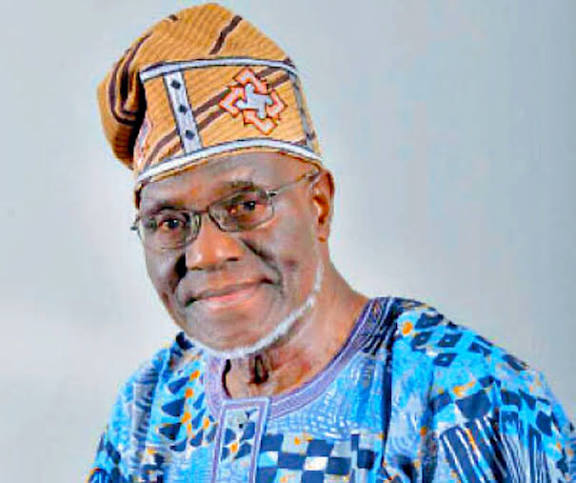










By Ismail Abdulaziz
The life of labour icon, Hassan Sunmonu, has been described as an example of effective and developmental unionism Africa.
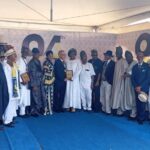
Dr Mohammed Ibn Chambas, Africa Union High Representative for Silencing the Gun, said this in a keynote address at the 85th birthday celebration of Sunmonu on Wednesday in Abuja.
The address was entitled: ” Celebrating 85 years of Purpose: The Life, Legacy and Enduring Vision of Comrade Hassan Adebayo Sunmonu; Lesson and Prospects for Nigerian and Africa Workers.”
Chambas said that the labour icon offered an enduring model that would continue to inspire trade unionists in challenging any repressive political dispensation.
‘’His career offers a case study in how labour leadership can be both militant and institution-building- a model useful to trade-unionists facing repressive or transitional political orders.
‘’His journey mirrors the modern history of African labour itself,” he said.
This, he said, was from colonial transition, through military authoritarianism, to democratic struggle; from shop-floor agitation to continental institution-building and from national wage battles to global debates on development, justice and sovereignty.
Chambas said that Sunmonu belongs to the generation of labour leaders whose influence transcended protest to shape institutions, policy frameworks and ideas.
He said that the technical and grassroots grasp that Sunmonu brought to the table enabled him to command respect and admiration among union institutions across the globe.
He said that his technical education as a civil engineer gave him credibility, adding that it made him to be a labour leader with competence and consciousness.
‘’He understood the language of workers not as rhetoric but as lived experience.
” It was this grounding that later enabled him to command trust during moments of national confrontation,” Chambas said.
He cited areas of Sunmonu’s contribution to unionism to include articulation of the Workers Charter of Demands and elevating issues such as national minimum wage, Pension reform and retirement security as well as workers’ participation in national development planning
He said that the 1981 general strike demonstrated Sunmonu’s strategic balance of being militant enough to force negotiations, and disciplined enough to preserve institutional survival.
‘’This comes with the understanding that militancy without structure dissipates energy; structure without militancy breeds irrelevance.
” Pa Sunmonu’s genius was holding both in productive tension,” he said.
He said that as the Secretary-General of the Organisation of African Trade Union Unity (OATUU), Sunmonu amplified Nigeria’s labour voice regionally and embedded himself in pan-African labour networks.
‘’Comrade Sunmonu mobilised African workers to resist authoritarianism and actively participate in democratic transitions, particularly across West Africa.
” Labour was repositioned not merely as an economic actor but as a democratic force.
‘’Under his leadership, OATUU mounted principled opposition to IMF-World Bank Structural Adjustment Programmes, exposing their anti-worker and anti-development logic.
‘’Crucially, Pa Sunmonu did not stop at resistance; he championed alternative development strategies rooted in productivity, social justice and African self-reliance.
‘’His legacy is less about one dramatic victory than about shaping institutional expectations (that workers and unions are legitimate policy actors) and providing durable organisational practices (charters, coordinated strikes, negotiation),” he said.
Chambas added that Sunmonu’s leadership was marked by strategic patience, moral clarity, deep pan-African conviction and an unshakeable integrity.
‘’The lesson here is that credibility is a union leader’s most valuable asset.
” Once lost, no mobilisation can recover it.
‘’The survival of the NLC, the endurance of OATUU and the institutionalisation of labour as a policy actor are evidence that strategic realism, not rhetorical purity, secures lasting gains,” he said.
He said that the lessons to be learnt by current unionists from Sunmonu include rebuilding ideological clarity, and investing in youth education and leadership renewals.
Others, he said, are linking labour struggles to national development agendas, defending organisational independence and reclaiming pan-African solidarity in confronting multinational capital.
” Pa Hassan Adebayo Sunmonu’s life reminds us that labour history is not written by anger alone, but by organisation, discipline and vision.
‘’He showed that workers can be both a moral force and a governing idea; both a pressure group and a policy partner.
‘’Pa Hassan Sunmonu’s life is best read as the arc of a practical organiser who built institutions.
‘’His balanced approach- readiness to strike combined with negotiation and institutional work- helped the labour movement survive political suppression and become an enduring actor in public life,” he added. (NAN)
Edited by Mufutau Ojo