



















By Kingsley Okoye, News Agency of Nigeria (NAN)
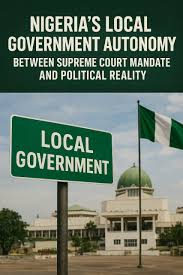
The Supreme Court’s judgment of July 2024 on local government autonomy was widely seen as a significant victory for local government administration and a step towards decentralisation and improved governance at the grassroots level.
The landmark judgment did not only grant financial and administrative autonomy to all the 774 local governments in Nigeria, it also declared that state governments have no constitutional authority to hold or manage funds allocated to local councils.
The apex court specifically declared state governors’ interference in local government administration, dissolution of elected councils and administration of state and local government joint accounts as illegal.
Consequently, the court ordered the Federal Government to remit funds accruable to local government councils directly to them to enhance grassroots development and accountability.
Interestingly however, the implementation of the judgment has not seen the light of the day well over a year after it was delivered by the apex court.
From all indications, it appears that some state governors have not only been resisting the implementation of the judgment, they are also doing everything possible to circumvent it.
Some of the governors have also been seen using their state Houses of Assembly to control their holds on the local governments through what is generally regarded as spurious legislations.
This development might have forced President Bola Tinubu to restate his administration’s commitment to local government autonomy through the implementation of the judgment.
Speaking at the 15th National Executive Committee meeting of the ruling All Progressives Congress (APC) recently, Tinubu warned failure by the governors to work in consonance with the court judgment might compel him to take some executive decisions.
“The Supreme Court has said ‘give them (local governments) their money directly. If you wait for my Executive Order, because I have the knife, I have the yam, I will cut it.
“I am just being very respectful and understanding with my governors. Otherwise, if you don’t start to implement it, FAAC after FAAC, you will see your allocations dwindling,” the president had said.
Dr Romanus Okoro, a development strategist and policy analyst, while describing Tinubu’s appeal to the governors as a call to action, stressed the need for effective governance and development at the local government level.
Okoro, who is the Executive Director, Vanguard for Development (VAD), said implementing local government autonomy could be a crucial step towards addressing the challenges of insecurity and volatility of the economy.
While expressing support for Tinubu’s position, he urged the governors to comply with the court judgment and allow the local government autonomy to come into fruition.
He also underscored the need for a legal framework, saying that constitution review and stronger legal frameworks would be required for sustainability of the court declaration on local government autonomy.
Okoro urged the Federal Government and anti-corruption agencies to enforce compliance, with warning of contempt charges for non-compliance.
To the Senate President, Godswill Akpabio, Tinubu deserves commendation for his commitment to enforcing the court’s pronouncement on local government autonomy.
Akpabio described the judgement as a significant step towards democratic consolidation and grassroots development.
He emphasised the need for governors to comply with court’s declaration, stressing that financial autonomy was crucial for local governments to deliver services and promote development at the grassroots level.
“And so for us in the legislature, the Supreme Court has spoken and we have no option than to abide by the Supreme Court ruling.
“I will just call on all states of the federation to respect what the Supreme Court has done, and then we will go back to the legislature and see where we can dot the ‘i’s’ and cross the ‘t’s’ to ensure full implementation.
“And I know that all Nigerians know that local government administration is an arm of government meant for the grassroots and their money should be for the grassroots,” Akpabio had said.
Speaker of the House of Representatives, Rep. Abbas Tajudeen, also described the judgment as an impossibility that had become a reality.
He said that history had been made via the judgment, adding that local government autonomy issue had been before the parliament for the past 20 years.
“All the constitutional amendments that were so far carried by the National Assembly, one aspect of it has always been local government autonomy, how to make the local government work independently.
“That impossibility became a reality; everyone is happy and we are looking forward to local government that will work functionally and that will be able to work on their own and extend goodwill to their own people, undisturbed by the excesses of the state governors,” the speaker said.
Attorney-General of the Federation and Minister of Justice, Lateef Fagbemi, also viewed the judgment as an emancipation for the local governments.
“The ball is in the court of the governors. Let us see what they will come out with, but the judgment is clear as to what they should do.
“It is clear as to what consequences will be attached to failure or refusal to follow the judgment of the Supreme Court which takes immediate effect,” he said.
Other lawmakers such as Senators Osita Izunaso, Sani Musa, Abdurahman Sumaila, Orji Kalu, Adams Oshiomhole and Rep. Oluwole Oke, also counselled governors against obstructing the efforts to ensure local government autonomy.
They advocated for accountability and transparency in the management of local government funds, emphasising that elected local government officials should be responsible for their actions.
Meanwhile, Gov. Abdulrazaq AbdulRahman of Kwara, speaking on behalf of all his colleagues, hailed the judgment, describing it as a relief to the governors, as it had provided for devolution of power to the third tier of government.
Analysts, however, insist that the body language of the governors does not appear to be in support of local government autonomy as ordered by the apex court.
Perhaps another dimension to the development, according some political commentators, is the need for constitutional reforms to back the implementation of the local government autonomy.
Whatever the situation, the truth remains: that local governments must be rescued from the stranglehold of the governors as a practical way of ensuring grassroots development in the country.
As the analysts have said: it is time to allow local governments to breathe, drive the much-anticipated development at the grassroots and fulfil their constitutionally-stipulated mandates.(NANFeatures)
***If used, please credit the News Agency of Nigeria and the writer.