















Beyond Survival: Africa’s culture seeks structure, value and global reach
By Olawunmi Ashafa, News Agency of Nigeria (NAN)
Africa’s cultural heritage is no longer content with survival; it is demanding structure, economic value and a global stage.
Recently, in the historic halls of the Cathedral of the Sacred Heart in Casablanca, Morocco, artisans, designers, cultural leaders and development partners from across Africa and the diaspora gathered for Heirs of Greatness Day.
It is a pan-African initiative aimed at repositioning creativity as a driver of development, unity and continental pride.
The event also centered on collaboration, sustainability, and the future of African craft.
The framework was brought to life through “seven Houses of Art”, focusing on weaving, foundry, crochet, tannery, dyeing, ceramics and couture, conceived as centres for skills transfer, experimentation and professional structuring.
Visitors examined woven textiles, ceramics, couture creations and leatherwork, while designers and institutional partners shared insights on scaling African creativity to global markets.
The event was more than an exhibition; it was a declaration of Africa’s ambition to translate heritage into measurable value and economic sovereignty.
Organisers said that the timing of the event was deliberate, coinciding with the Africa Cup of Nations to leverage global attention and reinforce Africa’s cultural visibility.
Every detail, from the layout of seven Houses of Art to the immersive programme of installations, editorial exchanges and symbolic performances, reflected a vision to move African culture beyond spectacle into structured, sustainable systems.
Mr Mouhammed Dieng, President of Senegal-based MRD Foundation, underscored the need for Africa to anchor development on human dignity, cultural identity, and shared values.
Dieng said that no nation could achieve lasting progress without embracing its cultural roots.
According to him, culture is not an accessory to development. It is what shapes how societies think, make decisions and grow over time.
He said that ORUN, the pan-African initiative unveiled at the event, was designed to strengthen African sovereignty by placing culture, craftsmanship and creativity at the centre of economic and social transformation, while restoring pride in African values.
Dieng recognised African youth as a key force for the continent’s future, urging greater investment in education, employment and innovation.
He said that young Africans were already driving solutions in sectors like renewable energy, health, agriculture and technology.
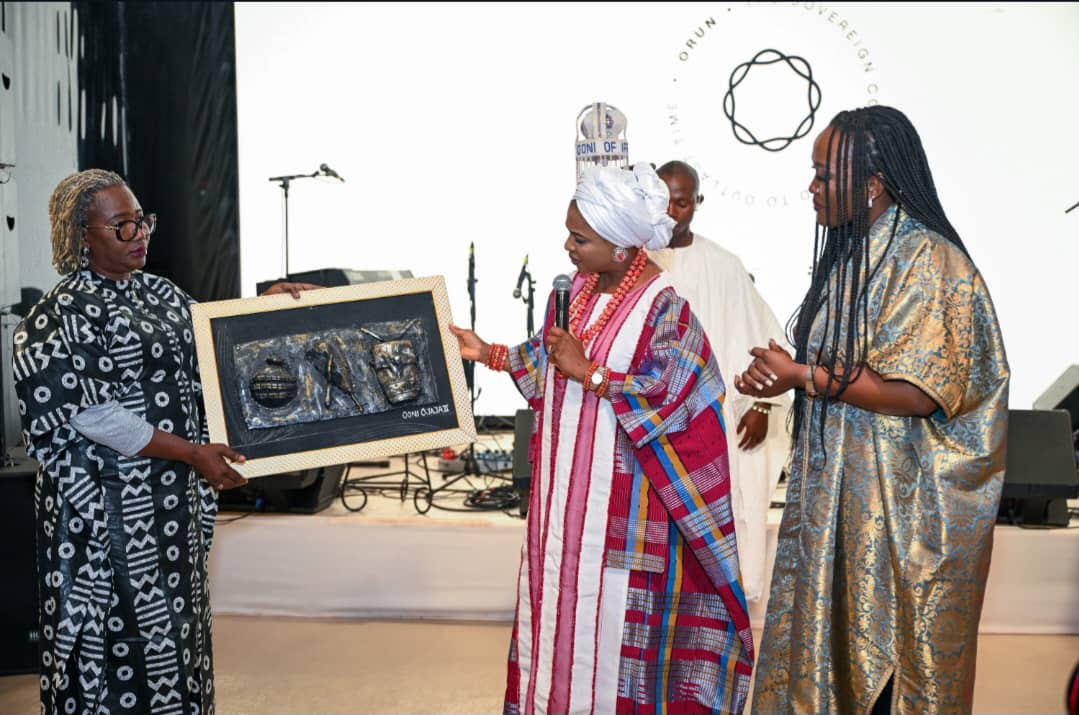
Also, Queen Temitope Ogunwusi, wife of the Ooni of Ife, Oba Adeyeye Enitan Ogunwusi, said that individual excellence, though admirable, is fragile without collective vision.
“You can be great as an individual, but if we do not stand together as Africans, we can easily be broken,” she said.
Drawing from a familiar African metaphor, she likened unity to a broom whereby, while a single strand snaps easily, a bundle bound together is almost impossible to break.
“When we come together as one, our strength becomes unshakable,” she said, urging participants to carry the lesson beyond the event.
Beyond unity among people, the queen challenged African brands, creatives, and institutions to deepen collaboration, stressing that partnerships built on shared values are essential for long-term impact.
“Wonderful brands should think beyond themselves. Think about connecting with other brands. Let us come together.”
Ogunwusi said that pride in African identity must remain central to collaboration, noting that culture and heritage shape how Africa presents itself to the world.
In a symbolic moment, the queen presented a cultural piece bearing the signature of the Ooni of Ife, describing it as priceless and deeply significant.
She said that the king, widely known for advocating the philosophy of “one Africa” across continents, asked her to deliver a message of unity.
“He told me to tell everyone here tonight that we should always see ourselves as united. When we stand together, we will always stand strong,” she said.
The gathering formed part of Heirs of Greatness Day, unveiled by ORUN, a subsidiary of the Africa Currency Network (ACN), to reposition African creativity as a driver of development, dignity, and cultural sovereignty.
The event brought together stakeholders from across Africa’s Cultural and Creative Industries (CCIs), positioning the sector as a contributor to sustainable development, job creation, and African soft power.
ORUN said Heirs of Greatness Day marked the activation of a long-term pan-African platform designed to move culture beyond symbolic celebration into structured and economically viable systems.
At the core of the initiative is The Sovereign Code, ORUN’s founding framework built on three pillars: memory, structure, and transmission.
The organisation said that the framework underpinned all its programmes and seeks to convert inherited cultural knowledge into measurable and sustainable value chains.
Mr Anil Padia, Programme Director of ORUN X Designers, said that the platform was created to correct long-standing imbalances in Africa’s creative supply chains.
“Artisans should not sit at the bottom of the value chain. They must become the foundation of everything we build,” Padia said.
According to him, the philosophy of ORUN X Designers is rooted in Africa’s origins and calls for innovation that grows from cultural identity.
“It is important for us to look at our roots, understand what we have and innovate from there. Everything we need is already on this continent,” he said.
Artistes and practitioners who presented works included Moukagny of Senegal, Kader Diaby of Côte d’Ivoire, Jennifer Mulli of Kenya, Henri Philippe Maidou of the Central African Republic, Sonia Ahmimou of Morocco, and Lucette Holland of France.
Padia said that the works reflected African creativity deeply rooted in local contexts but increasingly oriented towards international markets through collaboration between artisans and contemporary designers.
Participants said that the focus was not only on finished products but also on process, highlighting how traditional techniques can meet modern standards of quality, responsibility, and innovation.
The programme featured institutional engagements, artistic installations, editorial exchanges and symbolic performances, structured as an immersive, narrative-driven experience.
Organisers said that the format reflected their intention to position Heirs of Greatness Day as a continuous platform rather than a one-off event.
Diplomatic and institutional participation at the event further underscored growing recognition of CCIs as strategic sectors within Africa’s development agenda.
Padia said that ORUN X Designers was meant to reconnect the artisan, the process, and the final product as a single ecosystem.
“Artisans should not remain invisible.
“They carry memory, skill and value. When you remove them from the centre, you disconnect the product from its meaning,” he said.
On economic impact, he cautioned against relying solely on conventional indicators.
According to him, GDP does not fully capture human value or quality of life.
“The real question is whether growth benefits the people creating the products,” he said.
He said that the initiative planned to onboard at least 50 designers and artisans by 2030 through independent enterprise support, production partnerships, and product development within the ORUN ecosystem.
Also speaking at the event, African singer, Singuilar, said that language remained one of the biggest barriers limiting the global reach of Francophone artists.
“English and Spanish dominate the international market.
“If people do not understand what you are saying, it becomes difficult for them to fully feel the message,” he said.
Singuilar, whose work focuses on storytelling and emotion, said that while rhythm could transcend language, reflective music depended heavily on lyrical understanding.
“There is music for dancing, and there is music where you need to understand the message. That’s the kind of music I often make.”
He commended ORUN for celebrating African creativity and craftsmanship, describing handmade African work as true luxury.
“The real luxury is what is made by hand. Everything comes from the heart,” he said.
ORUN said that Heirs of Greatness Day formed part of its broader 2025–2030 strategy, which focuses on structuring cultural value chains.
It said that it also focuses on upskilling artisans and designers, creating skilled jobs, strengthening local production ecosystems, and expanding the global visibility of African talent.
The organisation described the Casablanca edition as the starting point of a long-term movement aimed at embedding culture at the heart of Africa’s economic and symbolic transformation.
ORUN is a pan-African initiative led by the Africa Currency Network and a member of the Kigali International Financial Centre.
It focuses on positioning cultural and creative industries as engines of sustainable development, cultural sovereignty and African soft power across the continent.(NANFeatures)
****If used, please credit the writer and News Agency of Nigeria