














By Henry Oladele
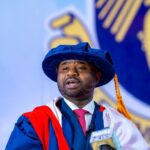
A Lagos traditional ruler, Oniru of Iru, Oba Omogbolahan Lawal, has urged policymakers, professionals and academics to collaborate more closely to shape the future of urban governance.
Oba Lawal spoke on Wednesday at the 2026 Distinguished Personality Lecture Series of Lagos State University (LASU), Ojo.
The News Agency of Nigeria (NAN) reports that the lecture theme was ‘Urban Governance and the Knowledge Economy: Strengthening Institutions for a 21st Century Lagos’.
He described urban governance reform as a continuous process, stressing that expansion must translate into resilience.
“Cities that thrive are those that invest patiently in institutional capacity and manage disruption creatively and with purpose,” Lawal said.
The traditional ruler highlighted Lagos State initiatives in agriculture, tourism, transportation, traffic management and institutional reforms.
“These efforts must be supported by research, innovation and data-driven decision-making to achieve sustainable development,” he said.
He added that collaboration with stakeholders and communities was vital to strengthening a knowledge-based economy.
Lawal said the theme reflected Lagos’ current realities as one of the world’s fastest-growing urban regions.
“Rapid growth places sustained pressure on infrastructure, institutions and social systems.
“At the same time, Lagos is increasingly shaped by knowledge, skills, data, innovation and human capital,” Lawal said.
He said how Lagos managed this intersection would determine the kind of city it became.
“This conversation is not abstract theory. It is about how decisions are made, services delivered and institutions respond under constant pressure,” he said.
Lawal noted that between 2000 and 2020, Lagos faced population growth, infrastructural deficits, environmental stress and rising social complexity.
“What distinguished Lagos was not the absence of challenges, but institutional learning, innovation and resilience,” he said.
He said this period marked a deliberate shift towards knowledge-based governance.
Lawal explained that urban governance in a megacity differed fundamentally from smaller or predictable environments.
He said the knowledge economy should not be viewed only through technology.
He said: “At its core, it is about organising intelligence, data, skills, institutions and learning to solve problems.
“A functioning knowledge economy requires skilled people, innovation systems, digital capacity, effective institutions and accountable governance.
“Technology alone does not create this. Governance does.”
He cited the Lagos Bus Rapid Transit system as an example of institutional learning.
“The BRT has transported over 550 million passengers since 2007 and reduced transport costs to five to seven per cent of household income.
“The system shows how data, coordination and adaptive planning improve mobility and affordability,” he said.
Lawal also stressed the role of traditional leadership in modern governance.
“Traditional institutions provide legitimacy, social trust and community engagement.
“They play a stabilising role, especially during periods of disruption and reform,” he said.
The Oba urged policymakers to protect and professionalise institutions, allowing them to mature.
“Governance reform is not an event. It is a process. The cities that thrive invest patiently in institutions and manage disruption with purpose,” he said.
Addressing youths, Lawal said cities were shaped by everyday institutional decisions, not only grand plans.
“The future belongs to those who think critically, act ethically and adapt intelligently,” he said.
He said 21st-century governance was about building institutions that could learn under pressure.
“The greatest risk for cities like Lagos has never been change. It has always been rigidity. Cities succeed because they learn faster than pressure accumulates,” he said.
In her remarks, LASU Vice-Chancellor, Prof. Ibiyemi Olatunji-Bello, described the lecture as a platform for critical thinking and engagement.
She said universities must produce graduates capable of contributing meaningfully to society.
“Knowledge becomes valuable when applied responsibly to solve societal problems.
“Strong institutions are what transform ideas into functional systems and potential into progress,” Olatunji-Bello said.
Deputy Speaker of the Lagos State House of Assembly, Mrs Mojisola Meranda, described the lecture as bridging scholarship, leadership and public policy.
She said it underscored the importance of informed leadership, inclusive governance and strong institutions.
Meranda reaffirmed the Assembly’s commitment to legislative frameworks promoting good governance and economic resilience.
“Urban governance in a megacity like Lagos requires institutional strength, innovation and collaboration,” she said.
Chairman of the occasion, Prof. Dapo Asaju, called for renewed appreciation of Africa’s intellectual and governance heritage.
He said traditional rulers had historically played key philosophical and leadership roles in society.
The lecture called for integrity, courage and responsibility in addressing Lagos’ urban and governance challenges. (NAN) (www.nannews.ng)
Edited by Kamal Tayo Oropo