
















Tolu Aiyegbusi
The Federal Government says it is intensifying efforts to commercialise research outputs and strengthen local innovation as part of measures to diversify the economy and reduce reliance on foreign technologies.
The Minister of Science, Innovation and Technology, Mr Kingsley Udeh, stated this on Thursday at a Nigerian National Order of Merit (NNOM) Joint Academy Town Hall meeting in Abuja.
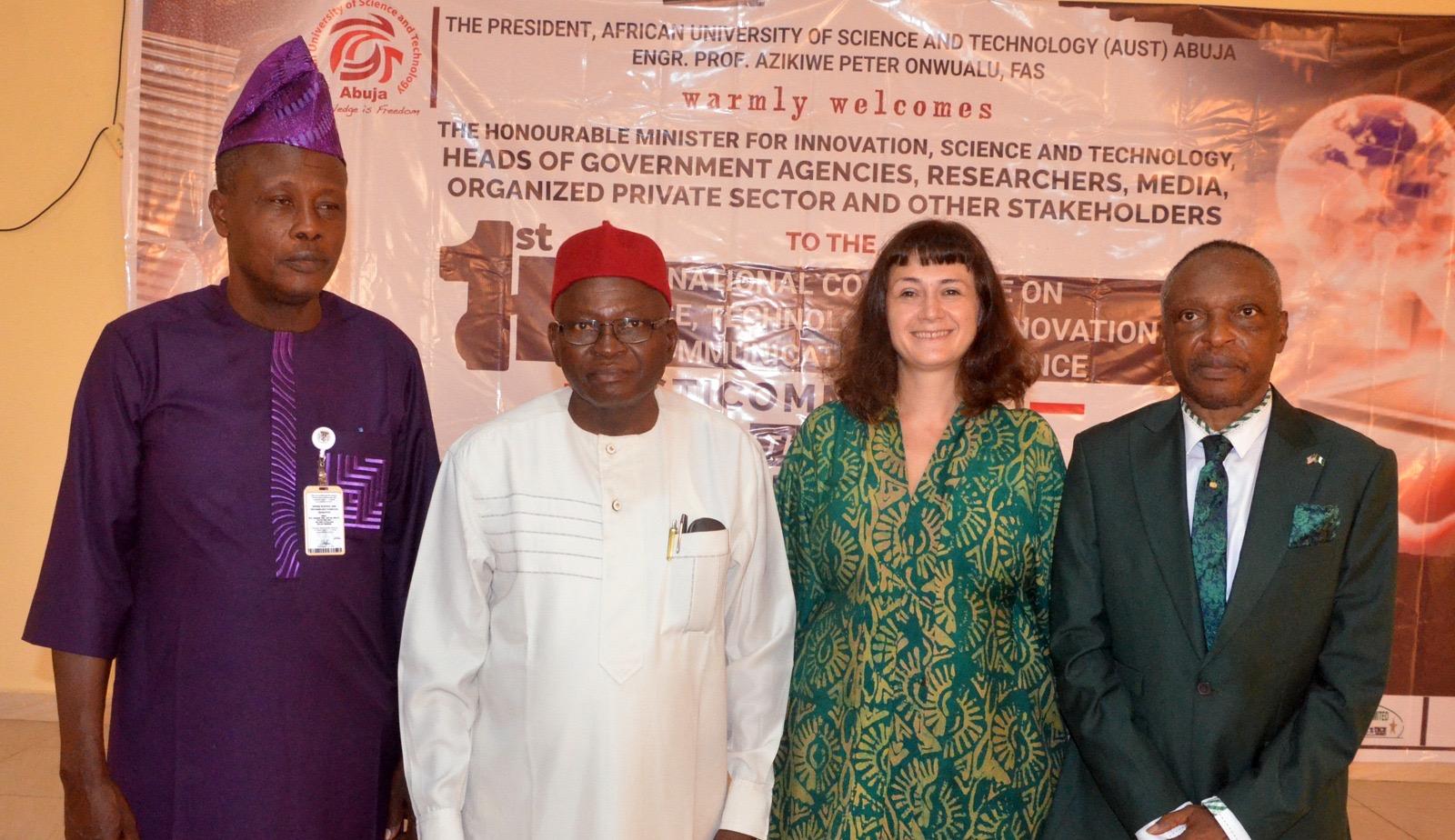
The meeting was at the close of the maiden three-day National Conference on Science, Technology and Innovation Communication.
Udeh, who was represented by the National Coordinator, Strategy Implementation Task Office for Presidential Executive Order No. 5, Dr Ibiam Oguejiofo, said Nigeria possessed abundant scientific expertise that remained largely uncoordinated and underutilised.
He lamented that decades of research activities had failed to translate into tangible economic value, noting that research outcomes were rarely transformed into market-ready products.
According to him, the country still depends heavily on foreign innovation and grants, with local researchers conducting studies whose final products are developed abroad and later imported.
“We have experts across all sectors, but we are not taking advantage of what we need in our daily lives. Research results exist, but there is no coordinated system to turn them into products that benefit the economy,” he said.
Udeh said the government was developing a National Policy on Research and Innovation Commercialisation to align the demand and supply sides of innovation for the first time.
He explained that the policy would enable government agencies to prioritise locally developed innovations through procurement, supported by incentives to help innovators refine products and attract private sector investment.
“The government is now ready to support any innovator with a tangible product that can be deployed in the economy to ensure such innovations are commercialised and profitable,” he said.
Also speaking, the Vice-Chancellor, Federal University of Science and Technology, Ogoni, Rivers, Prof. Chinedu Mmom, highlighted Nigeria’s growing environmental challenges, including desertification, air and water pollution, and land degradation.
Mmom said environmental pollution associated with natural resource exploitation and gas flaring had far-reaching economic consequences, adding that a significant portion of Nigeria’s Gross Domestic Product was affected by environmental degradation.
He expressed concern that despite extensive research on environmental challenges, most findings remained on shelves and were poorly communicated to end users, particularly rural and vulnerable communities.
“Many research outcomes never reach the people who need them most. Information dissemination is still largely limited to television and radio, which serve only a privileged few,” he said.
Mmom called for improved grassroots communication and disaster preparedness, noting that lack of awareness often escalated minor incidents into major disasters.
In his remarks, the President, African University of Science and Technology (AUST), Abuja, Prof. Azikiwe Onwualu, identified funding as the major challenge facing Nigeria’s science, technology and innovation ecosystem.
Onwualu said inadequate funding had continued to limit the translation of research into innovations, goods and services, despite the presence of several agencies under the Ministry of Science and Technology.
He said progress was being made towards establishing a National Research and Innovation Fund in line with President Bola Tinubu’s Renewed Hope Agenda.
According to him, a bill to that effect has been passed by the House of Representatives and is awaiting concurrence in the Senate, while a committee under the Vice President is finalising the implementation framework.
He said the proposed fund, to be overseen by the National Research and Innovation Council, would enable researchers and innovators to access financing to move ideas from concept to commercial reality.
Onwualu commended President Bola Tinubu for creating an enabling environment for research and innovation, expressing optimism that Nigeria would leverage science and technology to drive sustainable economic growth.
In a closing remark, the moderator, Prof. Hilary Inyang, said the convening role played by AUST should be sustained to regularly bring stakeholders together to harness Nigeria’s intellectual capital.
Inyang said stronger collaboration and deliberate investment in science, technology and innovation infrastructure would enable Nigeria to translate knowledge into economic value and compete more effectively globally.(NAN) (www.nannews.ng)
Edited by Bashir Rabe Mani