



















By Yunus Yusuf
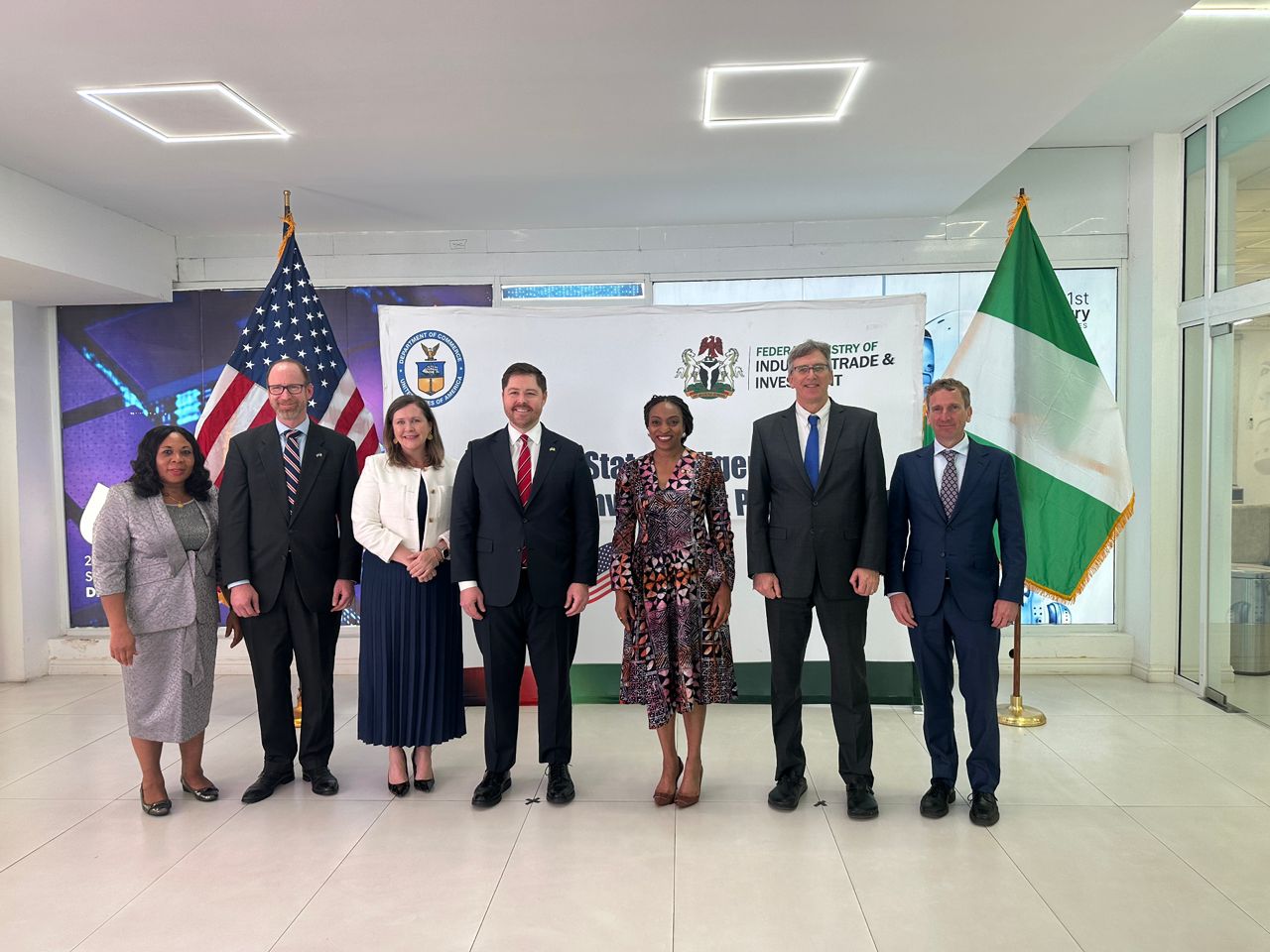
The United States and Nigeria on Thursday signed a Commercial and Investment Partnership (CIP) aimed at strengthening bilateral trade and investment, with priority sectors including agriculture, the digital economy, and infrastructure.
Speaking at the ministerial briefing in Lagos, Mr Bradley McKinney, Deputy Assistant Secretary for the U.S. Commercial Service, U.S. Department of Commerce, described the agreement as a major milestone in U.S.-Nigeria economic relations.
“It is a privilege to be here in Lagos for this pivotal U.S.-Nigeria Commercial and Investment Partnership ministerial meeting,” he said.
McKinney noted that he had been struck by Lagos’ strong entrepreneurial spirit, which he said mirrors that of the United States.
McKinney commended the Minister of Industry, Trade and Investment, Dr Jumoke Oduwole, for her leadership, as well as officials of the Federal Ministry of Industry, Trade and Investment, and the U.S. Foreign Commercial Service team in Nigeria, for driving the partnership forward.
He said the CIP working groups, covering agriculture, the digital economy, and infrastructure, had, within six months, moved the partnership “from concept to execution,” developing practical proposals to remove trade bottlenecks and deepen commercial ties.
According to him, the initiative aligns with the broader U.S. strategy for economic engagement in Africa under the Trump Administration, which focuses on expanding exports, strengthening the industrial base, and creating high-quality jobs, while working with trusted partners.
“Nigeria is precisely the kind of partner that shares that vision,” McKinney said, describing the country as one of the United States’ most important commercial partners in Africa.
The deputy assistant secretary disclosed that bilateral trade between both countries reached about 13 billion dollars in 2024.
He said this underscored the nation’s scale, talent, and long-term market potential for U.S. companies, while noting growing Nigerian investment interest in the United States.
McKinney emphasised that predictability in regulation and policy was critical to attracting long-term investment,
He added that the success of the CIP would depend on translating recommendations into concrete government commitments and measurable outcomes over its five-year lifespan.
“This ministerial is a milestone, not a finish line,” he said.
In her remarks, Minister of Industry, Trade, and Investment Dr Jumoke Oduwole, said the CIP, signed in July 2024, was designed to deepen collaboration across key growth sectors and to convert dialogue into tangible commercial value and shared prosperity for businesses in both countries.
She said trade in goods and services between Nigeria and the U.S. stood at approximately 13 billion dollars in 2024, with U.S. exports to Nigeria valued at 4.2 billion dollars, mainly machinery, vehicles, agricultural products, and consumer goods.
Nigerian exports to the U.S., she added, reached 5.7 billion dollars, dominated by oil and energy, but increasingly complemented by cocoa, sesame, fertiliser, and manufactured products.
Oduwole stressed Nigeria’s commitment to accelerating non-oil export diversification and expanding market access for Nigerian businesses in a competitive and sustainable manner.
The minister highlighted strong U.S. participation in Nigeria’s digital economy, aviation, and infrastructure sectors.
She cited recent fleet expansion agreements between Nigerian airlines and U.S. aircraft manufacturer Boeing, as well as a partnership to establish Maintenance, Repair and Overhaul (MRO) facilities in Nigeria, expected to save over 200 million dollars annually.
The minister said ongoing business climate reforms, including the launch of national investment playbooks, tariff reviews, and the implementation of Nigeria’s National Intellectual Property Policy, were improving investor confidence and strengthening competitiveness.
According to her, Nigeria’s reform agenda has begun to yield results, with improved credit outlooks by Fitch, Moody’s and S&P, non-oil export earnings rising to 6.1 billion dollars in 2025, and capital importation increasing from 3.9 billion dollars in 2023 to 12.3 billion dollars in 2024.
Oduwole reaffirmed Nigeria’s ambition to build a one- trillion dollar economy driven by industrial value creation, competitive exports, and strong institutions, adding that strategic partnerships such as the CIP were central to achieving that goal.
The News Agency of Nigeria (NAN) reports that the ministerial meeting was attended by Nigerian and U.S. stakeholders from the agriculture, digital economy, and infrastructure sectors.
Edited by Olawunmi Ashafa