
















By Philip Yatai
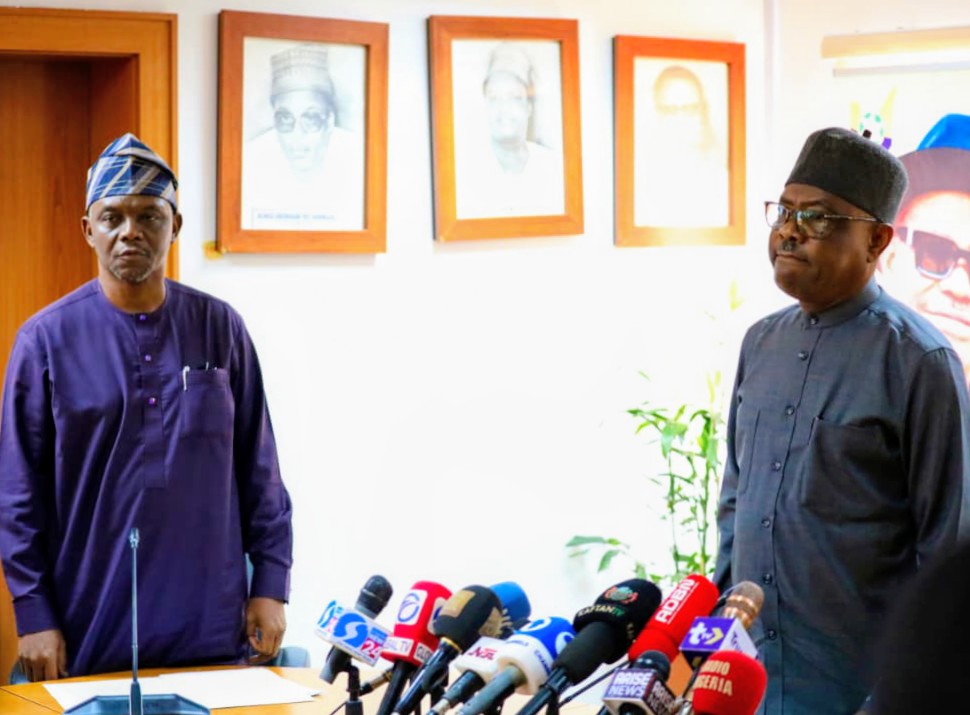
Minister of the Federal Capital Territory (FCT), Nyesom Wike, has commended Mr Richard Dauda, the acting Executive Secretary (ES), Federal Capital Development Authority (FCDA) for providing exceptional leadership that drives infrastructural development across the FCT.
Wike gave the commendation in Abuja on Wednesday, during a meeting with members of staff of the FCT Administration as part of activities to celebrate the territory’s golden jubilee.
He explained that the commendation followed Dauda’s exemplary leadership, which he described as key to achieving desired results.
“Leadership is key. When you have the right leadership, you get the results you want.
“Having been appointed as acting Executive Secretary of FCDA, I can see that you align yourself with the aims and with the vision of the present administration. You’re up and doing.
“Because you’re up and doing your work, see the results we have achieved today.
“So, I commend you, and it would not have been possible if those who are working with you are not giving you the cooperation,” the minister said.
Earlier, Dauda said that a total of 26 projects were completed and inaugurated since Wike assumed office in August 2023, describing it as unprecedented.
He explained that nine projects were inaugurated in 2024 to celebrate Tinubu’s first year in office and 27 in 2025 to mark Tinubu’s second anniversary.
He recalled that in 1975, the then Federal Military Government set up the Justice Akinola Aguda Committee on the suitability and continuation of Lagos as the Capital City or the relocation of the Capital City to a new location.
Dauda added that on the recommendation of the committee, a Decree No. 6 of 1976 (effective 4th February, 1976) was promulgated, establishing the Federal Capital Territory (FCT) with an area of about 8000 square kilometers and the FCDA respectively.
He said that the FCDA was charged with the responsibility of planning, development and administration of Nigeria’s new Federal Capital City, Abuja and the territory as a whole.
“This arrangement has undergone several amendments with the most recent being the Federal Capital Territory (Dissolution) Order 1 of 2004 which saw the dissolution of the Ministry for the FCT and the creation of the FCT Administration along with Mandate Secretariats,” he said.
He said that following the approval of the Federal Capital City’s (FCC) and the Federal Capital Territory’s Master Plan in 1979 and 1983 respectively, active infrastructural development of FCC and FCT commenced in the early 1980’s.
He pointed out that although the FCT witnessed appreciable achievement in the last 50 years, the developments were at a very slow pace, with FCC initially envisioned to be fully developed within 25 to 30 years.
The acting ES disclosed that in the 50 years of development, the development of Abuja Phases I had attained about 85 per cent overall planned infrastructural development.
This, he said, included roads network, districts and services like water supply, sewerage, electrical power supply, and telecommunication facilities among others.
He said that Phases II and III of the FCC on the other hand have only attained about 30 per cent and 10 per cent completion respectively with the Phase IV yet to be provided with any infrastructure.
“Over the years, major infrastructural deficits in the development of the FCC have emerged due to limited availability of funds.
“This is further exacerbated by the need to extend the city’s infrastructural services to the satellite environments.
“The influx of people into the FCT has equally put pressure on the available infrastructure. This comes with the challenge of resettlement and compensation of the original inhabitants in the city.
“This pressure has led to the creation of new Districts such as Guzape, Katampe Extension, Maitama Extension among others within the urban fringes of the FCC, which effectively altered the earlier technical design considerations of infrastructural development of the city,” he said.
Dauda further said that the creation of Phase V arose from the additional urban population density.
“This implies that the city, which was earlier planned for an initial area of 562 square kilometres with a 3.1million projected population for phases I to IV, now has an area of about 801sq km with a projected population of 5.5 million. (NAN)
Edited by Muhammad Lawal