



















By Justina Auta
The Federal Ministry of Agriculture and Food Security has partnered with the Alliance for a Green Revolution in Africa (AGRA) to scale priority post-harvest technologies to curb Nigeria’s N3.5 trillion annual agricultural losses.
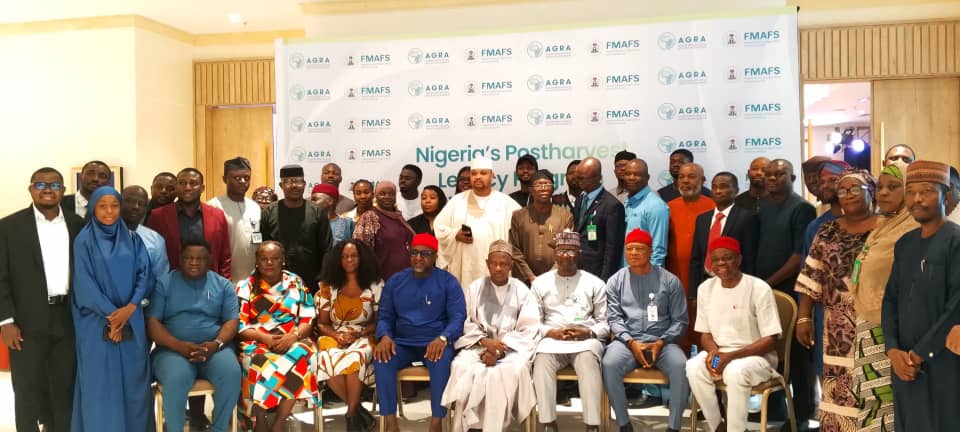
The partnership was highlighted during a validation workshop in Abuja organised by both institutions to review the Market and Business Case Analysis for Priority Post-Harvest Technologies in Nigeria.
The event, under the Nigeria Postharvest Legacy Programme, is designed to modernise the nation’s agricultural mid-stream segment and fulfil its commitments under the Comprehensive Africa Agriculture Development Programme framework goals.
Nigeria’s agricultural sector contributes about 24 per cent to national Gross Domestic Product and employs more than 40 per cent of the labour force, especially across rural communities nationwide.
However, post-harvest losses, especially for perishable crops, remain as high as 60 per cent, significantly undermining food availability and costing the economy about N3.5 trillion annually, according to sector estimates.
Minister of Agriculture and Food Security, Abubakar Kyari, said previous interventions focused largely on production, leaving gaps along the post-harvest value chain that reduced farmers’ incomes and threatened national food security.
“For too long, our efforts have focused primarily on production, leaving a vacuum in the post-harvest value chain that erodes farmer incomes and threatens our national food security,” Kyari said.
“Today’s validation of the NiPHAST business case represents our shift toward a demand-led, technology-driven approach.
“By mobilising the 2.8 billion dollar portfolio identified in this report, we are not just saving food; we are creating thousands of jobs for youth and women,” the minister said.
“We are also stabilising market prices for millions of Nigerians while strengthening the resilience of our agricultural value chains nationwide,” he further explained.
Earlier, Dr Rufus Idris, AGRA Nigeria Country Director, represented by Mr Theophilus Raymond, emphasised the importance of private-sector participation and innovative financing mechanisms in scaling post-harvest technologies across the country effectively.
“The business case is clear: post-harvest technology in Nigeria is a bankable frontier,” Idris said.
“From appropriate storage systems for perishables to the Warehouse Receipt System for grains, these models offer sustainable pathways for MSMEs to thrive.
“AGRA remains committed to supporting the Federal Government in creating an enabling environment through blended finance and policy alignment,” he said.
Idris said the organisation would ensure the technologies reach last-mile farmers, improving livelihoods while strengthening food systems and encouraging inclusive participation across agricultural communities and value chain actors nationwide.
Dr Lekan Tobe, Country Director of Heifer Nigeria, said prioritising post-harvest management would significantly increase productivity and help the country achieve sustainable food security outcomes.
“In Heifer, post-harvest losses is one of our thematic focus areas, which is in alignment with the priorities of the Federal Government.
“We are working with farmers and other stakeholders to bring to consciousness the need to reduce post-harvest loss.
“This will increase productivity, improve incomes and strengthen national food security through better preservation, aggregation and market access for agricultural produce,” Tobe noted.
The study mapped seventy-two storage facilities across the six geopolitical zones and identified nine high-impact investment nodes, including hermetic bag production, solar-powered cold rooms and smart metal silos for deployment.
Findings indicated projected internal rates of return exceeding forty per cent and payback periods as short as two years, demonstrating strong potential for private investment in post-harvest infrastructure development nationwide.
Participants validated a framework for commercialising post-harvest service enterprises, enabling private MSMEs and cooperatives to provide fee-based drying and storage services at market hubs with incubation support mechanisms.
They also advocated fiscal incentives, including import duty waivers and tax relief for equipment, while prioritising women-led cooperatives and youth-driven digital monitoring tools to promote inclusive agricultural transformation nationwide sustainably.
Stakeholders said the roadmap would transform agricultural storage into a professionalised, investment-ready ecosystem supported by a national network of laboratories and aggregation warehouses to enhance food safety and price stability. (NAN) (www.nannews.ng)
Edited by Tosin Kolade