















By Lucy Ogalue
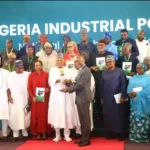
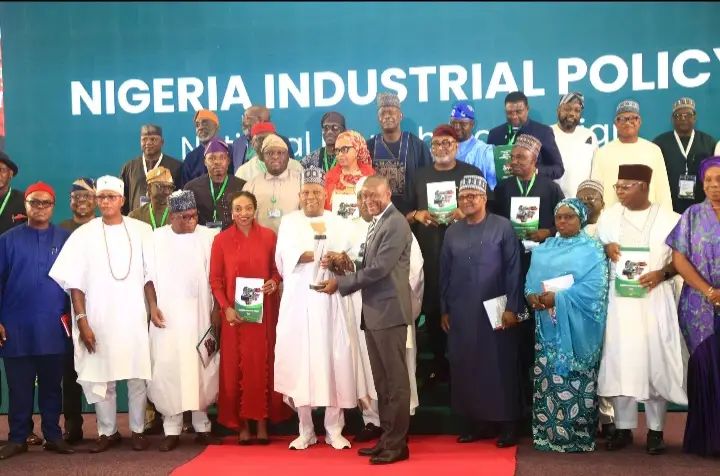
The Federal Government says Nigeria is ready for large-scale production and global competitiveness with the unveiling of the Nigeria Industrial Policy 2025.
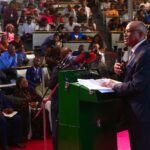
The Minister of State for Industry, Sen. John Enoh, made the declaration at the official presentation of the policy on Tuesday in Abuja.
Enoh described it as a disciplined and structured response to President Bola Tinubu’s directive to reposition Nigeria from potential to productivity.
“Today, Nigeria makes a declaration; to itself and to the world: that industrialisation is no longer a distant aspiration, but a disciplined national priority,” Enoh said.
He said the policy was anchored on clarity of purpose, grounded in realism and focused on execution.
According to him, the launch of the policy is not merely an announcement but fulfilment of a presidential commitment.
“At your inauguration, you made a clear commitment to rebuild the productive capacity of the nation and place industry at the centre of economic policy.
“Today, we stand here to say: this is that promise delivered,” he said.
Enoh cited the prohibition of raw shea nut exports in August 2025 as practical proof of the government’s commitment to value addition.
According to him, prior to the policy, Nigeria, in spite accounting for nearly half of global shea production in West Africa, captured barely one per cent of the 6.5 billion dollar global shea industry value.
“We exported jobs. We exported industry. We exported opportunity. Mr President changed that trajectory.
“This policy did not only create factories; it created dignity in rural communities. It created industrial jobs. It created national confidence,” he said.
The minister emphasised that the policy directly addressed key industrial foundations such as power supply, infrastructure, skills development and policy stability.
Enoh further disclosed that the Raw Materials Research and Development Council Amendment Bill, also known as the 30 per cent Value Addition Bill, had been passed by both chambers of the National Assembly and awaited presidential assent.
He said the law would institutionalise value addition and permanently move Nigeria away from being a purely extractive economy.
“To investors, domestic and global, the message is clear: Nigeria is open for production. Nigeria is ready for scale. Nigeria is serious about competitiveness,” he said.
The minister added that the success of the policy would be measured not by announcements but by expanding factories, emerging value chains, growing exports and restored confidence in Nigeria’s industrial future.
Gov. Babajide Sanwo-Olu of Lagos State, represented by his Commissioner for Commerce, Trade and Investments, Folasade Ambrose-Madebem, said the policy marked a turning point in Nigeria’s economic history.
“For too long, we exported raw materials and imported finished goods. That cycle must end, and it is ending,” he said.
Sanwo-Olu added that raising manufacturing’s contribution to Gross Domestic Product (GDP) to 25 per cent by 2030 was ambitious but achievable through coordinated implementation.
The Organised Private Sector (OPS) also pledged support for the policy, describing it as a strong national commitment to industrial transformation
The Director of the Abuja Nigerian Association of Chambers of Commerce, Industry, Mines and Agriculture (NACCIMA) office, Dr Emmanuel Akeh,said Nigeria possessed the fundamentals for industrial success.
He, however, emphasised the importance for disciplined implementation to determine the desired outcomes.
The President, Manufacturers Association of Nigeria (MAN), Mr Francis Meshioye, also reiterated the importance of effective implementation of the policy for the development of the nation.
Other stakeholders at the event expressed optimism that effective execution of the policy would boost domestic production, expand exports, reduce import dependence and create millions of jobs.(NAN)
Edited by Bashir Rabe Mani