














By Nana Musa
The Minister of State for Finance, Dr Doris Uzoka-Anite, has reiterated the Federal Government’s commitment to actualising President Bola Ahmed Tinubu’s one trillion-dollar economy.
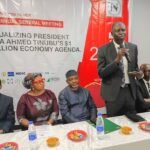
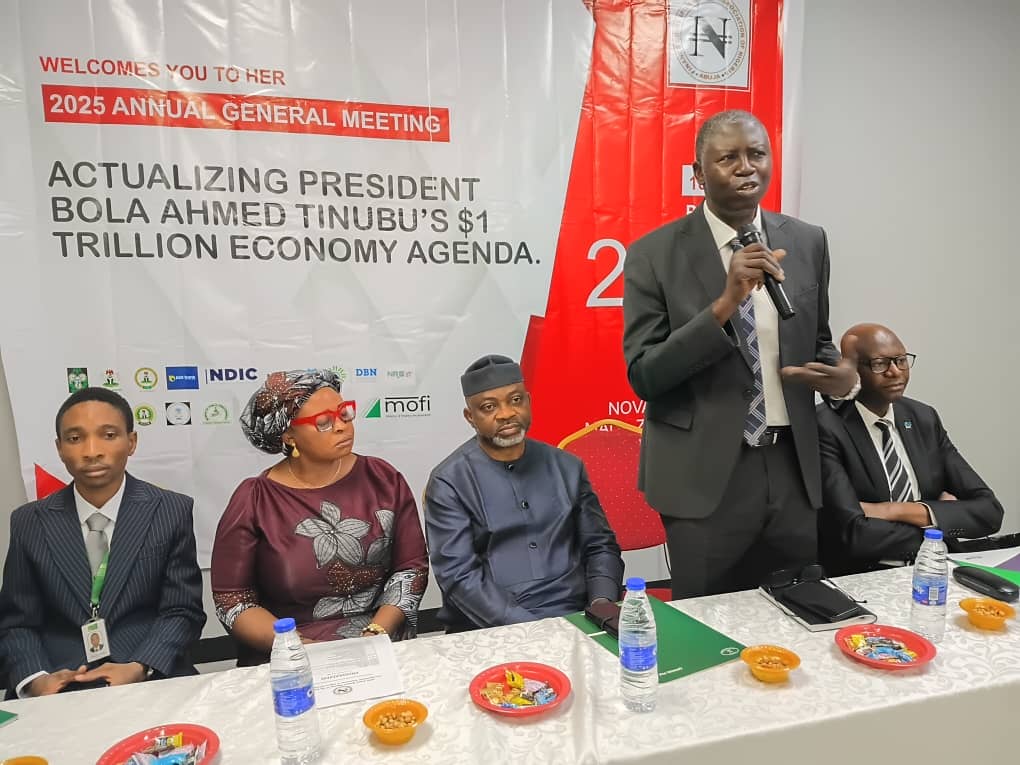
Uzoka-Anite made this known at the Annual General Meeting (AGM) of the Finance Correspondents Association of Nigeria (FICAN) in Abuja, on Wednesday.
The theme of the meetingwas, “Realising Tinubu’s One Trillion Dollars Economic Agenda”.
The minister, who was represented by the ministry’s Assistant Director of Media and Public Relations, Mrs Uloma Amadi, described the target as “a specific, measurable destination” rather than a slogan”.
She said that the ongoing reforms by the Federal Government had a solid foundation for sustained double-digit growth.
Uzoka-Anite said that the country’s Gross Domestic Product (GDP) was currently estimated at about 375 billion dollars.
She said that it would require sustained annual growth of between 10 per cent and 12 per cent over the next decade to reach the one trillion-dollar mark.
“That is an ambitious target, and this administration is not shy about saying so. Ambitious targets are what move nations.
“Upon assumption of office in 2023, this administration inherited an economy marked by structural distortions.
“These include a fuel subsidy regime that gulped over five trillion Naira annually, and a multiple exchange rate system that undermined investor confidence,” she said.
According to her, the removal of fuel subsidy and the unification of the foreign exchange market were difficult but necessary steps to restore market integrity.
“Both decisions imposed short-term pain, neither decision has been reversed. Today, those reforms are being vindicated by the data,” she said.
She said that the government had restructured the budget framework to distinguish clearly between recurrent and investment expenditure, with emphasis on channeling resources toward infrastructure and growth-enhancing projects.
“We are now asking, not just how much we are spending, but what we are building with what we spend,” she said.
The minister said that the second phase of reforms, anchored on the Disinflation and Growth Acceleration Strategy (DGAS), was designed to unlock productive capacity and deliver non-inflationary growth of over seven per cent by 2027.
She said that DGAS, developed in collaboration with the Central Bank of Nigeria (CBN), was built on nine pillars.
The minister listed the pillars to include Capital mobilisation through development finance instruments, sectoral acceleration in agriculture, energy, technology and manufacturing, and nationwide energy expansion.
Others are digital infrastructure development and large-scale human capital training.
She said that the strategy also prioritised an expanded consumer credit platform to enable Nigerians access structured financing for housing, healthcare, education and other essential needs.
According to her, about 70 per cent of raw materials used in local industrial production are imported, adding that the needed to be reversed.
Uzoka-Anite said that the Dangote Refinery was an example of the benefits of domestic processing of resources, saying similar models would be replicated across agriculture, mining, health and manufacturing.
“The removal of the country from the Financial Action Task Force (FATF) grey list underscored strengthened anti-money laundering and counter-terrorism financing frameworks, thereby enhancing investor confidence”.
The minister said that the country had submitted its ECOWAS tariff offer under the African Continental Free Trade Area (AfCFTA), committing to zero duties on 90 per cent of goods traded within Africa
She said that the move was strategic, repositioning in an evolving global trade environment.
She commended FICAN for its role in deepening public understanding of economic reforms, noting that the media remained a critical partner in shaping informed public discourse.
The Managing Director of the Nigerian Export-Import Bank (NEXIM), Abubakar Bello, said that there were some strategy to drive Nigeria toward one trillion dollars economy,
Bello, who was represented by Babagana Musti, said that the bank’s efforts were centered on empowering exporters, leveraging regional trade, and eliminating logistics bottlenecks.
He said that the three pillars for the economic growth were: exporter empowerment, AfCFTA leadership, infrastructure and logistics.
Bello said that the bank had also disbursed 108 billion dollars to exporters in 2025.
He urged the media to provide accurate reporting on the growth of the non-oil sector to build global investor confidence.
“When you report accurately on the growth of the non-oil sector, you are not just reporting an export you are building the global investor confidence required to hit the one trillion-dollar economy,” Bello said.
The Director-General (D-G) of the Bureau of Public Enterprises (BPE), Ayodeji Gbeleyi, said that the country was currently undergoing one of the most transformative economic periods in the history.
Gbeleyi was represented by the Director of Industries and Services, Mr Tajudeen Oduniyi.
He said that to bridge the nation’s infrastructure gap, BPE was developing a robust pipeline of Public-Private Partnership (PPP) projects across several critical sectors.
He said that the critical sectors included energy and transport, agriculture and housing, ICT and environmental services.
The D-G said that the one trillion-dollar goal demanded a combination of fiscal discipline, institutional strengthening, and a vibrant private sector.
He said that the BPE’s approach remained rooted in the Public Enterprises (Privatisation and Commercialisation) Act of 1999, which has historically birthed key agencies such as the NCC, PenCom, and the EFCC.
He urged financial journalists to maintain their role as watchdogs of the reform process.
The D-G said that all future privatisation and commercialisation initiatives remained transparent, accountable, and aligned with national priorities under the “Renewed Hope agenda.
The Vice President of the Nigeria Infrastructure Fund at the Nigeria Sovereign Investment Authority (NSIA), Abraham Durosawo, said that diversified village approach to infrastructure financing was essential for the country to achieve its ambition.
Durosawo, who was represented by NSIA Managing Director/CEO Aminu Umar-Sadiq, said that the country required an annual investment of 100 billion dollars to 150 billion dollars to close its current infrastructure deficit.
He said that the NSIA continued to play a pivotal role through the Presidential Infrastructure Development Fund (PIDF), ensuring that projects are executed to international standards.
He called for a shift in public perception regarding how projects are funded.
Durosawo said that the “universe of infrastructure” in the country was currently powered by several distinct layers:
He said that the PIDF was managed by the NSIA in conjunction with the Federal Government.
According to him, a comprehensive review of the national infrastructure strategy was ongoing to ensure that future implementations are both sustainable and efficient.
He reiterated NSIA’s commitment to renewable energy through its strategic partnership with the Rural Electrification Agency (REA).
”The core role we play is acting as a catalyst to attract capital,” he said. (NAN)(www.nannews.ng)
Edited by Kadiri Abdulrahman