








The Chief Justice of Nigeria (CJN), Justice Kudirat Kekere-Ekun, says the law is the anchor of political stability, the guarantor of economic confidence and the framework within which freedoms are exercised and responsibilities
enforced.
Kekere-Ekun stated this on Tuesday at the Nigerian Institute of Advanced Legal Studies (NIALS) Fellows’ Lecture and 19th Conferment of Institute’s Honorary Fellowship in Abuja.
The News Agency of Nigeria (NAN) reports that the lecture was titled: “Law, Politics and Economic Development; Nigeria at Crossroads.”
The CJN said the law is not an abstract ideal confined to courtrooms or classrooms.
“At a moment when our nation confronts complex socioeconomic pressures and shifting political expectations, the primacy of the rule of law becomes even more evident.
“For the judiciary, this reality carries a solemn charge.
“Our constitutional mandate demands fidelity to the law, impartiality in its application, and courage in its defence.
She said public trust, which is the lifeblood of justice, must be earned every day through transparent processes, reasoned decisions and an unwavering commitment to fairness.
“The courts do not operate in isolation from society; rather, they operate at its moral and institutional core.
“It is, therefore, essential that our deliberations today contribute to
strengthening that core.
“This is precisely why the Fellows’ Lecture remains such a vital institution
within NIALS,” she said.
The CJN, who is also a fellow of the institute, commended the leadership of NIALS for preserving the tradition and for continuing to elevate the quality of public discourse in the country.
The Guest Lecturer, Mr George Etomi, said his paper established a conceptual framework that defines Nigeria’s efficacy through the critical correlation of law, politics and economic development.
“It argues that a functional, predictable legal framework is the indispensable ‘Architect of Society,’ necessary to constrain political power and create the certainty required for sustainable economic growth,” he said.
According to Etomi, by analysing Nigeria’s trajectory, the study demonstrates that the nation’s systemic governance crisis is rooted not in the absence of policy or law, but in widespread, institutionalised non-compliance with its own legal instruments.
“This non-compliance manifests as weak enforcement of contracts, arbitrary regulatory application and compromised accountability, leading to reduced government revenue, deterred Foreign Direct Investments (FDIs), and eroded public trust in the judiciary.”
He said to achieve a future of diversified, inclusive economic progress, this would depend entirely on enforcing the laws that already exist, thereby restoring legal predictability and political legitimacy.
The Director-General (DG) of NIALS, Prof. Abdulqadir Abikan, in his welcome remark, said this year’s title was not just merely an academic topic but the central dilemma of the nation’s national project.
“It demands that we confront the intricate, often contentious, nexus where legal frameworks intersect with political will and economic aspirations.
“At this crossroads, the choices we make—or fail to make—will define our trajectory for generations.
“We have assembled today to listen, learn, and engage with a rigorous examination of this critical triad.
We expect nothing less than a lecture that will illuminate the path forward with scholarly insight and courageous clarity,” he said.
The DG said the dual agenda of the occasion speaks directly to the core of the NIALS institutional mission.
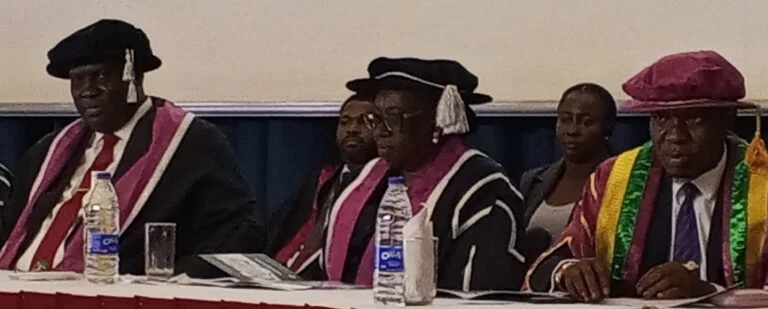
NAN reports that Chief Kanu Agabi, SAN; Muhammed Adoke, SAN; Malam Yusuf Alli, SAN, and Prof. Muhammed Ladan were conferred with Honorary Institute Fellowship 2025. (NAN)(www.nannews.ng)
Edited by Sadiya Hamza