


By Mark Longyen
Stakeholders have lauded the successes recorded under the African Peace and Security Architecture (APSA-IV) programme between 2020 and 2025.
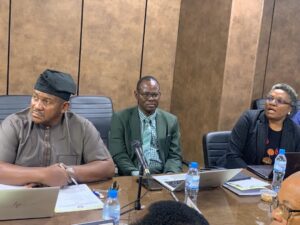
They gave their views in separate interviews with the News Agency of Nigeria (NAN) on the sidelines of a workshop in Abuja.
They also expressed optimism over the planned roll-out of APSA-IV’s successor programme, the Governance, Peace and Security (GPS) initiative, in January 2026.
The workshop, organised by the ECOWAS Peace Fund (EPF), reviewed APSA-IV’s five-year implementation under the theme: “APSA-IV Implementation, Capitalisation and Lessons Learned.”
The EPF, under the ECOWAS Department of Political Affairs, Peace and Security, coordinates APSA, an AU programme funded by the EU to promote peace and security on the continent through Regional Economic Communities (RECs) and regional mechanisms (RMs).
APSA components include the Peace and Security Council, the Panel of the Wise, the Early Warning System, the African Standby Force and the Peace Fund.
Former ECOWAS Director of Private Sector, Dr Tony Elumelu, described the workshop as timely, saying it offered an opportunity to assess APSA’s achievements and challenges.
He said the collaboration of implementing directorates would further strengthen APSA-IV’s successor programme.
Elumelu expressed optimism that the next phase would better integrate economic and security issues to address drivers of conflict.
“There’s a condition precedent for peace to reign; we don’t need guns to be able to solve peace.
“The creation of jobs and proliferation of businesses will enhance the peace we are trying to achieve. Peace matters, but first we need economic development,” he said.
EPF Manager, Mr Dieudonné Nikiema, said that although APSA-IV had three predecessors since 2004, its coordination and success under his team were significantly improved.
He said APSA-IV enabled ECOWAS to set up Early Warning Systems in Niger, Benin, Ghana, Senegal and Cape Verde—marking an important milestone in achieving the programme’s objectives.
According to him, the centres now have modern IT and communication facilities, conference systems, transport logistics, vehicles and generators, with an inter-operational system linking member states to the ECOWAS headquarters in Abuja.
Nikiema said that while APSA could not solve all of Africa’s challenges, it had made significant contributions across various directorates.
 He said the peacekeeping and regional security directorate recorded progress in supporting children affected by conflict, while the political affairs department improved youth engagement and inter-generational dialogue for peace.
He added that the finance department strengthened its capacity to manage donor funds in preparation for the GPS programme, which will prioritise staff training in fund management.
EPF Programme Officer, Mrs Gloria Ugwunze, said APSA provided the continental framework for the AU, RECs and RMs to jointly prevent, manage and resolve conflicts.
She said the EPF receives donor support from the EU, the five per cent annual ECOWAS Community Levy and partner countries such as Canada.
According to her, the Peace Fund got an initial takeoff grant of about 50 million dollars from the African Development Bank, adding that interventions are largely capital-intensive.
She said the Fund provided 41,000 two-bedroom housing units for conflict-affected persons in Liberia, Sierra Leone and Guinea; refurbished hospitals and schools; and supplied medical equipment.
Ugwunze said the EPF, through donor partners, had coordinated more than 12 APSA projects and implemented several humanitarian interventions since 2004.
“We’ve also been able to fund the deployment of troops under the ECOWAS Standby Force, such as during the Mali crisis.
“The funding used initially to mobilise and deploy peacekeepers came from the ECOWAS Peace Fund.
“In elections, we sent about one million dollars to Guinea-Bissau for electoral support, among many other interventions.
“We are talking about several conflicts in our region, so we need more money to mitigate them—maybe scaling funding to 200 million dollars. In fact, even if you give us one trillion, it will not be enough,” she said.
Dr Brown Odigie of the ECOWAS Department of Political Affairs, Peace and Security said APSA-IV made significant contributions to peace and security in the sub-region.
He said the programme’s multiple components contributed to peace support operations, conflict prevention and management, youth peace and security, governance and election support.
Odigie commended the EPF team for coordinating the programme, saying APSA-IV strengthened resilience for peace, security and governance across West Africa.
He said the programme made notable gains in conflict prevention and early warning, as well as in the deployment of election observation missions across member states.
Odigie expressed optimism that the GPS initiative, due for launch in January 2026, would consolidate APSA-IV’s achievements.
“The GPS will leverage what has been achieved under APSA-IV in a manner that ensures sustainability,” he said. (NAN)
Edited by Emmanuel Yashim

Comments