


By Angela Atabo, News Agency of Nigeria (NAN)
In today’s fast-moving digital world, social media can feel like both a megaphone and a battlefield.
TikTok skits, Instagram reels and anonymous comment threads have become places where people living with disabilities are mocked, impersonated or openly harassed.
For many Nigerian women with disabilities, these platforms that promise connection often deliver cruelty instead.
When Susan Ihouma, a Person With Disability (PWD), opened her phone earlier this year, she was not expecting abuse — a man who had expressed interest in her lashed out when she declined.
His response was swift and cruel: he called her “crippled” and posted her photo online.
Instead of retreating, Ihouma took a screenshot and shared it publicly. What followed surprised even her.
“Making it public made no fewer than 10 women with disabilities come out to speak about the same man and we realised that it was a trend for him.
“When he asks you out and you do not respond or turn him down, he begins to troll you and make you feel like he is doing you a favour.
“Are you kidding me? Doing us a favour? How? She asked.
Ihouma, a member of the Network of Women with Disabilities and founder of Susan’s Unique Oasis Foundation, says online abuse against women with disabilities is not an isolated experience.
Ihouma knows this reality too well, having found herself targeted online.
“I see videos of people mimicking cerebral palsy, autism and other disabilities for entertainment on online platforms.
“When a woman with a disability becomes pregnant or gets married, trolls rush in with comments like, ‘them dey marry too? So she too dey do?”‘ she said.
According to her, people think women with disabilities are asexual; so once you celebrate a pregnancy or marriage, the trolling begins.
For millions of women with disabilities, technology has become a lifeline.
A smartphone can serve as a classroom, a workspace, a social community or a business outlet; it makes room for independence that physical infrastructure rarely allows.
But the same digital space that offers freedom also exposes them to new risks.
Cyberbullying, sexual harassment, image-based violence, digital stalking and scams are now part of their daily reality.
Cynthia Ukachi, a disability and inclusion advocate, puts it starkly.
“For every discrimination women face, women with a disability face it double or triple.
“Technology that should assist us has been weaponised against us.’’
For disability inclusion advocates like Ukachi, the online world mirrors the discrimination women with disabilities already face in their daily lives, only amplified.
Ukachi spoke during a panel discussion titled “Technology Facilitated Gender Based Violence(TFGBV)Prevention and Response”.
She explained that while technology should make life easier, it often did the opposite.
“Blind women, for instance, struggle with websites or apps that lack screen readers.
“When they rely on others for help navigating digital spaces, the trust can be abused.
“Cases include helpers borrowing money through their phones from loan apps, accessing harmful sites or taking photos without consent; some women even find strangers impersonating them online.
“What is supposed to help us is now being weaponised,” Ukachi said.
In spite of these challenges, the digital space offers real opportunities.
A smartphone can serve as a classroom, workplace, social circle or business platform, especially in a world where physical spaces are still largely inaccessible.
But increased visibility comes with increased risk; many women say they avoid posting personal content after repeated harassment.
The challenges women with disabilities face formed the heart of a national policy dialogue held by the Federal Ministry of Women Affairs, the Network of Women with Disabilities, and partners working under the UK-funded SPRiNG programme.
Their goal was to confront a growing crisis: the rise of technology-facilitated gender-based violence (TFGBV) against women and girls with disabilities, among other issues.
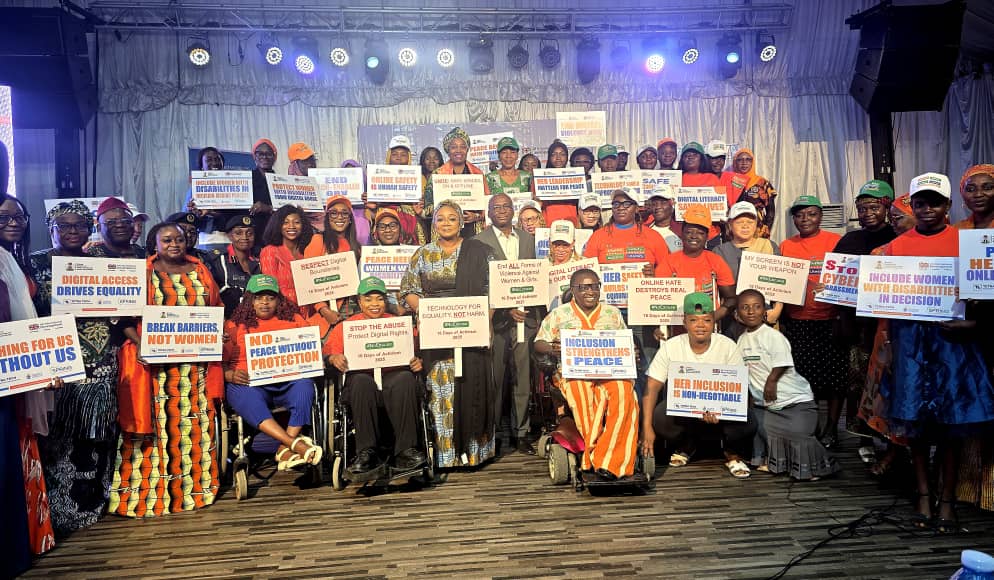
The President of the Network of Women with Disabilities, Lois Auta, shared stark data.
“Almost 69 percent of women with disabilities in Nigeria experience online gender-based violence daily.
“More than 13 percent lack regular internet access, and digital platforms remain largely inaccessible.”
She said that gaps in digital literacy, weak enforcement of disability laws and a lack of assistive technology make online spaces even harder to navigate safely.
The dialogue also highlighted a major policy vacuum.
While Nigeria has strong legal frameworks such as the Discrimination Against Persons with Disabilities Act and a new Third National Action Plan on Women, Peace and Security (NAP III), disability issues remain poorly represented in digital safety policies.
“We need policies that directly protect women with disabilities from digital harm,” Auta said.
The Minister of Women Affairs, Imaan Suliaman-Ibrahim, underscored the urgency in creating safe spaces for women with disabilities digitally.
She said that 2025 carries symbolic weight: 30 years since the Beijing Declaration, 25 years of UN Security Council Resolution 1325 and continued global push for inclusion.
“These commitments are not symbolic; they demand real implementation.
“We cannot talk about peace, security or digital inclusion without centering the voices of women with disabilities,” she said.
Imaan Suliaman-Ibrahim said the silence must end as she unveiled the Women with Disabilities Network for Peace and Security.
She emphasised that Nigeria could not achieve peace, security or digital inclusion while leaving women with disabilities behind.
The minister said the government would soon roll out the Third National Action Plan for Women, Peace and Security (NAP III), which embedded disability inclusion, digital safety and women’s leadership.
Available data indicate that globally, one in six people live with a disability.
In Nigeria, more than 35 million people fit this demographic, nearly 19 million of them women and girls.
She said that studies showed women were two to three times more likely to experience gender-based violence and face systemic exclusion in education, employment, health and security processes.
“These are statistics; they represent dreams and lives that deserve protection,’’ the minister said.
The Chair of the House Committee on Women’s Affairs, Kafilat Ogbara, said the country needed stronger laws, safer infrastructure and fairer representation, echoing the need for systemic reform.
Ogbara said that persons with disabilities must be at the centre of national conversations about security and infrastructure.
“My first motion in the 10th Assembly was for a minimum of 10 percent employment slot for persons with disabilities.”
She reminded the country that inclusive infrastructure benefits everyone.
“Whether president, governor or everyday citizen, we are building a system we ourselves will one day need,” she said.
She also insisted that security agencies must be trained to respond better to persons with disabilities.
Partners from the UK-funded SPRiNG Programme echoed this imperative.
They say that Nigeria’s complex security landscape, climate pressures and rising digital threats require inclusive solutions.
Dr Ukoha Ukiwo, Tetra Tech SPRing Programme Team Lead, said the UK Government, through the SPRiNG programme, partnered with Nigeria to promote peace, stability, and climate change adaptation.
He said the programme supported security, justice, conflict resolution institutions and strengthened community resilience, working in various areas.
“SPRiNG is partnering with the Federal Ministry of Women Affairs and the Network of Women with Disabilities during the 16 Days of Activism.
“The goal is to create a platform to discuss rising threats in the digital space and how they affect women, especially women with disabilities.
“The 2025 global theme is “End Digital Violence Against All Women and Girls; the campaign calls for awareness, prevention, and support for survivors of gender-based violence,” he said.
Ukiwo said that SPRiNG was leveraging the global campaign and the momentum of UNSCR 1325’s 25th anniversary to raise awareness on TFGBV and digital safety and provide platforms for women with disabilities to build digital skills and engage in policy advocacy.
In spite of the aforementioned obstacles, women with disabilities continue to shape online spaces with courage and creativity; they are entrepreneurs, peace builders, educators and leaders.
Experts say Nigeria’s digital future must be safe, accessible and inclusive.
They say protecting women with disabilities online is not charity; it is necessary for justice, equality and Nigeria’s progress.(NAN features)
***If used, please credit the writer and the News Agency of Nigeria.
Comments