


By Mercy Omoike
The Food and Agriculture Organisation (FAO) of the United Nations, and the Lagos State Ministry of Agriculture and Food Systems have partnered to drive investment in the Red Meat and Coconut value-chains.
A roundtable to discuss investment strategies for both value chains, held on Tuesday at Eko Hotels and Suites, Victoria Island, Lagos.
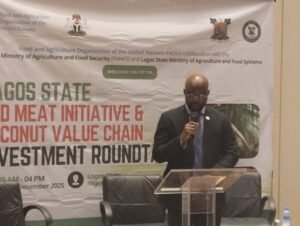
The News Agency of Nigeria (NAN) reports that the two-day Investment Roundtable is aimed at validating key investment proposals under the Lagos State Red Meat Initiative and the Coconut Value Chain Programme.
The roundtable follows extensive technical support provided through the FAO Technical Cooperation Project: “Technical Support for Feasibility and Value Chain Analysis of Lagos State Cattle Feedlot Farm Estate” and the FAO–UNIDO-supported Coconut Value Chain Programme.
Both initiatives have produced detailed economic and financial analyses and investment notes that now require stakeholder support in resource mobilisation and implementation.
Ms Abisola Olusanya, Lagos State Commissioner for Agriculture and Food Systems, appreciated the efforts of the FAO in boosting both value chains’ growth.
Olusanya, represented by the Permanent Secretary, Mr Emmanuel Audu, commended FAO for its continued technical partnership and shared commitment to building a modern, competitive and investment-ready agri-food economy in Lagos.
“Today’s gathering is not just another meeting, it is a deliberate matchmaking platform to translate value chain analysis into bankable investments.
“And to connect financiers with viable projects, and to unlock new levels of productivity, jobs, industrialisation, and food security,” Olusanya said.
She also noted that, “In Lagos State, we are clear-eyed about the realities: our population and consumption demand are growing rapidly, and the food economy must grow with it.
“Lagos is one of Nigeria’s largest consumer markets for beef. The FAO-supported assessment highlights the scale of demand: Lagos State is estimated to require about 1,873,667 heads of cattle annually.
“While local production is far below this need, supply is still largely dependent on inflows from outside Lagos.”
On the coconut value chain, Olusanya noted that Lagos has a strong comparative advantage with about 60 per cent of Nigeria’s domestic coconut output being produced in the state (about 135,000 MT out of 225,500 MT in 2020, whole nut equivalent).
“At the same time, Nigeria still imports large volumes, nearly 400,000 MT (whole nut equivalent) and much of that import flow enters through Badagry.
“This tells us something important: demand is massive, and the opportunity for import substitution and value addition is real, especially if we improve productivity and mature nut availability for processors,” she said.
According to the commissioner, Lagos offers what serious investors look for: a large market, an active private sector, improving infrastructure, and government commitment to reforms.
“In both value chains, the evidence shows that actors can be profitable when systems work efficiently and standards are strengthened.
“Our role as government is clear: to set the rules, enable investments, coordinate stakeholders, protect consumers, and ensure sustainability, so that the private sector can scale,” the commissioner said.
Also, the FAO Representative in Nigeria and ECOWAS, Dr Hussein Gadain represented by Mr Tofiq Braimah, FAO Programme Officer, said Lagos is strategic in engendering Nigeria’s food security.
“This gathering is not just an event; it is a defining moment in our shared commitment to transform agriculture and food systems in Lagos State and Nigeria at large.
“Lagos is more than the economic nerve centre of Nigeria—it is a gateway to regional and global markets, a hub of innovation, and a melting pot of opportunities.
“Lagos occupies a unique and strategic position in the national food value chain. The state influences consumption patterns, drives technological adoption, and sets benchmarks for agricultural modernisation.
“This strategic role gives Lagos the potential to catapult Nigeria’s agricultural transformation,” Gadain said.
According to him, through the Ministry of Agriculture and Food Systems, Lagos has demonstrated bold leadership and unwavering commitment to building a sustainable agri-food system.
Gadain noted that the UN’s FAO is proud to stand with Lagos as a trusted partner on this transformative path, adding that the collaboration is anchored on strategic investment analysis in key value chains.
These value chains include coconut, livestock, and feedlot systems—to attract private sector and multilateral investments.
“These analyses provide evidence-based insights that guide strategic decisions, ensuring investments are impactful, sustainable, and inclusive.
“This initiative is not just about agriculture, it is about building an integrated economic ecosystem that connects production, processing, logistics, and trade.
“By leveraging Lagos’ industrial potential and commercial networks, we aim to unlock new economic opportunities, create decent jobs, and empower the vibrant youth population.
“This approach positions Lagos to fully exploit AfCFTA opportunities, making it a model for agricultural transformation across Africa,” he said.
On his part, the Permanent Secretary of the Lagos state Ministry of Agriculture and Food Systems, Mr Emmanuel Audu, represented by the Director of Veterinary Services, Dr Rasheed Macaulay, said Lagos is ready and up to the task for the investments.
Audu said FAO’s collaboration reflects a shared commitment to moving beyond policy dialogue to practical, investment-driven solutions for food systems transformation. (NAN) (www.nannews.ng)
Edited by Oluwafunke Ishola


Comments