


By Nefishetu Yakubu
The National Institute for Legislative and Democratic Studies (NILDS) on Thursday disclosed plans to host a national summit on elite consensus in the first quarter of 2026.
The Director-General, Prof. Abubakar Sulaiman, made this known during the public presentation of National Survey Report and Commissioned Papers on Elite Consensus Development in Nigeria.
Sulaiman, in his opening remarks, said the summit would afford the elites the opportunity to dialogue on issues geared towards national development.
He described the elite consensus project as nationally strategic, noting that it provided an evidence-based framework for aligning influential stakeholders around critical reforms needed to drive Nigeria’s development.
He said that the event marked the institute’s third major stakeholders’ engagement on catalysing elite consensus, aligning with NILDS’ mandate in research, capacity building, and national development.
According to him, the project began with a methodology workshop in March 2024, drawing academics, civil society actors, and practitioners to shape credible approaches for elite opinion gathering.
He noted that recommendations from the workshop informed a nationwide survey conducted across the 36 states and the Federal Capital Territory, which he said was validated at a workshop in August.
“Findings from the validation exercise were integrated into the final report, now released alongside commissioned papers addressing critical national governance challenges.
“The commissioned papers examined state police frameworks, ethnofederalism and group rights, revenue mobilisation and allocation, and broader issues surrounding elite consensus building in Nigeria,” Sulaiman said.
The director-general appreciated stakeholders, scholars, and participants for their contributions, noting that the project, initiated in 2023, aimed to guide consensus on key national questions.
While acknowledging funding challenges, Sulaiman stressed that national development demanded sacrifice, urging stakeholders to support NILDS in sustaining the project’s momentum.
He commended the project committee chairman, Prof. Attahiru Jega, for dedication in delivering the report and commissioned studies.
He urged participants to engage the findings constructively and contribute to building consensus capable of strengthening Nigeria’s unity, governance, and sustainable development.
On his part, Jega, former INEC chairman and NILDS’s consultant on the elite consensus projects, said the committee began work in February 2024 with a mandate to drive dialogue, research, advocacy, and consensus among elites.
Jega noted that the committee’s objectives included drafting a concept note, to organise inclusive dialogues, produce publishable research, promote public advocacy, and lay groundwork for a national summit on consensus.
He stated that the committee achieved most targets, developing survey methodologies refined in March 2024 through stakeholder workshops involving academics, journalists, civil society, professionals, and partners.
“Dedicated academics from universities nationwide served as coordinators and assistants, administering questionnaires to sampled elites across security, finance, politics, labour, traditional institutions, religion, media, judiciary, entertainment, and academia,” Jega said
According to him, the committee was also commissioned to produce papers on elite consensus, state police frameworks, ethno-federalism, citizenship rights, and revenue mobilisation, allocation, and generation in Nigeria.
In his goodwill message, Mr Ibrahim Olarewaju, Senior Special Assistant to President Tinubu on National Assembly, urged translating findings into constitutional and legal reforms.
Olarewaju pledged government’s continued support for NILDS’ elite consensus project.
Prof. Adeniji Adeyinka of the Department of Political Science, University of Abuja, and Prof. Shola Omotola of the Department of Political Science, Federal University, Oye-Ekiti, reviewed the report.
They described the committee’s work as timely, comprehensive, and critical to strengthening democratic governance and institutional accountability in Nigeria.
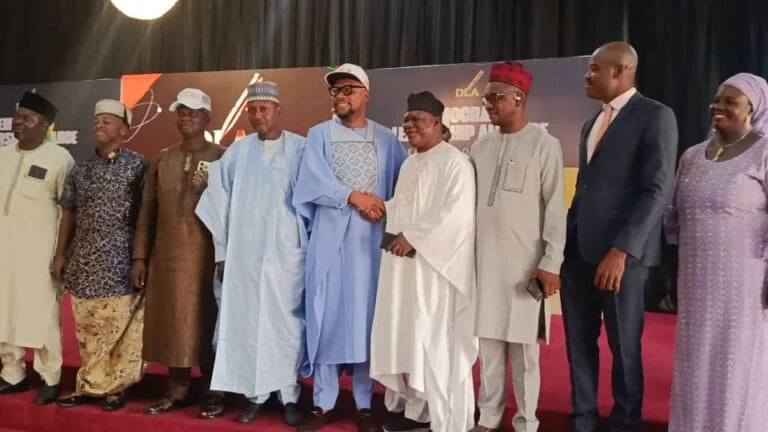
The high point of the event was the official public presentation of the survey report and commissioned papers on NILDS’ elite consensus in Nigeria. (NAN)(www.nannews.ng)
Edited by Kevin Okunzuwa

Comments