

By Olanrewaju Akojede
Barely months after President Bola Tinubu re-established the National Sports Commission in 2024, Nigeria’s sports sector is undergoing a noticeable structural transformation.
The shift marks a clear departure from years of improvised administration towards a more deliberate, policy-driven governance framework anchored on planning and accountability.
For decades, sports administration oscillated between emergency responses and ad hoc decisions, often triggered by international competitions or domestic pressure.
The return of the NSC has reintroduced a governance philosophy that treats sports as a strategic national asset rather than a seasonal or reactive activity.
Stakeholders across federations, athletes’ unions and private partners have described the change as overdue and necessary for long-term sustainability.
Previously, the Federal Ministry of Youth and Sports Development focused largely on administrative coordination, with limited autonomy for specialised sports governance.
Many observers argued that structure weakened institutional memory and blurred accountability across federations and competitions.
The NSC’s reinstatement effectively restored a model many believed was dismantled prematurely, leaving Nigerian sports without clear strategic direction.
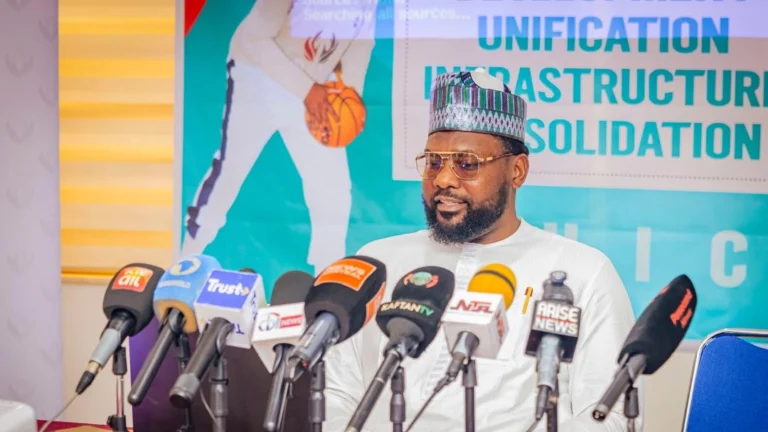
Under Chairman Mallam Shehu Dikko and Director-General Bukola Olopade, the Commission has adopted a measured but firm reform approach.
Rather than loud declarations, the leadership has prioritised institutional adjustments, policy clarity and quiet enforcement of new standards.
Early in 2025, Dikko articulated the Commission’s philosophy, insisting Nigerian sports must move “from emergency management to strategic planning.”
The statement resonated widely, signalling an end to sentiment-driven decisions, last-minute funding releases and rushed athlete preparations.
It also suggested a cultural shift within federations, long accustomed to crisis management instead of structured annual planning.
In practical terms, the NSC moved quickly to align personnel deployment with its reform agenda.
A directive was issued mandating the Federation Establishment and Appointment Department to implement new postings across sports federations.
The reassignment of 57 Secretary-Generals and five officers aimed to strengthen institutional capacity and improve operational efficiency.
According to Commission officials, the move was not punitive but corrective, designed to match skills with evolving governance demands.
The reorganisation also sought to align federations with priorities such as grassroots development, elite performance and sports economy growth.
One of the earliest public tests of the NSC’s resolve was the organisation of the National Sports Festival.
Historically plagued by postponements and funding delays, the festival often symbolised administrative weaknesses within Nigerian sports.
In 2025, the Commission ensured the festival held as scheduled, restoring confidence among states and athletes.
Ogun hosted what many stakeholders described as one of the most organised editions in recent history.
Gateway Games 2025 featured over 10,000 athletes representing 36 states, the Federal Capital Territory and the Invited Junior Athletes team.
Competitions spanned 33 sports, with improved logistics, accommodation and scheduling drawing praise from participants.
Beyond organisation, the NSC enforced integrity standards previously ignored or weakly applied.
The Commission openly rejected the culture of “fire brigade” preparations that had defined previous festivals.
Athletes with unresolved anti-doping issues were disqualified from medal contention, in strict compliance with WADA regulations.
The decision followed joint meetings of the Main and Local Organising Committees, underscoring collective responsibility and due process.
Observers noted the stance sent a strong signal that credibility would no longer be sacrificed for medals.
Another significant milestone was Nigeria’s hosting of the 3rd African U18/U20 Athletics Championships in Abeokuta.
Held from July 16 to July 20, 2025, the event tested Nigeria’s capacity to deliver international competitions efficiently.
Olopade described securing hosting rights as a “win-win” for sports development and economic growth.
He explained that hosting events locally builds technical capacity while stimulating tourism, commerce and infrastructure development.
The approach aligns closely with the Federal Government’s Renewed Hope Agenda, which emphasises domestic value creation.
Preparations covered accommodation, transportation, feeding, technical services and comprehensive media logistics.
Over 50 African countries participated, with teams arriving days ahead of competition, boosting local economic activity.
The successful hosting further enhanced Nigeria’s reputation as a dependable hub for continental sporting events.
Private sector confidence was evident through sponsorship from organisations including FIRS, BOI and LEDCO Ltd.
Such partnerships reflect growing corporate interest driven by clearer governance structures and accountability.
Beyond events, the NSC initiated deeper governance reforms within sports federations.
Federations were encouraged to appoint Chief Operating Officers to separate administrative, technical and financial responsibilities.
The reform addresses longstanding issues where officials combined multiple roles, often creating conflicts and inefficiencies.
Strategic meetings were also convened to resolve persistent federation disputes that previously embarrassed Nigeria internationally.
Grassroots development emerged as a central pillar of the Commission’s reform agenda.
The Invited Junior Athletes Scheme introduced a new pathway for identifying and fast-tracking exceptional young talents.
Under the scheme, junior athletes competed alongside state teams at the National Sports Festival.
The exposure accelerated their transition to elite sport and provided early experience of high-pressure competitions.
Dikko disclosed that selected athletes would represent Nigeria at upcoming African Youth Games.
He also revealed that 65 athletes currently benefit from the “Adopt-An-Athlete” initiative.
The programme is privately funded and managed by the Elite Athletes Development Podium Committee.
Athlete welfare remained another defining focus area throughout 2025.
The NSC ensured prompt compensation for athletes representing Nigeria in international competitions.
At the African Weightlifting Championship in Mauritius, Olopade personally donated 3,800 dollars to athletes and officials.
The gesture reinforced official assurances that athlete welfare remains central to the Renewed Hope Agenda.
Improved welfare coincided with stronger international performances across multiple sports.
Nigeria fielded teams simultaneously in Morocco, Algeria, Côte d’Ivoire and Wales.
D’Tigress claimed the 2025 FIBA Women’s AfroBasket title, reaffirming continental dominance.
Para-badminton star Eniola Bolaji won gold at the British and Irish Para-Badminton International in Wales.
Team Nigeria also impressed at the maiden African School Games in Annaba, Algeria.
A 60-member student-athlete delegation competed across 10 sports, gaining valuable international exposure.
In football, the Super Falcons completed their historic “Mission X.”
They won a record 10th Women’s Africa Cup of Nations after a dramatic 3–2 comeback victory.
Nigeria also asserted dominance in arm wrestling at the African Championship in Abuja.
At the Islamic Solidarity Games in Riyadh, Rafiatu Lawal won three gold medals in weightlifting.
Collectively, these results reflect the cumulative impact of governance stability and better preparation.
Through hosting events, reforms, partnerships and youth development, the NSC is reshaping Nigeria’s sports economy.
Facilities are being revived, investments attracted, jobs created and development pathways strengthened.
While the Dikko–Olopade era is still unfolding, its early impact is already visible.
Sustained progress will depend on continuity, discipline and institutional respect for established reforms.
One reality, however, is increasingly clear: Nigerian sports is no longer drifting, but being deliberately rebuilt. (NAN) (www.nannews.ng)
Edited by Kamal Tayo Oropo
Dxd Global | Development dxd global, global dxd, deluxe bilisim, deluxe global, IT solutions, web developer, worpress global, wordpress setup