









By Emmanuella Anokam
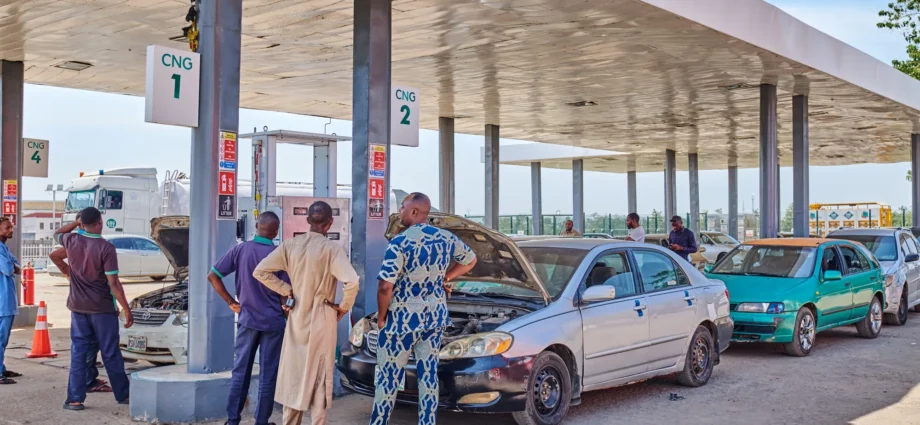
The regular long queues witnessed at various Compressed Natural Gas (CNG) refilling outlets seem to be easing off, following the inauguration of more stations in the FCT.
A correspondent of the News Agency of Nigeria (NAN) who went round the town to monitor situation discovered that additional four new stations were inaugurated in the FCT.
NAN reports that the new infrastructure are situated at the NNPC filling station, opposite Shoprite, along Airport Road, NNPC behind Russian Embassy, Central Business District, Mobil by Madalla Junction and Shafa, Lugbe, along Airport Road.
The development had drastically decongested most of the refilling stations that usually encounter long queues.
Nobody stays more than one hour on queue for CNG because of its availability, especially as the price of Premium Motor Spirit (PMS), known as fuel is also coming down.
Some motorists who spoke to NAN said they no longer spend the whole day waiting to refill their vehicles, as the development had helped to ease its supply.
Mr Timothy Amadi, an Uber driver, said he no longer spend up to one hour on CNG queue, unlike few months ago where he usually spent up to eight hours.
Amadi said the availability of the CNG being sold at N380 per Standard Cubic Metre (SCM) was necessary to make the impact of its affordability and utilisation felt by users.
Mr Sunday Aliyu, another motorist expressed satisfaction over the development, adding that it brought a relief from the ugly experience and untold hardship motorists encountered during the constant CNG queues.
“More refilling stations are coming up in the first quarter of 2026 with NIPCO’s inauguration of its Mabushi station and the NASENI centre along Kubwa expressway,’’ he added.
Another motorist, Mr Abdul Al-amin also observed that the recent availability of the product and reduction in the fuel price had contributed to the normalcy being experienced.
According to him, MRS fuel stations belonging to Dangote sells PMS at N739, thereby making a lot of people to pick interest in PMS oce again.
He aid most Uber drivers even preferred buying PMS at that price to queuing to buy CNG.
NAN further checks revealed that the NNPC retail outlets sell PMS at N815 from N835 of previous week, while AA Rano sell at N820 from N840 of previous week.
Mr Zayyanu Tambari, Chief Compliance Officer, Presidential Initiative on Compressed Natural Gas (PiCNG) and Electric Vehicles (EVs),, had told NAN that queues signaled growth, not failure.
Tambari, said the queues formerly witnessed at some CNG retail outlets across the country were a sign of success, not a setback, reflecting the growing demand created by the Federal Government’s CNG adoption drive.
He recalled that when President Bola Tinubu unveiled the PiCNG programme in 2023, Nigeria had very limited CNG infrastructure and extremely low demand.
“At the time, there were very few CNG facilities in the country, and demand was minimal. One of our first tasks was to deliberately create aggregate demand,” Tmbari said.
He explained that it introduced a Conversion Incentive Scheme, which led to the establishment of multiple conversion centres nationwide and the distribution of CNG conversion kits, some provided free of charge and others at concessionary rates.
According to him, the queues observed then are a direct result of th demand created over the past two years.
He said queues could look like a challenge, but they were actually a positive problem, showing that demand now existed, with clear opportunity for private sector investment.
According to him, the PiCNG programme is designed to be private sector-driven, and once demand is visible, supply naturally follows.
He cited Abuja as a clear example of progress.
“Two years ago, Abuja had just one or two active CNG retail outlets. Today, we are looking at more than 10 active outlets, and the number continues to grow,” he said.
Tambari acknowledged that running CNG facilities involves multiple challenges, including technical, commercial, operational, and regulatory issues, but assured Nigerians that the Initiative is actively engaging operators to resolve bottlenecks.
“Any facility that is fully commissioned and licenced will be supported. Where there are issues around gas supply or operations, we are engaging with companies to resolve them as quickly as possible so more facilities can dispense gas,” he added.
On Electric Vehicles (EVs), Tambari said EVs deployment remained a key component of the Initiative, adding that it would make EVs adoption sustainable in Nigeria.
NAN reports that the initiative recently inaugurated 40 electric vehicles as it unveiled its 2.0 and electric mobility programmes in Dec. 2025, aimed at expanding nationwide transition to cleaner and more affordable transport energy.
He added that the Initiative was working with private sector partners and original equipment manufacturers (OEMs) to promote local production of EVs, improve affordability, boost charging infrastructure and electricity supply. (NAN)(www.nannews.ng)
Edited by Ese E. Ekama-WILLIAMS