






By Usman Aliyu
The Managing Director of the News Agency of Nigeria (NAN), Malam Ali Mohammed Ali, has called for deeper inter-agency cooperation and stronger African-led storytelling to counter decades of distorted global narratives about the continent.
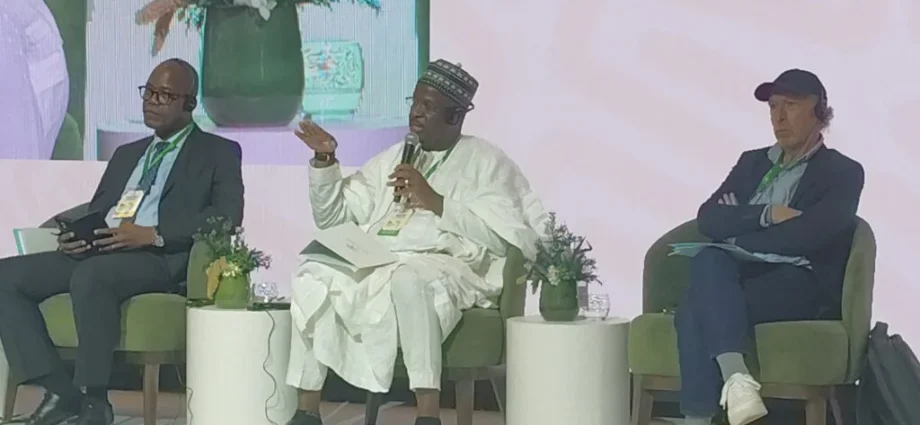
Ali spoke during a high-level panel titled “Giving a Voice to Territories: the Role of the Media in Building an Inclusive Africa” at the ongoing 9th General Assembly of the Atlantic Federation of African Press Agencies in Marrakech, Morocco, on Wednesday.
The NAN boss said African countries had for too long relied on external media “hegemons” to tell their stories.
This, he said, often resulted in imbalanced portrayals that emphasise conflict, poverty, and crisis while ignoring progress, innovation, and everyday realities across the continent.
“For years, African nations waited for others to tell their stories.
“That is gradually changing with the reawakening of African media and platforms like FAAPA, where Africans tell African stories from African perspectives,” he said.
Drawing from NAN’s operational model, he explained that inclusivity begins with visibility at the grassroots.
According to him, the agency deliberately moves stories “from the hinterland to the national stage, and from the national to the international stage,” ensuring that local voices were not excluded from global discourse.
Nigeria, he noted, with over 200 million people, presented both a challenge and an opportunity for inclusive reporting.
He said maintained 1correspondents across all 36 states and more than 100 reporting districts to ensure fair territorial representation.
“The idea is to give everyone a sense of belonging and fairness.
“Every part of the country deserves visibility,” he said.
Ali highlighted NAN’s growing partnerships with other African and global news agencies, singling out its collaboration with Morocco’s national news agency as a milestone.
He said the agreement, signed in recent years, had strengthened news exchange, professional training, and cultural understanding.
“Our partnership with the Moroccan news agency has helped amplify African stories and deepen capacity building,” he said, citing the recent long-term training of a NAN photographer in Morocco as a practical outcome of such cooperation.
He, however, acknowledged that language remained a major barrier to deeper inter-African media collaboration, particularly for Nigeria, which is surrounded largely by francophone countries.
“Language limitation has hampered our operations. Sometimes, we rely on foreign media to tell stories from neighbouring African countries because of this gap,” he said.
To address this, he said NAN had begun recruiting and training bilingual reporters and was gradually expanding its foreign-language desks beyond English.
“It is work in progress,” he said, adding that future plans included strengthening French and Arabic language capacity to reduce dependence on non-African sources.
Ali also criticised what he described as persistent misrepresentation of Africa in global media narratives, where struggles for self-determination were framed through biased language and African governance models judged against rigid external standards.
“Unless Africa fits into a one-size-fits-all model, its democracy is questioned.
“Achievements in education, technology, and healthcare are often ignored, while negative stereotypes are amplified,” he bemoaned.
He cited the significant contribution of African professionals, particularly Nigerians, to global health systems as an example of stories that rarely receive adequate attention.
The NAN MD stressed that press agencies occupy a strategic position in bridging governments, local authorities, and citizens, and in simplifying complex policies so they could be understood by ordinary people.
“Our role is to break down complex ideas and make them meaningful to citizens.
“That is how the media becomes a catalyst for social cohesion and good governance,” he said.
He concluded that stronger collaboration among African press agencies remained key to unlocking the continent’s narrative power.
“Inter-agency cooperation expands storytelling frontiers.
“It is how Africa will reclaim its voice and shape its own image in the global information space,” he said. (NAN) (www.nannews.ng)
Edited by Olawunmi Ashafa