


By Deji Abdulwahab
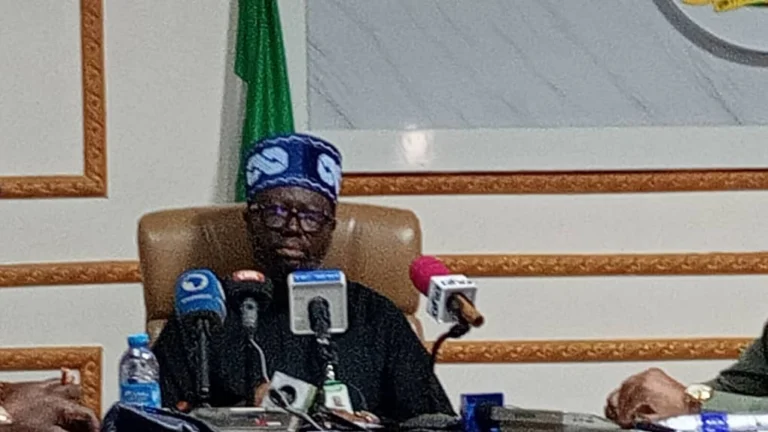
Boss Mustapha, former Secretary to the Government of the Federation (SGF), says the biography of Hajia Bilikisu Bashir, the pioneer Secretary, Federal Judicial Service Commission (FJSC) is Nigeria’s judiciary memory.
He said that Bashir’s biography “The Woman I Know” had contributed to Nigeria’s institutional memory, recording experiences within the judiciary’s challenges, internal dynamics, and moments of progress.
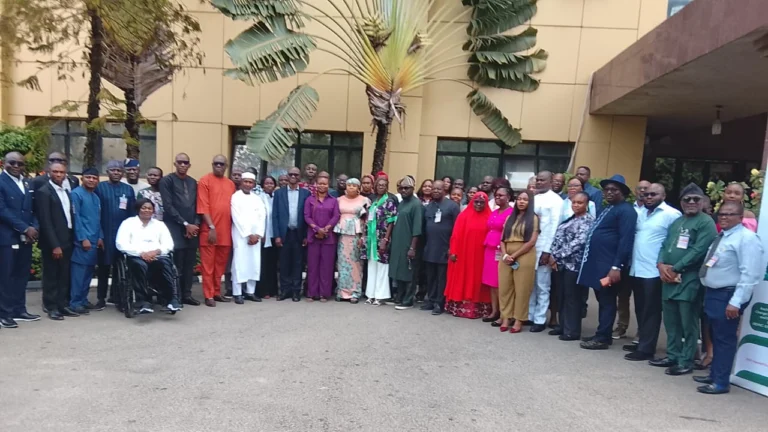
Mustapha said this on Wednesday at the Public Presentation and Formal Reading of Hajia Bilikisu Bashir’s Biography “The Woman I Know” in Abuja, where he served as chairman.
The News Agency of Nigeria (NAN) reports that Hajia Bilikisu Bashir was appointed the foundational Secretary by the FJSC under the chairmanship of Hon. Justice Lawal Uwais, then Chief Justice of Nigeria, in 2001.
The former SGF said that the book helped to preserve lessons that might otherwise be lost.
According to him, one of the strongest contributions of the book is its focus on leadership as an institutional practice rather than a personal performance.
“At the FJSC, the responsibilities associated with recruitment, discipline, and administration required a careful balance between discretion and rules, firmness and fairness, authority and restraint.
“These are not matters that attract public attention, but they are central to institutional credibility.
“The book shows that leadership in such contexts is cumulative. It is built through consistency, attention to detail, and the willingness to carry responsibility without seeking visibility,” he said.
Mustapha said that the lesson was relevant, not only to the judiciary but to the public administration more broadly.
According to him, a recurring theme in the narrative is humility, not as posture but as conduct.
“The humility described in this book coexists with authority.
“It is expressed through accessibility, listening, and a willingness to engage with others without diminishing one’s office. It does not weaken decision-making, rather it grounds it.
“In public life, humility of this kind often provides the discipline required to manage power responsibly.
“It allows institutions to function without being overshadowed by personalities, and it fosters trust without eroding standards,” he said.
He said that another important thread in the book was the emphasis on institutions outlasting individuals.
“That fact has been properly advanced in the context of this book.”
Speaking on the role of biographies in national development, Prof Udenta Udenta, who was the keynote speaker, said that the role of history was critical in elevating our public consciousness.
Udenta said that it helped in bringing together the soul of a nation and helping that soul to grow.
“This book, therefore, tells the story, not only of Hajia Bilikisu Bashir, it tells the story of an era, and it tells the story of the nation.
“That is very important for us to understand what she has done with the team of authors that helped her do this work.
“In that sense, what her work represents is some tension between what we call historical periodisation.”
The book reviewer, Dr Lizzy Iheanacho, modelled Bilikisu Bashir’s leadership style on creating, projecting, protecting and preserving what she terms the FJSC family.
“Indeed, the word family appears no less than 50 times in the book. I counted.
“It was her duty to be the mother of the FJSC family. Her staff were members of this family and her duty to them went beyond the boundaries of official responsibility.
“It was stretching into all areas of life that enabled them to be their best and to give their all to the organisation that she was nurturing.
“This attribute was recognised, applauded and won her accolades such as Mama Nigeria Judiciary.”
Bashir was born in Okene in present day Kogi, into some of the two most prominent and distinguished lineage in Ebira land, the Atta and Ajanah families.
She was married to Engineer Mohammed Bashir Karaye, a native of Karaye in Kano State.
Upon her husband’s death, she immortalised him by instituting a literary prize in his honour, the famous, but now rested Engineer Bashir Karaye Prize for Hausa Literature.
A passionate lover of the arts, promoter of literature and literary activities, she is a recipient of numerous literary awards in recognition of her patronage of the arts.
The groups include the Abuja Branch of the Association of Nigerian Authors.
She also received an award at Minna from Northern Nigeria Writers Association for her contributions to the development of literature in indigenous language. (NAN)
Edited by Kadiri Abdulrahman

Comments