


By Felicia Imohimi
ActionAid project, Strategic Partnership for Agroecology and Climate Justice (SPAC–West Africa), has supported more than 12,000 women farmers and youths in FCT with agroecology known as organic farming.
Mrs Hajara Ramson, Project Lead, SPAC–West Africa, Nigeria, disclosed this at the stakeholders Campaign and Advocacy on Land Ownership and Market Access for Smallholder Women Farmers (SHWFs) and Young Farmers in FCT on Thursday in Abuja.
Ramson said that the project had supported over 12,000 women farmers and youths across the six Area Councils of the FCT in the past three years, through agroecology capacity building and Training of Trainers (ToT).
She said that the gesture had resulted in improved sustainable farming practices and strengthened community resilience.
“We were able to get this number through cooperatives.
“We mobilise cooperative heads, and in the first batch in 2023, trained 80 women and they in turn trained 50 each, giving us a total of 4,000.
“We did the same in 2024 and 2025. In total, we have 12,000 women and youths that have expertise in agroecology,” she said.
She said that though the project had ended, there was need to scale it up to ensure enough organic food to safeguard the health of citizens in the country .
“We want government to join forces with the smallholder farmers that have been trained to ensure that there is ripple effect in communities and the country at large,” she said.
Ramson, however, said that while production had improved, many SHWFs and young farmers were still unable to fully benefit economically.
She said that this was due to persistent insecure access to land and limited access to structured and profitable markets.
“without clear and secure land rights, women farmers cannot sustainably invest in agroecological farming.
“More importantly, without reliable market linkages, fair pricing and inclusion in formal supply chains, increased production does not translate into increased income, improved livelihoods, or economic empowerment.
“This gap continues to limit the ability of SHWFs and youths to build resilient livelihoods and contribute meaningfully to local food systems.”
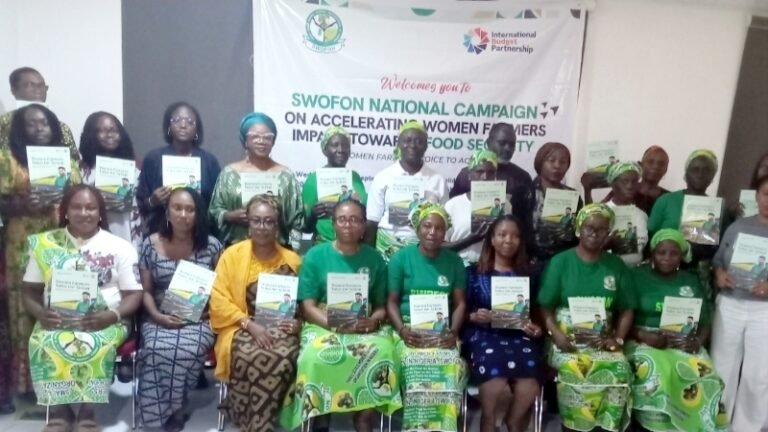
She said that SPAC–West Africa, Nigeria, with support from ActionAid’s International Transformative Impact Fund (TIF) was being implemented in collaboration with the Small-Scale Women Farmers Organisation in Nigeria (SWOFON).
According to her, this group accounts for over 500,000 rural women farmers across the 36 states of the federation, contributing over 75 per cent to the country’s food basket.
She said that the group worked to promote sustainable agriculture, rural economic development, and improved livelihoods, through capacity building, advocacy, and engagement with duty bearers on behalf of smallholder women farmers.
Ramson said that SPAC was initiated to address the lingering challenges posed by unwholesome and unhealthy farming practices like the use of synthetic fertiliser, hazardous chemicals for weed control among others in food production.
She listed challenges posed by such practices as land degradation and unhealthy food production, thereby endangering the health of the general public and compounding the country’s disease burden.
According to her, the stakeholders’ campaign and advocacy is to have a robust conversation and ensure that women farmers own lands and have access to market for food secured nation.
Alhaji Kana Shuaibu, District Head of Abaji, commended ActionAid for empowering women and youths in agroecology practices.
Shuaibu called for the extension of the project to accommodate more people and enable beneficiaries to attain the desired height.
Representing the Onna of Abaji, he acknowledged the availability of vast farmland in the southern parts of Abuja.
He urged women farmers to harness themselves by forming clusters to have access to land.
He further urged them to cascade the knowledge gained in their various communities.
Mrs Olabisi Ogedengbe, SWOFON Coordinator, Gwagwalada, speaking on behalf of some beneficiaries of SPAC project, said through agroecology practice, she had sustainable vegetable production and more patronage in terms of market.
Ogedengbe said that with organic farming, her pumpkin, popularly known as Ugu, could stay for days without getting spoilt after harvesting, unlike the chemical farming that usually turns yellowish within a day. (NAN)(www.nannews.ng)
Edited by Ifeyinwa Okonkwo/Kadiri Abdulrahman


Comments