


By Sumaila Ogbaje, News Agency of Nigeria (NAN)
For decades, the oil-rich creeks of the Niger Delta symbolised both Nigeria’s economic lifeline and one of its gravest national security challenges.
Vast mangrove forests concealed illegal refineries, crude oil thieves and armed criminal networks that siphoned national wealth, devastated the environment and undermined investor confidence.
Today, however, a decisive shift is underway.
Recent media tours of Operation DELTA SAFE formations across Rivers and Bayelsa States reveal a more coordinated, intelligence-driven and technologically enabled military campaign that is steadily tightening the noose around crude oil theft syndicates.
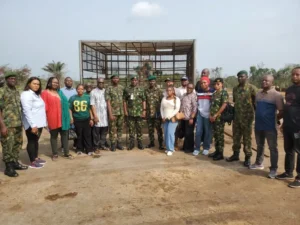
At the heart of this renewed push is Operation DELTA SAFE (OPDS), the joint land, maritime and air task force mandated to secure Nigeria’s oil and gas infrastructure.
From the creeks of Southern Ijaw to the oil corridors of Rivers, troops now dominate areas once considered impenetrable.
The General Officer Commanding (GOC), 6 Division, Nigerian Army, Maj.-Gen. Emmanuel Emekah, disclosed during the tour in Port Harcourt that the Division had recorded zero incidents of pipeline vandalism within its Area of Responsibility in the last one year.
“Since I assumed command on Jan. 24, 2025, we have recorded zero cases of violent pipeline vandalism. No oil company has reported any breach due to vandalism within this period,” Emekah said.
According to him, the achievement was the result of sustained patrols, intelligence-led operations, community engagement and close inter-agency collaboration.
He noted that Nigeria’s crude oil production, which averaged 1.4 to 1.5 million barrels per day before 2025, rose to about 2.2 million barrels per day by December 2025, attributing the improvement largely to enhanced security.
For the Division, Emekah said, the performance of the oil and gas sector remains a key indicator of operational success, stressing that most oil leakages now recorded were due to aging infrastructure rather than sabotage.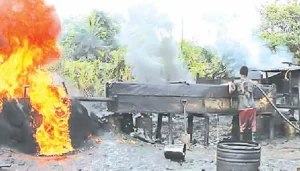
A recurring theme from commanders across OPDS formations is the shift from routine patrols to precision, intelligence-driven operations.
Oil thieves, according to Emekah, have grown increasingly sophisticated, laying long hoses from pipelines into remote creeks and communities and restricting waterways to evade detection.
“We have learnt that destroying illegal sites alone is not enough. That is why we revisit cleared locations repeatedly to ensure they are not re-established,” he said.
Beyond dismantling camps, the Army now targets the support ecosystem; markets, logistics chains and community enablers that sustain illegal refining.
“If there is no market, there will be no production. Once we disrupt patronage, the operations collapse,” the GOC added.
On the Rivers–Bayelsa boundary, troops of 16 Brigade Nigerian Army have dislodged oil thieves from the once-notorious Adibawa oil well area, concluding plans for a permanent military deployment to prevent resurgence.
The Acting Garrison Commander, Maj. Hassan Mohammed, explained that the swampy terrain posed operational challenges but had not deterred troops.
“Our objective is to project forces deep into the forest. As criminals retreat further into the bush, we pursue them relentlessly,” he said.
Plans include deploying gunboats, a houseboat, land troops and surveillance drones, in synergy with the Nigerian Air Force, to ensure year-round dominance of the strategic oil facility.
On the maritime front, the Nigerian Navy Ship (NNS) SOROH, operating under Central Naval Command and Sector 2 of OPDS, has recorded significant successes across Bayelsa waterways.
Between January 2025 to date, the Commanding Officer of NNS SOROH, Commodore Omobamidele Akinbami, said the base had deactivated over 12 boats, dismantled more than 15 illegal refining sites and handled millions of litres of suspected stolen and adulterated petroleum products.
Sustained naval pressure, he noted, had forced oil theft syndicates to move smaller quantities using smaller boats, even as naval patrols remained relentless.
NNS SOROH has also recorded successes against piracy, militancy and kidnapping, including swift operations that led to the release of abducted victims unharmed.
Beyond kinetic actions, the Navy has sustained non-kinetic engagements, including medical outreach, peace-brokering and flood mitigation, helping to build trust with host communities.
Air operations have played a decisive role in reshaping the operational landscape.
The Air Component of OPDS destroyed 131 illegal refining sites in 2025 alone, while conducting 495 missions in 779 sorties, logging over 784 flight hours.
Assets deployed included T-129 ATAK helicopters, Wing Loong II UCAVs, EC-135 helicopters and Diamond-62 aircraft, which enabled deep intelligence, surveillance and reconnaissance missions.
The Commander, 115 Special Operations Group, Group Capt. Abdulafeez Opaleye, said air power had denied criminals freedom of action and created psychological pressure that forced many to abandon camps.
“Oil theft has become sophisticated, but when oil production improves, the entire nation benefits,” he said, urging sustained community cooperation.
The Commander of OPDS, Rear Adm. Olugbenga Oladipo, warned that criminals were shifting from open refining to chemical adulteration and exploiting remote wellheads.
In response, OPDS has recalibrated its intelligence focus, tracking chemical supply chains and increasing surveillance around vulnerable wellheads.
He disclosed that OPDS conducts at least two major operations daily, in addition to routine patrols, stressing that operations do not pause for weekends or holidays.
To address disputes between oil companies and host communities, OPDS has also established a Situation Room and Mediation Centre, which recorded peak engagements in December, preventing disruptions to production.
Throughout the tour, the Director of Defence Media Operations, Maj.-Gen. Michael Onoja, emphasised transparency, accountability and strategic communication.
He described journalists as “partners in progress” and “heroes of democracy,” noting that accurate reporting builds public trust and counters adversarial narratives.
“The confidence and trust of the civilian population are critical to operational success,” Onoja said, stressing that security remains a collective responsibility.
From land to sea to air, the renewed military push in the Niger Delta signals more than improved security.
Stakeholders say that this reflects a coordinated national effort to protect Nigeria’s economic lifelines, restore environmental sanity and rebuild investor confidence. (NANFeatures)
***If used, please credit the writer and the News Agency of Nigeria.


Comments