









By Angela Atabo
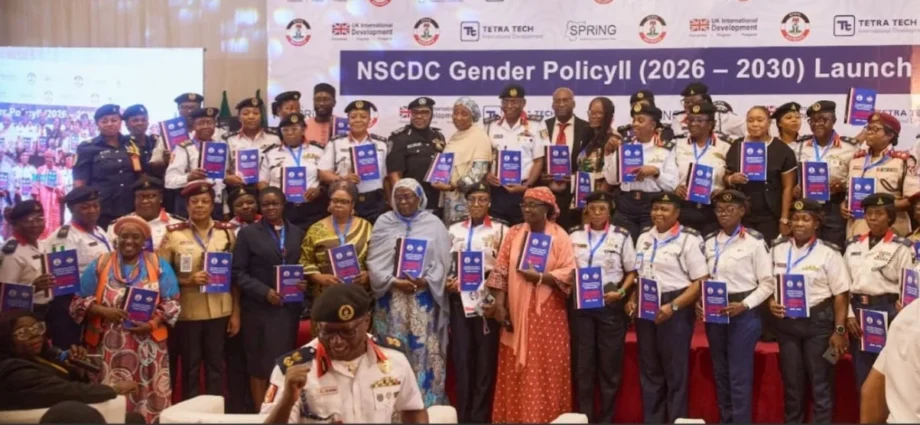
UK-funded programme, Strengthening Peace and Resilience in Nigeria (SPRiNG Programme) has partnered with the Nigeria Security and Civil Defence Corps (NSCDC) to inaugurate its Gender Policy 2 for 2026–2030.
Dr Ukoha Okiwo, Team Leader of SPRiNG, at the policy launch event in Abuja, said SPRiNG was committed to strengthening government institutions, security agencies and community actors with mandates in peace building and security.
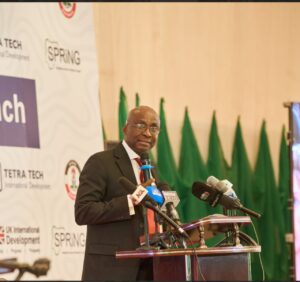
According to him, what SPRiNG seeks to achieve in partnership with government institutions is to enhance capacity of institutions to deliver their services in more inclusive, participatory, transparent, accountable and effective ways.
He said, “We believe that if this is done, members of the public will have enhanced confidence in what they do and partner with them to deliver on their mandates.
“Through this, individuals and actors will have lesser disposition to resorting to self-help which, as we know, results in violence.”
Okiwo explained that one key area of SPRiNG’s work was in promoting the participation of women, youths, persons with disability and minorities in all spheres of life, in peace building and in governance.
He added, “We are also keen to work with security services to ensure that in the delivery of their mandates civilian protection is recognised, human rights is protected and there is cordial relationship with communities and members of the public.
“We see, therefore, this initiative of the gender policy as driving that agenda and aligning with the objectives of the programme.
“We are happy to note that the adoption of this gender policy coincides with the adoption of Nigeria’s Third National Action Plan on Women, Peace and Security as well as plans also to adopt a National Action Plan on Youth, Peace and Security.”
Okiwo, therefore, hoped that through gender policy, the NSCDC would ensure that the objectives of the key national commitments would be achieved in its efforts.
He emphasised the importance of gender responsiveness to addressing matters of security to cover all gender, age and groups in Nigeria.
He expressed hope that the policy would help the NSCDC in playing a key role in prevention, in reporting, in protection, as well as in prosecution of those who undermine rights, who violate the rights of women, and who engage in sexual and gender-based violence.
Ms Gill Lever, Deputy High Commissioner of the British High Commission in Abuja, praised NSCDC’s leadership for its commitment to gender responsiveness.
Lever said that the revised policy was evidence-based and inclusive, addressing technology-facilitated gender-based violence, disability inclusion, and gender-responsive budgeting and accountability.
According to her, a policy is meaningful only when it moves from paper to practice.
She added that strong leadership, adequate resources, continuous learning, and collective accountability would be essential for this policy to reach its full potential.
Lever added, “The women and girls’ agenda is very important to the UK government. We think it is very important that the rights of women and girls are protected and that we also have inclusive policymaking where women and girls have the ability to say what is important to them.
“We also understand that it is very well evidenced when you bring women and girls into policymaking, whether it is in the security sector or whether it’s in political life, you get much better outcomes.
“You get more accountability, you get to growth in GDP, you get less conflict, more peace, much better outcomes, better special social and economic policies for countries.”
Lever called for the need to include women wherever possible in the national life and politics adding that it would be Nigeria’s great leap forward, economically and politically, bringing women and girls into policymaking.
She said, “I am very hopeful that women will have their rightful place in public life in Nigeria.
“Women are nearly 50 per cent of the population here, but you only account for less than five per cent of the seats in the National Assembly and only 13 state assemblies have women in them.
“So, women are woefully underrepresented in political life and all works of life.
“So, I hope that with the gender policies and national action plans, women will find their voice, be given a voice, be given more of a platform, because it could really lead to better outcomes at a national level.”
Also speaking, the Minister of Interior, Dr Olubunmi Tunji-Ojo, represented by the Commandant General of NSCDC, Prof. Ahmed Audi, said the first gender policy in the country was championed by NSCDC born from a desire to create an inclusive platform for women in the security sector.
Tunji-Ojo said having seen through years, gaps were realised, thus the need for a review and a second gender policy and commended SPRiNG for the support.
He added that since the establishment of the NSCDC Gender Policy, the corps has enjoyed more inclusive participation among others.
“We have seen women achieve greatly in our service, and this policy gives them a formidable chance to compete equally,” he said.
In her remarks, the Minister of Women Affairs, Hajiya Imaan Suleiman-Ibrahim, represented by a Director, Ms Ola Erinfolami, commended NSCDC and SPRiNG for the policy’s focus on preventing sexual and gender-based violence, promoting women’s participation in decision-making, and creating safe and supportive work environments.
She said, “This policy is a crucial step towards creating a more inclusive and effective security sector”, urging all stakeholders to support its implementation. (NAN)(www.nannews.ng)
Edited by Bashir Rabe Mani