


By Tosin Kolade, News Agency of Nigeria (NAN)
Nigeria’s efforts to provide safe water and sanitation to millions of citizens have suffered a major setback following a broad suspension of United States Agency for International Development (USAID) programmes.
Reports indicate that Nigeria’s access to a 602.95 million dollar grant for 2025 has become uncertain after a temporary freeze of USAID activities was instituted to review U.S. foreign assistance programmes.
This freeze, ordered by U.S. leadership in January 2025, affects funding previously expected for a range of development initiatives, including health and basic services.
While this figure refers to overall USAID funding and not water and sanitation alone, it reflects the scale of potential reductions in development assistance.
Such cuts could indirectly affect the Water, Sanitation, and Hygiene (WASH) sector, especially when multi-sectoral programmes lose support.
Historically, Nigeria has been one of the top recipients of USAID support in Africa, with total assistance reaching about 876 million dollars in 2024, covering health, water supply, and sanitation projects.
Global reports have highlighted that cuts in U.S. foreign aid have left water and sanitation projects, including boreholes, irrigation schemes, and wells half-finished, forcing work to halt and leaving communities without promised infrastructure.
Although these reports do not specifically mention Nigeria, they illustrate the real consequences of funding freezes on WASH initiatives worldwide.
Moreover, local reports from northern Nigeria suggest that the 90-day suspension of humanitarian aid has led to job losses among volunteers and staff working on WASH, health, and other development interventions, underscoring the human cost of halted funding.
This development comes as Nigeria’s WASH sector operates at just a quarter of the resources needed to save lives.
With less than five years remaining to achieve the Sustainable Development Goals (SDGs), especially SDG 6, experts warn that urgent action is required.
This urgency also aligns with the African Union’s 2026 theme, “Assuring Sustainable Water Availability and Safe Sanitation Systems to Achieve the Goals of Agenda 2063”.
Experts emphasise that water and sanitation are more than technical or environmental issues; they are critical to economic stability, public health, and peace.
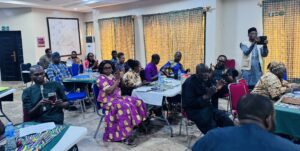
At the opening of a two-day Stakeholders Forum on Developing a Resource Mobilisation Strategy for Nigeria’s WASH Sector, Mr Benson Attah, the National Coordinator of the Society for Water and Sanitation (NEWSAN) described the sector as being in a “state of emergency”.
“Vision without funding is a hallucination; to meet SDG 6 targets by 2030, Nigeria requires an annual investment of approximately 1.30 per cent of GDP.
“Yet, we are currently investing only 0.32 per cent. This means we are funding a mere quarter of what is needed to prevent the 250,000 preventable deaths each year due to poor hygiene, inadequate sanitation, and contaminated water.”
He warned that the funding freeze has immediate consequences.
According to him, ongoing rural water schemes have stalled, and technical gaps have emerged following the loss of international support for laboratory networks and supply chain management.
He said that projects previously backed by external grants were currently struggling to secure operational and maintenance funds.
The forum, convened by NEWSAN, seeks to chart a new path for domestic resource mobilisation, stronger public-private partnerships, and community-driven solutions.
“If the treasury cannot fund it alone, we must look to the market and the community; no single agency can fix a dry tap. A whole-of-society approach is essential,” Attah said.
The national coordinator urged government agencies, civil society, development partners, and the private sector to work together to ensure universal access to safe water and dignified sanitation.
Speaking virtually at the forum, Mr Kevin Roussel, Head of the Country Engagement Team at Sanitation and Water for All (SWA), observed that the financial landscape for development in low- and middle-income countries was under unprecedented pressure.
He noted that shrinking aid, mounting debt, and limited sector-specific funding are constraining development efforts.
He stressed that while official development assistance remains critical, it is contracting across traditional donor countries, limiting resources available for sustainable development.
“This is not something that will change overnight; even with leadership or policy shifts, the fundamental challenges to development financing remain,” Roussel said.
He also pointed to a looming sovereign debt crisis, with many countries facing fiscal pressures amounting to approximately 1.4 trillion dollars in debt servicing, forcing governments to prioritise debt repayment over domestic investment in development.
Roussel further highlighted that the water and sanitation sector has historically absorbed only 2–4 per cent of Official Development Assistance (ODA) allocations, in spite being critical for public health and sustainable development.
He described the combination of diminishing aid, limited fiscal space, and low sector-specific absorption as a “triple challenge,” calling for strategic and coordinated action.
 Earlier, Ms Catarina Fonseca, Senior Finance Advisor at IRC WASH and SWA, urged civil society organisations (CSOs) to adopt a practical, context-sensitive approach to mobilising domestic resources.
She said that while Nigeria had substantial internal resources, they were often not directed toward the water and sanitation sector.
“Funding strategies cannot be ideological; it is about what is feasible in your context.
“Services must be high-quality, affordable, and attractive for private or concessional finance.”
She outlined a structured framework for domestic resource mobilisation.
Fonseca, who also spoke virtually, explained that strategies could range from narrowly focused projects on urban water supply to broader, integrated approaches covering sanitation, solid waste, flood management, and water for agriculture, energy, and food security.
She highlighted practical measures governments and utilities can take to maximise domestic resources, including improving efficiency, reducing non-revenue water, streamlining billing systems, and adjusting tariffs or taxes where feasible.
“Leveraging cross-subsidies and sector-specific levies can also generate additional funds, while private sector and innovative financing mechanisms require greater coordination.’’
Fonseca emphasised the critical role of CSOs in advocating for WASH financing, raising the sector’s profile, educating governments, mobilising communities, and ensuring funds were used effectively.
She noted that private sector involvement ranges from small family-run maintenance businesses in peri-urban areas to large public-private companies.
“Everywhere in the world, there has been a mix of private and public involvement for over 200 years.
What matters is good services, credible maintenance, and affordability, not ideology,” she said.
On domestic financing, Fonseca highlighted the importance of creditworthiness for utilities and service providers seeking loans, noting that rural projects could be pooled with larger urban utilities to reduce financial risk and attract funding.
She cited examples where city councils supported small waste operators through business plans, leasing options, and dedicated credit lines.
She urged CSOs to prioritise strategies that generate the highest financial returns and are realistically achievable within Nigeria’s economic context.
The SWA finance advisor emphasised that evidence-based decision-making and strong stakeholder engagement are critical to mobilising resources effectively.
Earlier, Secretary of NEWSAN’s Board, Dr Priscilla Achakpa, said the meeting showed that “it is not just about eligibility; it is about ranking partners.
“From that ranking, we decide how to engage and what each partner can contribute; this is not about handouts; it’s about real partnership for the community”.
She noted that the funding landscape is shifting, with the U.S scaling back support for UN initiatives in women, youth, and water.
“Many partners no longer speak of grants; everything now is about interest and investment.
“In the water sector, we must ask: where are the opportunities, and what can we realistically change?”
Achakpa said that governments and organisations must define their own interests.
“Africa has vast resources, but every country and organisation operates based on interest; converting a million pounds into naira is not trivial, that’s hundreds of millions, even over a billion naira.
“What can that money do for us? Success in the water sector depends on power, investment, and strong partnerships,’’ Achakpa said.
Overall, observers say that ensuring every Nigerian has access to safe water and proper sanitation will require coordinated action, robust domestic financing, and strong public-private collaboration.(NANFeatures)

Comments