






By Funmilayo Adeyemi
The National Universities Commission (NUC) and the Commonwealth of Learning, Canada are collaborating to establish a National Micro-credential Framework aimed at enhancing skill development, improving employability, and facilitating lifelong learning.
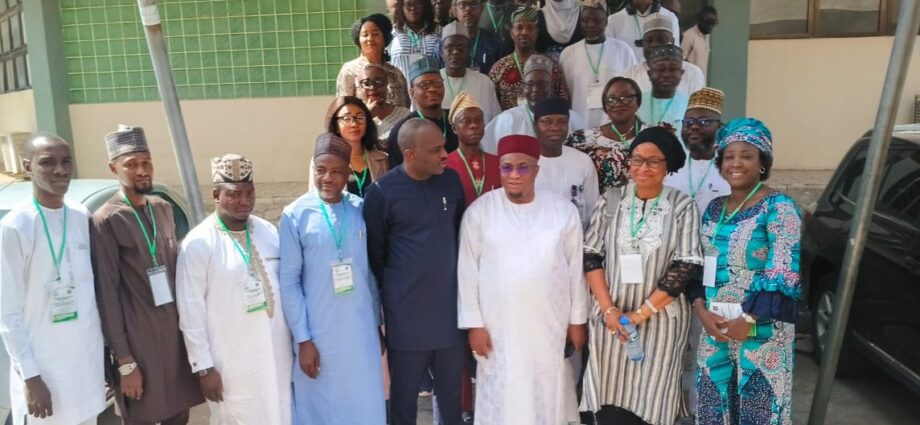
The Executive Secretary of NUC, Prof. Abdullahi Ribadu, at a two-day Stakeholders’ workshop in Abuja on Monday, said the reform must align education with labour market realities and technological change.
Ribadu was represented by Malam Lawal Faruk, NUC’s Director of Research, Innovation and Information Technology.
Micro-credentials are short, focused, and competency-based education programmes that certify specific skills or knowledge in a narrow field.
The executive secretary said micro-credentials would complement, not replace, degree programmes by providing flexible pathways for upskilling, reskilling and continuous learning within Nigeria’s higher education system.
He added that the proposed framework would guide design, delivery, assessment, recognition and progression of short-cycle learning linked to national education policy and quality assurance standards.
“The National Universities Commission has, over the years, pursued reforms aimed at strengthening quality assurance, curriculum relevance, employability outcomes, and responsiveness of university education.
“These efforts are reflected in the Core Curriculum Minimum Academic Standards (CCMAS), which place strong emphasis on learning outcomes, skills acquisition, entrepreneurship, digital literacy, and adaptability of graduates.
“However, as the nature of work continues to evolve, there is growing recognition (both nationally and globally) that traditional programme structures alone may not sufficiently address the need for continuous upskilling, reskilling, and lifelong learning.
” It is within this policy context that micro-credentials are emerging as a complementary mechanism for delivering short-cycle, outcomes based learning aligned with specific skills and competencies,” he said.
Director of Open and e-Learning, NUC, Dr Funmilayo Morebise, said Nigeria could not afford to lag behind in adopting micro-credentials for workforce development and lifelong learning.
Morebise said the workshop aimed to build regulatory understanding, examine global best practices and develop a draft framework for implementation across universities and approved higher institutions.
Also, the President and Chief Executive Officer of COL, Prof. Peter Scott, described micro-credentials as a major post-pandemic innovation enabling flexible, quality-assured learning and rapid response to emerging skills demands.
Scott said Nigeria was among pilot countries working toward a coherent, trusted national system that enhances learner mobility, employability and international recognition of competencies.
Mrs Sia Fasuluku, Deputy Chief from the Ministry of Technical and Higher Education (MTHE) in Sierra Leone, urged stronger private-sector ownership to ensure training matched labour market needs and provided practical learning spaces.
Fasuluku emphasised that skills-focused education was essential to addressing youth unemployment, social challenges and rapid technological change across Africa.
” I really want to see more of the private sector come to the academics because they are going to be the ones absorbing this youth.
” They are going to be the one that would tell us what they want because when we train our youth and the training does not align with what the market wants, then we are just training for nothing.
“So it’s good for us to hear what the private sector wants and that now in turn can be inputted into the curricula of what we’ll be training our children,” she said.
The News Agency of Nigeria (NAN) reports that the two-day workshop is expected to produce a draft national micro-credential framework and strengthen collaboration among regulators, institutions, industry and international partners.(NAN)(www.nannews.ng)
Edited by Sadiya Hamza