


By Ebere Agozie
The Nigerian Guild of Investigative Journalists (NGIJ) has called for strategic partnership with the National Orientation Agency (NOA) to strengthen collaborations on promoting ethical, evidence-based reporting to combat the spread of misinformation
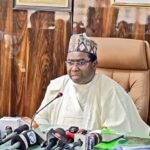
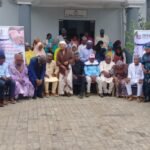
The National President of NGIJ, Malam Abdulrahman Aliagan, made the call when he led his team on a visit to the Director General of NOA, Mallam Lanre Issa-onilu , on Monday in Abuja.
Aliagan said the collaboration was to strengthen civic education, combat misinformation and promote accountability in governance as both institutions identified investigative journalism as critical to Nigeria’s democratic development.
“The mandates of NGIJ and NOA are naturally complementary, while NOA is charged with civic education, value re-orientation and public enlightenment, investigative journalism provides verified facts and evidence that enable citizens to make informed decisions and hold public institutions accountable.
“Investigative journalism is pro-accountability and pro-transparency, it is not antagonistic to government but rather designed to strengthen institutions and rebuild public trust.
“When facts are responsibly presented and aligned with civic values, citizens become better informed, more responsible and more engaged in democratic processes,’’ Aliagan reiterated.
He equally identified misinformation, declining public trust in institutions, social tension and civic apathy as major threats to Nigeria’s democracy.
He urged closer collaboration between journalists and NOA to address the challenges through joint public enlightenment campaigns, capacity-building on fact-checking and counter-disinformation, as well as platforms for constructive engagement with the public.
Aliagan further called for an enabling environment for ethical journalism, access to information and institutional support for investigative reporting.
He noted that investigative findings should be seen as tools for civic education rather than adversarial attacks on government.
He expressed hope that the courtesy visit would mark the beginning of a structured and enduring partnership between NGIJ and NOA in the collective task of nation-building.
Issa-Onilu in his response expressed worry over the steady decline of investigative journalism in Nigeria.
He said that the erosion of depth, accuracy and attention to facts in media practice had weakened the profession and contributed to misinformation and social division.
“Journalism has increasingly become superficial, with little emphasis on interpretation, context and fact-based reporting, thereby making it difficult to distinguish between professional journalism and unverified content circulating on social media.
“Facts are fundamental tools for civic orientation and national unity and when facts are no longer treated as sacred, society becomes vulnerable to ignorance, manipulation and conflict’’.
He noted that investigative journalism played a vital role in national development by promoting fairness, balance and objectivity, and by compelling government to do the right thing through informed public scrutiny.
Issa-Onilu also highlighted some of the challenges faced by NOA in fulfilling its mandate.
“We have limited resources for voter education and civic enlightenment, and widespread public misunderstanding of electoral processes is evidence of the consequences of weak civic education and poor-quality reporting’’.
He pledged the agency’s support for NGIJ, offering to facilitate collaboration through NOA’s network of Community Orientation and Mobilisation Officers (COMOs) across local governments nationwide.
These networks, he said, provide grassroots feedback to government and could serve as valuable community-level sources of information for investigative journalists.
He further proposed the establishment of a joint committee between NOA and NGIJ to explore concrete areas of collaboration, in public enlightenment campaigns, counter-disinformation initiatives and mechanisms for strengthening investigative journalism in the public interest.
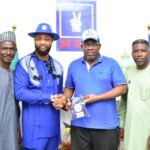
Highlight of the visit was the presentation of a plaque containing the National Value Charter to the NGIJ delegation by the Director-General.
He said the plaque was a symbol of shared commitment to national values and civic responsibility.
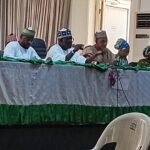
He also conducted the team around the historic monument within the agency, the National Executive Boardroom, where the administration of Nigeria’s former late President, Shehu Shagari, once held Executive meetings.
The President’s table and chairs, still preserved by the agency, were showcased to the delegation as part of efforts to sustain institutional memory and national heritage.
Both organisations expressed optimism that sustained engagement and structured collaboration would contribute to rebuilding public trust, strengthening democratic culture and promoting national cohesion through responsible journalism and effective civic orientation. (NAN)
Edited by Sadiya Hamza