






By Philip Yatai
Minister of the Federal Capital Territory (FCT), Nyesom Wike, has described the FCT as a “laboratory of dividends of democratic governance”.
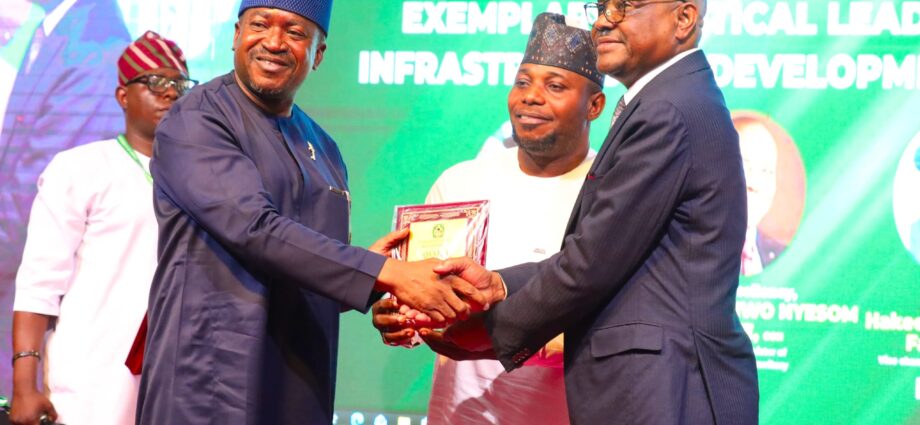
Wike stated this in Abuja on Tuesday, in a lecture titled, “The Impact of Political Leadership on Infrastructural Development in Nigeria: Between Dividends of Democracy and Good Governance.”
The minister presented the lecture at the 2026 Annual Distinguished Personality Lecture Series, organised by the Faculty of Social Science, Yakubu Gowon University, Abuja.
He said that in the FCT, infrastructure was treated not as a favour dispensed by power, but as a right owed to citizens, not as propaganda, but as policy.
“In this sense, Abuja was increasingly emerging as a living laboratory of democratic governance, where the dividends of democracy are translated into everyday realities, and where leadership is judged not by promises made, but by systems built, sustained, and trusted,” he said.
He said that leadership is not about pleasing everyone, “but about doing what is right, lawful, and necessary for the collective progress of the people.
“Our interventions in the FCT since 2023 demonstrate that when authority is exercised with accountability, infrastructure becomes more than concrete and steel.
“It becomes a visible lesson in ethical leadership, a tangible affirmation that the state exists to serve, and a durable foundation for social and economic transformation.
“Permit me to state that the FCT is cited here not for self-praise, but as concrete evidence of what becomes possible when political leadership aligns authority with responsibility.’
He pointed out that Abuja was conceived as a symbol of national unity, order, and purposeful governance, adding that over time, that founding vision came under strain.
He explained that over time, unplanned settlements expanded, infrastructure became overstretched, urban discipline weakened, and the credibility of governance itself was gradually eroded.
“Our task has therefore been clear and non-negotiable: to restore Abuja to its founding ideals while deliberately adapting it to the realities of a rapidly growing and modern capital.
“In recent times, the transformation of the FCT has demonstrated what focused, principled, and intentional leadership can achieve when democracy is treated not as a ceremonial ritual, but as a continuing responsibility to deliver public good.
He said that such commitment has found expression in massive investment in road networks to improve mobility, stimulate economic activity, reconnect communities, ease congestion, and unlock productivity.
He added that commitment also involved the systematic renewal of urban infrastructure to enhance safety, aesthetics, and operational efficiency.
This, he said, was based on the recognition that a capital city must not only function effectively, but also embody dignity, order, and national pride.
“Equally important has been the firm yet humane enforcement of planning regulations, guided by the conviction that a city without order cannot truly serve its people.
“Legality has been balanced with compassion, and discipline pursued not as punishment, but as a prerequisite for shared prosperity,” he said.
He said that the FCT Administration was also committed to inclusive development, ensuring that growth does not terminate at the city centre but extends meaningfully to satellite towns and surrounding communities.
This step, according to him, will ensure that no part of the capital is left behind.
“Across Abuja today, there is an unmistakable momentum toward infrastructural renewal: abandoned projects are being revived, public spaces reclaimed, service delivery strengthened, and urban order progressively restored.
“These interventions are not cosmetic gestures; they are structural reforms that reflect a philosophy of governance that insists that democracy must be visible, functional, and fair.” (NAN)
Edited by Emmanuel Yashim