







By Ibironke Ariyo
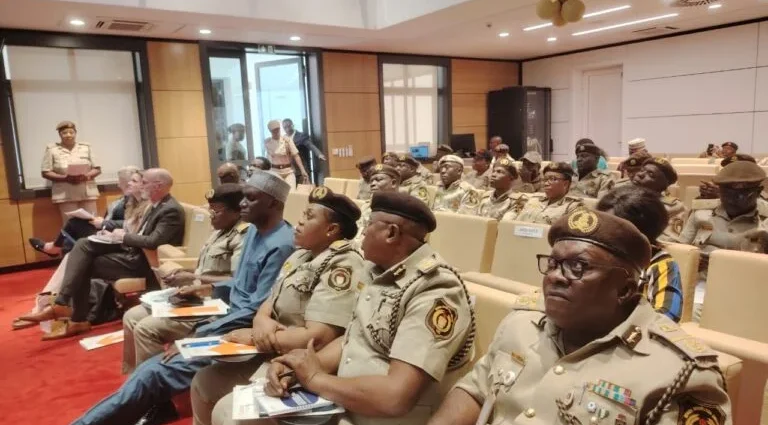
The Comptroller-General, Nigeria Immigration Service (NIS), Kemi Nandap, has inaugurated the Project Steering Committee for Mobile Teams (MT) Nigeria Project.
The project was aimed at strengthening border security and migration management across the country.
Nandap, who stated this on Tuesday in Abuja during the inauguration, said the initiative was supported by the Government of the Netherlands and the International Centre for Migration Policy Development (ICMPD).
The News Agency of Nigeria (NAN) reports that the Mobile Teams Nigeria Project is expected to strengthen operational response mechanisms and enhance Nigeria’s capacity to manage migration and secure its borders more effectively.
The theme of the event is “Enhancing Border Control Capacities of the Nigerian Immigration Service (NIS) – Mobile Team Nigeria”.
Nandap was represented by Mrs Franka Nwaneka, the NIS Deputy Comptroller General (DCG) in charge of Visa and Residency.
The CG said the initiative was designed to enhance the operational capacity of the service in securing Nigeria’s borders and improving migration governance.
The NIS boss described the event as a significant milestone in Nigeria’s ongoing efforts to modernise border management systems.
According to her, Nigeria and the Netherlands have maintained a strong partnership in migration management, with sustained technical assistance provided to the service over the years.
Nandap noted that recent support from the Dutch government included the handover of Edison Software License Keys and the Passport Examination Programme Manual (PEPM III), both of which had strengthened operational efficiency within the service.
She added that the Netherlands-backed Hostmanship Programme had also been institutionalised within the NIS, contributing to improved professionalism and a better international image for Nigeria at border entry and exit points.
Highlighting Nigeria’s border management realities, Nandap said the country’s vast geographical expanse posed significant challenges.
This, she said, was with more than 4,000 kilometres of land borders shared with four neighbouring countries and about 853 kilometres of coastline requiring effective surveillance.
She explained that the Mobile Teams Project would provide modern equipment and resources needed to enhance patrol operations and improve border control capabilities.
“Strengthening border security would enable Nigeria to better address irregular migration, combat transnational crimes, respond to emerging security threats and promote regional stability,” she said.
Nandap disclosed that the Project Steering Committee, inaugurated by the Minister of Interior, Olubunmi Tunji-Ojo, would provide governance oversight for the project.
This, she said, would be through review and approval of work plans, strategic guidance and monitoring of implementation outcomes.
She described ICMPD as a trusted implementing partner, recalling the successful collaboration between both organisations under the Modernising Nigeria Immigration Service (MoNIS) Workforce Project.
“This has, however, significantly advanced institutional development within the service,” she said.
The CG commended ICMPD’s professional approach to project execution, particularly its emphasis on human rights compliance through the Do-No-Harm analysis conducted during the project’s inception phase.
Nandap urged members of the Steering Committee to demonstrate strong commitment toward ensuring the successful implementation of the initiative.
She also expressed appreciation to the Government and people of the Netherlands for their continued partnership and support, reaffirming the service’s commitment to deeper collaboration and effective delivery of the project.
Speaking, Head of Mission, ICMPD, Ms Isabelle Wolfsgruber, described the initiative as the second milestone in efforts to improve the operational capacity of the NIS and strengthen border governance across Nigeria.
She noted that the project brought together stakeholders from diverse sectors involved in border management and governance, underscoring a collaborative national approach to migration and security challenges.
She said that the initiative was expected to contribute to safer borders, improved immigration governance and enhanced national security in Nigeria.
“The establishment of well-equipped and highly trained integrated mobile teams will significantly improve the NIS’ ability to respond swiftly and effectively to irregular migration, cross-border crime and emerging security threats,” she said.
Wolfsgruber explained that the teams would particularly focus on remote and underserved border areas where permanent infrastructure was limited or non-existent.
She said the mobile units, supported with modern technology and advanced training, would enhance border control operations while ensuring the protection of human rights.
“The importance of the human rights sector remains central to this project and to the broader work of the NIS,” she said.
Wolfsgruber explained that the inauguration of the project steering committee formed a key component of the initiative, providing strategic oversight, ensuring alignment of activities and monitoring progress throughout implementation.
“The committee will also guide the validation of its terms of reference and help determine immediate next steps for the project’s inception phase,” she said.
She disclosed that participants would review project objectives and operational frameworks, formalise governance arrangements and agree on priority actions to sustain implementation momentum.
Wolfsgruber encouraged members of the NIS community and other stakeholders to engage in practical dialogue and joint discussions, noting that experts involved in the project’s initial assessment were present to support effective delivery.
She expressed appreciation for the leadership and dedication of partners involved, reaffirming ICMPD’s commitment to close collaboration with all stakeholders to ensure the project’s success. (NAN)(www.nannews.ng)
Edited by Ifeyinwa Okonkwo and Yakubu Uba