


By Sumaila Ogbaje, News Agency of Nigeria (NAN)
Towering over the waters with quiet authority, the Indian Navy Ship (INS Vikrant) has quickly become the most visible symbol of India’s rising maritime power and industrial confidence.
Commissioned into the Indian Navy in September 2022, the indigenously designed aircraft carrier represents decades of planning, engineering discipline and strategic foresight.
Today, Vikrant is not only a centrepiece of India’s naval fleet but also a statement of the country’s expanding role in ensuring maritime security and supporting economic growth across the Indo-Pacific and littoral regions.
The journey of INS Vikrant from drawing board to operational deployment is widely regarded as one of the most significant milestones recorded by the Indian Navy in recent decades.
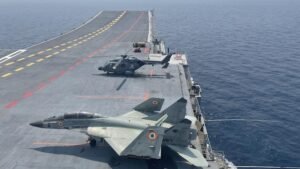
Designed by the Navy’s Warship Design Bureau and built by Cochin Shipyard Limited, the carrier marked India’s entry into an elite league of nations capable of designing and constructing aircraft carriers domestically.
India has achieved major milestones in building its defence capabilities indigenously. In August 2013, the country successfully launched the indigenous aircraft carrier into the water. In August 2021, it completed its maiden sea trials validating propulsion and navigation systems, while the ship was formally inducted into the Indian Navy in September 2022.
Between 2023 and 2025, the Indian Navy conducted progressive aviation trials and operational work-ups, culminating in prominent participation at the International Fleet Review 2026 and MILAN 2026.
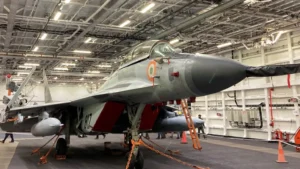
Naval officials on board the ship during a cruise visit by international journalist delegates on Thursday revealed that each phase has deepened India’s confidence in complex warship construction and carrier aviation operations
.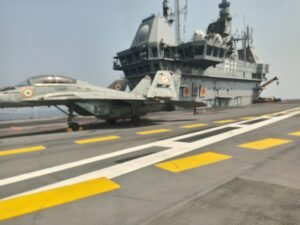
An overview of INS Vikrant was presented by the Commanding Officer, Capt. Ashok Rao.
At approximately 262 metres long and displacing about 45,000 tonnes, Vikrant functions as a mobile airfield at sea. The carrier can embark more than 1,600 personnel and operate a potent air wing including MiG-29K fighters and multi-role helicopters.
Its ski-jump configuration enables Short Take-Off But Arrested Recovery (STOBAR) operations — a capability the Indian Navy has steadily refined through years of carrier aviation experience.
Beyond combat power, naval planners emphasise survivability, networked warfare capability and extended endurance across the Indian Ocean.
The induction of INS Vikrant has significantly boosted India’s maritime domain awareness and sea control capability at a time of increased naval activity in the Indian Ocean region.
The ship operates alongside INS Vikramaditya, giving India the strategic advantage of sustaining carrier presence on both eastern and western seaboards when required.
Analysts say this dual-carrier capability supports India’s ambition to act as a “net security provider” in the region, helping protect sea lanes that underpin global commerce and regional stability.
Maritime experts stress that Vikrant’s importance extends beyond deterrence. Secure sea lanes are vital for trade-dependent economies across the Indian Ocean rim.
By enhancing surveillance, deterrence and rapid response, the carrier supports the stability required for blue economy initiatives, offshore energy development, safe commercial shipping and regional maritime cooperation.
Indian naval leadership has repeatedly linked maritime security to shared prosperity among littoral nations — a message strongly echoed at recent multinational naval engagements.
Another key milestone in the Navy’s evolving doctrine is the increasing use of major naval platforms for humanitarian assistance and disaster relief (HADR).
INS Vikrant is configured to support mass evacuation, helicopter rescue operations and emergency medical response — capabilities that have become central to India’s maritime diplomacy across the Indo-Pacific.
The carrier was among the star attractions at the just-concluded International Fleet Review 2026 in Visakhapatnam, where dozens of navies converged in a major show of maritime solidarity.
In her address at the event, President Droupadi Murmu praised the professionalism displayed by participating navies and highlighted the deeper meaning of the gathering.
Murmu noted that the review “reflects unity, trust and respect among nations for maritime traditions,” adding that ships flying different flags demonstrated a powerful spirit of togetherness.
She emphasised that India’s ties with the seas are “deep and enduring,” describing the oceans as historic pathways of commerce, connection and cultural exchange for the country.
The President further underscored India’s maritime vision of MAHASAGAR — Mutual and Holistic Advancement for Security and Growth Across Regions — saying the initiative reinforces the country’s commitment to cooperative maritime security.
She also highlighted India’s civilisational ethos of Vasudhaiva Kutumbakam — the world is one family — stressing that global security and growth are built through partnerships and collective responsibility.
Murmu commended the Indian Navy for remaining vigilant in safeguarding maritime interests and contributing to stability across the wider maritime commons.
According to her, naval units deployed across the region serve as credible instruments of deterrence and defence against emerging threats at sea.
She further described the Indian Navy as “often the First Responder” during humanitarian crises and natural disasters, noting its record of extending assistance “with compassion and competence.”
Her remarks closely mirror the operational philosophy embodied by platforms like INS Vikrant — combining hard power with humanitarian reach and cooperative engagement.
At the ongoing MILAN 2026, INS Vikrant continues to serve as a powerful symbol of India’s maritime outreach and indigenous capability.
At the International City Parade on Thursday, Chief of the Naval Staff, Adm. Dinesh Tripathi, emphasised that India’s maritime strategy is rooted in trust, openness and mutual respect for global seas.
Tripathi stressed that events like IFR and MILAN 2026 foster international cooperation, camaraderie and interoperability among friendly navies, acknowledging delegations and crews who crossed oceans to participate in the historic celebration.
His speech preceded a spectacular 45-minute display of naval air power, cultural performances and marching contingents at RK Beach in Visakhapatnam, showcasing India’s naval might while blending tradition, culture and operational excellence.
MILAN, one of the region’s largest multinational naval gatherings, brings together navies for professional exchanges, sea exercises and strategic dialogue.
Foreign delegates have shown keen interest in Vikrant’s indigenous design, aviation facilities and operational philosophy — viewing the carrier as evidence of India’s growing blue-water competence.
For many Indians, the name Vikrant carries deep emotional resonance. It honours the original INS Vikrant, which played a notable role during the 1971 conflict.
The new Vikrant, however, reflects a different era — one defined by indigenous capability, industrial confidence and expanding maritime partnerships.
As global navies gather in Visakhapatnam for IFR and MILAN 2026, one silhouette continues to command attention on the horizon.
INS Vikrant — built in India and sailing for collective maritime security — stands today as the floating embodiment of the nation’s resolve to keep the oceans safe, stable and open for shared prosperity.
To many observers, the steady progress recorded on INS Vikrant is more than a shipbuilding success — it is a strategic signal.
With sustained investment in indigenous design, domestic shipbuilding and home-grown defence technologies, analysts say India’s ambition to achieve 100 per cent self-sufficiency in defence capabilities by 2047 is increasingly within reach.
If the momentum witnessed in platforms like Vikrant is maintained, India’s vision of full-spectrum defence self-reliance may well shift from aspiration to reality within the targeted timeline. (NANFeatures)



Comments