









By Hajara Leman, News Agency of Nigeria (NAN)
Development is not just about roads, restored landscapes, or new infrastructure; it is also about listening to people and addressing their concerns before they escalate into conflict.
For instance, in many communities, a single unresolved complaint can make residents feel ignored.
A farmer worried about damaged crops or a shop owner anxious about construction near her stall does not just want compensation; they want assurance that their voice matters.
Moreover, where projects touch daily life, trust is as critical as funding.
When residents understand how decisions are made and where to raise concerns, they are far more likely to support development efforts.
However, across villages, disagreements over land boundaries, compensation, or shared resources can quickly escalate without clear systems in place.
It is against this backdrop that the Agro-Climatic Resilience in Semi-Arid Landscapes (ACReSAL) project is implementing environmental restoration and livelihood support initiatives across Gombe.
The project is also strengthening mechanisms to resolve disputes and prevent conflicts before they arise.
Recently, the project organised a training for key stakeholders on the Grievance Redress Mechanism (GRM), a structured system for receiving, documenting, and resolving complaints arising from project activities.
Experts note that large-scale interventions; especially those involving land, compensation, natural resources, and infrastructure often generate tensions in local communities.
Consequently, without clear channels for redress, minor disputes can escalate, potentially delaying or undermining projects.
Therefore, grievance redress mechanisms have become essential for development programmes, ensuring transparency, timely resolution of complaints, protection of citizens’ rights, and stronger community ownership.
Indeed, evidence from similar programmes across Africa and Asia shows that projects with functional grievance systems manage disputes more effectively.
By addressing complaints promptly, such systems reduce litigation, accelerate compensation, and increase community satisfaction, as people feel their voices are heard and respected.
Thus, early and fair handling of grievances strengthens trust, safeguards projects, and promotes sustainable development.
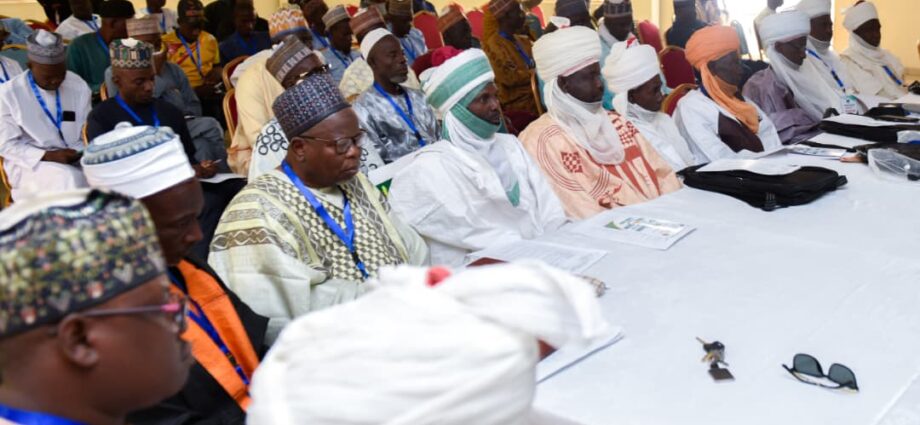
The Gombe training brought together community leaders, traditional rulers, religious representatives, law enforcement personnel, and project committees to strengthen local capacity for conflict prevention and participatory governance.
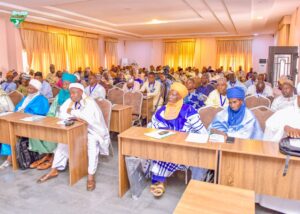
Speaking at the session, Dr Sani Jauro, ACReSAL’s state project coordinator, described it as a refresher aimed at deepening collaboration and aligning stakeholders with international best practices.
“Even well-designed interventions can face resistance if communities feel excluded. Listening to people’s concerns is a responsibility, not a favour,” he said.
He added that ACReSAL’s multi-sectoral activities, which include landscape restoration, erosion control, and livelihood support through community revolving funds, make it necessary to institutionalise fair and transparent complaint-handling processes.
Traditionally, disputes in rural areas are settled informally through elders or community councils.
While such approaches remain important, structured grievance redress mechanisms introduce documentation, traceability, and clarity, protecting both citizens and the project.
Complaints under ACReSAL can be lodged through community committees, local government offices, hotlines, emails, or complaint boxes, ensuring accessibility even for vulnerable residents.
Jauro disclosed that nearly 700 individuals received compensation under the project’s Settlement Action Plan.
“After verification by the State Compensation Committee, only 14 complaints were validated, mostly due to misunderstandings over asset valuation.
“All confirmed cases were resolved peacefully, avoiding prolonged disputes or litigation that could delay the project,” he said.
Analysts note that these outcomes mirror experiences in other resilience programmes, where early mediation reduces delays and strengthens trust.
The District Head of Dukku, Alhaji Abubakar Haruna-Rashid, said traditional leaders are often the first point of contact for disputes.
The training has enhanced their ability to guide residents towards dialogue and lawful resolution rather than confrontation, and they plan to cascade this knowledge to communities.
Religious leaders also emphasised collaboration.
Alhaji Sale Danburam of Jama’atu Nasril Islam highlighted the importance of synergy among project officials, grievance committees, and faith-based institutions.
Similarly, Rev. Jim James of the Christian Association of Nigeria underlined proper documentation as vital for transparency and accountability.
From a legal perspective, ACReSAL consultant Mwalin Abdu explained that grievance redress mechanisms are formal accountability tools designed to handle complaints fairly and transparently.
She noted that many people often treat complaints casually or as personal disagreements.
However, she warned that when documentation is missing or procedures are ignored, even minor issues can escalate into court cases or long-standing disputes.
Abdu emphasised that the grievance redress mechanism has legal backing, which protects the rights of complainants and ensures that every report is officially recorded.
She explained that complaints can be submitted through community grievance committees, hotlines, email addresses, or complaint boxes, providing multiple options so that even shy or vulnerable residents can speak up safely.
She further clarified that not all complaints are resolved at the same level, noting that some can be handled within the community, while others may need to be escalated to higher authorities or require legal expertise.
Abdu also strongly advised against self-help or violence, stressing that using the proper channels ensures fairness, protects rights, and maintains peace.
Participants at the training committed to act as bridges between the project and the communities, emphasising that development must proceed alongside accountability, dialogue, and peaceful conflict resolution.
They observed that by strengthening grievance management, ACReSAL not only restores ecosystems and supports farmers but also helps institutionalise inclusive governance at the grassroots level.
They concluded that while infrastructure may initiate development, it is trust that sustains it, and that through structured grievance redress, ACReSAL ensures community voices remain central to the process. (NANFeatures)
*****If used, please credit the writer and the News Agency of Nigeria (NAN)