







By Angela Atabo
The Chief Justice of Nigeria, Kudirat Kekere-Ekun, has tasked judges on advancing the Women, Peace and Security (WPS) Agenda in the justice system.
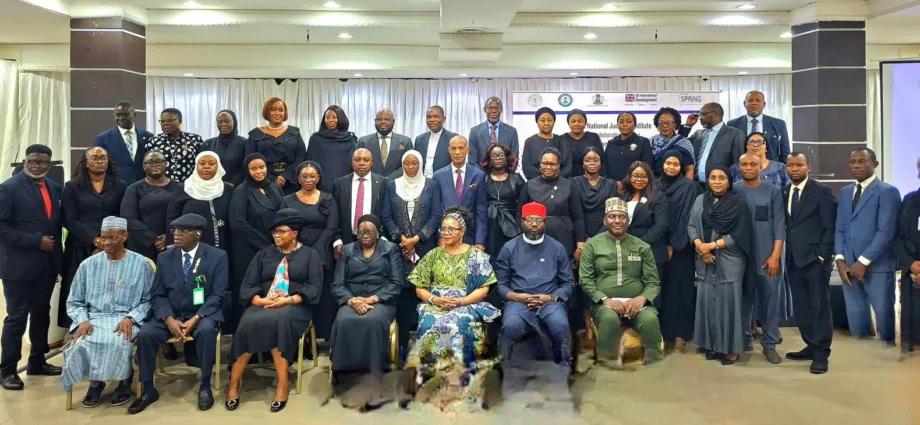
Kekere-Ekun made the call on Thursday in Abuja at a Capacity Strengthening and Dialogue Workshop for Judicial Officers on the Women, Peace and Security (WPS) Agenda.
The workshop was organised by the National Judicial Institute (NJI) in collaboration with the Federal Ministries of Women Affairs and Justice with support from the Strengthening Peace and Resilience in Nigeria (SPRiNG) programme funded by the United Kingdom Foreign, Commonwealth and Development Office.
The CJN underscored the critical role of the judiciary in advancing the WPS agenda, declaring that sustainable peace and justice in Nigeria depended on a responsive, accessible and accountable justice system.
She said that the workshop convened under the theme “Operationalising the Third National Action Plan on Women, Peace, and Security, NAP3” validated the National Judicial Guide on Women, Peace, and Security.
“For the judiciary, operationalising the NAP3 means ensuring that the core principles of women, peace, and security agenda are reflected in how cases are heard, how procedures are applied, and how judges are trained.
“These places clear responsibilities on institutions, including the judiciary, to protect rights, promote participation, ensure accountability, and guarantee access to justice for women, children, and other vulnerable groups affected by conflict, insecurity, and displacement.
“The courts, beyond the resolution of disputes, are institutions entrusted with the protection of rights, the preservation of human dignity, and the maintenance of social order.
“Where court processes are slow, inaccessible, or insensitive to the realities of conflict and gender-based harm, justice is weakened.”
According to Kekere-Ekun, where courts are informed, responsive, and properly supported, they strengthen accountability, deter wrongdoing and promote public confidence in the rule of law.
She said that judicial commitment aimed at giving effects to the national action plan should, therefore, be reflected in judicial reasoning and courtroom practices.
She acknowledged that in spite of Nigeria’s strong and progressive legal framework, gaps remained between legal standards and the experiences of many court users.
“Survivors of conflict-related sexual violence, women and girls displaced by insurgency, persons with disabilities and other vulnerable groups often face procedural obstacles evidentiary difficulties and institutional barriers that limit their access to justice.
“These challenges make it difficult to fully realise the objectives of the national action plan within the justice system.
“These do not arise from a lack of commitment by judicial officers rather they more often reflect the complexity of these cases, limited data evolving legal standards and the absence of practical guidance tailored to conflict-related and gender-based harm.
“This context explains the importance of today’s consultation and the value of a structured judicial guide which will respond directly to the justice system.”
The CJN said that the integration of the guide into judicial education through the NJC was welcomed as it would promote consistency and sustainability while preserving the discretion of judges to decide cases.
Also speaking, the Minister of Justice, Lateef Fagbemi, commended NJI, in collaboration with SPRiNG for strengthening justice delivery through inclusive, responsive, and rights-based approaches, particularly as it relates to women’s participation, protection, and access to justice.
Fagbemi, represented by Mrs Yewande Gbola-Awopetu, Head of Sexual and Gender-Based Violence Response Unit, said the courts remained central to translating constitutional guarantees, statutory protections, and international obligations for women and girls, especially those affected by conflict, violence, and structural inequality.
He said the workshop, therefore, provided an important opportunity for dialogue, that allowed for the exchange of experiences, identification of challenges, and exploration of practical solutions for strengthening judicial responses within the Women, Peace and Security Framework.
Also speaking, Justice Babatunde Adejumo, Administrator, NJI, said the workshop reflected the Institute’s commitment to facilitating capacity-building initiatives that are diverse, inclusive, and aligned with international standards and global practices.
Adejumo said the collaborative effort between the NJI, SPRiNG and the other partners aimed to garner judicial support for the implementation of the UN Security Council Resolution UNSCR 1325 on Women, Peace, and Security.
He said the Judiciary, as the custodian of justice, stood as a pivotal institution for the advancement of the pillars of the WPS Agenda, particularly in prevention, protection, relief and recovery.
“In performing its adjudicatory functions, the courts are able to elicit accountability from perpetrators of conflict-related sexual violence and gender-based violence, enforce reparations and other reliefs for victims; and ensure deterrence through conviction.”
In her remarks, Amina Akano-Bello, Gender Equality, Disability and Social Inclusion Lead for SPRiNG Programme, said the workshop was expected to review and validate the WPS Guide for the Nigerian Judiciary, as an instrument for operationalising the NAP on Women, Peace and Security.
This, Akano-Bello said, was to ensure that the judiciary effectively translated commitments of the Women, Peace and Security into actionable judicial standards that improve protection and accountability.
“The role of the judiciary and more broadly justice sector institutions is critical to our shared commitments to fulfilling the transformative agenda of the UNHCR 1325 on Women, Peace and Security.
“Nigeria has so far implemented two National Action Plans and just in Dec. 2025, the third NAP on Women, Peace and Security was launched.”
She noted that SPRiNG is an initiative of the UK supporting efforts to build a more stable Nigeria where citizens benefit from reduced violence and improved resilience to climate pressures. (NAN)(www.nannews.ng)
Edited by Sadiya Hamza