










By Angela Atabo
Dr Atinuke Owolabi, a member of the North Central Development Commission representing the Southwest, has established a 10-year Science, Technology, Engineering and Mathematics (STEM) empowerment initiative for Internally Displaced Persons (IDP) children.
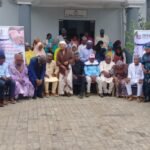
Owolabi, who is also a Society for Women Engineers (SWE) Ambassador in the United States, disclosed this during an outreach at the IDP camp in Abuja.
The News Agency of Nigeria (NAN) reports that the expert, who is also a fellow, Nigerian Society of Engineers (NSE), established the empowerment initiative to mark her 50th birthday and World Engineering Day.
She said, “As you can see, most of the kids here are vulnerable kids that got here through all these terrorist attack, insurgency. But we want to inspire them, we want to mentor them.
“We want to let them know that the fact that they are in this IDP camp does not mean that this will define their future. The initiative is called `Seeds of Hope, Planting Today, Engineering Tomorrow’.
“This is the way that I chose to mark my 50th birthday. Because when I am 60 years old, I want to look back and say, thank you, Lord.
“By that time, we will have some of our girls and boys studying engineering and some STEM-related courses. While some are already graduates, we need to give them a future.”
Owolabi said that at the beginning of the outreach, the children did not know anything about STEM nor about engineering.
“If kids of today don’t know what is called engineering, who is going to build the future of our country and the world? The world needs them. And that is what we want them to know.
“What we have done today is to have inspired them and to start a 10-year investment camp. So, it is not just going to be a one-off thing. We will be coming here for different skills, digital skills.
“We want to integrate them into the society. We want to connect them to the innovators, professionals within this country and even outside the country.
“What we have started today is elementary. By next year, they will be able to go into the competition with other girls in private schools, in public schools,” she said.
Owolabi said laptops would be provided to connect the children to global learning platforms and international opportunities, adding that the goal was to integrate them into society and expose them to innovators and professionals both within and outside Nigeria.
She said the initiative also included scholarships for outstanding and active participants, as well as the inauguration of the Society of Women Engineers Next Generation Club to commemorate World Engineering Day.
She also called on the Ministry of Environment to intervene in improving the sanitary condition of the camp, to make it more conducive for the children.
She urged women in Nigeria to support the kids, adding that uniforms, sandals would be provided for them, as well as chairs, tables, among others to equip them for STEM.
In support of the initiative, Dr Felix Adegboye, the President of the Nigeria Institute of Electrical and Electronic Engineers (NIEEE), commended Owolabi’s decision to celebrate her birthday by touching lives.
“When I heard she was marking her 50th birthday by inspiring girls in an IDP camp to pursue STEM, I had to come and support,” he said.
Adegboye urged the girls to remain focused on their academics and not be discouraged by their background.
“They must be serious with their studies, ask questions in class and never think that where they come from limits them,” he advised.

Also speaking, Mr Simeon Isibor, the Registrar of the Chartered Institute of Electrical and Electronic Engineers, described the outreach as an eye-opener on the need for increased corporate social responsibility.
“We are in full support of her programme. The institute has donated N100,000 to support the children, and this is just the beginning. We will continue to come here,” he said.
Facilitating the hands-on experiments, Stella Ozochukwu-Dennis explained that the children were introduced to simple robotic projects using everyday materials, including building a “wiggle bot” capable of drawing shapes.
She added that another project involved converting discarded plastic bottles into solar lamps to enable the children study at night.
“We want them to enjoy the same exposure as children in privileged schools. Today, they know what STEM means. Every Saturday for the next 10 years, we will be here to build their capacity,” she said. (NAN)(www.nannews.ng)
Edited by Deji Abdulwahab