








By Ibironke Ariyo, News Agency of Nigeria (NAN)
Across Nigeria’s custodial centres, a quiet transformation is unfolding; one that is gradually reshaping the narrative of punishment into a story of rehabilitation, education and second chances.
For decades, incarceration in Nigeria largely revolved around confinement and deterrence, with limited attention to reintegration.
Today, however, reforms spearheaded by the Nigeria Correctional Service (NCoS) have shifted the emphasis towards structured rehabilitation, skills acquisition and formal education.
The enactment of the NCoS Act 2019 marked a watershed.
It formally redefined prisons as correctional centres and mandated comprehensive rehabilitation programmes aimed at preparing inmates for lawful and productive lives after release.
Among the beneficiaries of these reforms is Mr Ehime Osahon, a former inmate at the Kuje Custodial Centre, whose academic journey behind bars reflects the evolving philosophy of correctional justice in Nigeria.
Osahon spent approximately four years at the facility after his arrest for aiding the transportation of cannabis.
Rather than succumb to despair, he chose to rebuild his life through education.
“I was already passionate about education before my incarceration. Ironically, what I struggled to fund outside became available to me free inside the correctional facility,” he told the News Agency of Nigeria (NAN).
“I entered the correctional centre with regret, but I found purpose there. Education became the turning point that reshaped my thinking and restored my dignity”.
Before his conviction, Osahon had earned a first degree from a conventional university and worked briefly in the banking sector.
In 2015, after losing his job, he sought admission into a master’s programme but faced mounting financial pressure.
Determined to support his family and fund his education, he ventured into transportation and agricultural trading, conveying produce such as plantain, pineapple and pawpaw across major cities.
During one of those trips, he agreed to transport bags of cannabis concealed in his vehicle in exchange for extra payment.
“I knew it was illegal and risky, but I allowed financial pressure to cloud my judgement,” he admitted.
He was intercepted along Abaji Road in Abuja by operatives of the National Drug Law Enforcement Agency (NDLEA) and subsequently convicted for aiding drug trafficking.
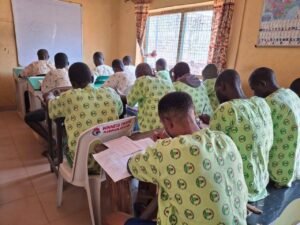
Upon arrival at Kuje, he confronted the psychological burden of stigma and regret. Yet within the custodial walls, he discovered an unexpected opportunity.
Through a collaboration between the NCoS and the National Open University of Nigeria (NOUN), inmates are permitted to enrol in academic programmes.
The partnership provides distance-learning materials, examination access and administrative support within custodial centres, enabling inmates to pursue certificates, diplomas and degree programmes while serving their sentences.
“I realised that what I was struggling to pay for outside was available inside. It was structured and supported,” Osahon said.
He enrolled in a master’s programme in Education Administration and Planning and immersed himself in his studies in spite of the constraints of custodial life.
By the time he completed the programme, he emerged as the best graduating student in his cohort.
“Winning that award restored my confidence. It reminded me that one mistake does not erase your potential,” he said.
With about a year left on his sentence, he registered for a PhD programme through NOUN.
“I told myself that if I must serve time, then the time must serve me,” he added.
Beyond personal advancement, Osahon began organising preparatory classes for inmates intending to sit for the West African Senior School Certificate Examination (WASSCE).
Working with the centre’s education officer, he taught core subjects such as Mathematics and English.
According to him, more than 50 inmates passed with five credits, including compulsory subjects, while about 30 enrolled in NOUN programmes.
“Some of those I taught are now graduates. Seeing their transformation gives me greater joy than my own achievements,” he said.
Correctional authorities describe such outcomes as validation of ongoing reforms.
A senior officer at Kuje, who requested anonymity because he was not authorised to speak publicly, stated that education is “the backbone of modern corrections”.
“When inmates engage productively, disciplinary issues decline significantly. Education changes perspectives and prepares them for reintegration,” he said.
Criminology experts affirm that correctional education is globally recognised as a strategic tool for reducing recidivism.
Dr Adewale Adeniyi, a criminologist based in Abuja, noted that international studies consistently show that inmates who access educational opportunities are less likely to reoffend.
“Education reshapes self-perception and expands legitimate economic options. When former inmates see themselves as professionals or scholars, the likelihood of returning to crime diminishes,” he said.
Section 10(g) of the NCoS Act 2019 mandates correctional facilities to provide educational and vocational training, as well as support income-generating initiatives for inmates as part of rehabilitation efforts.
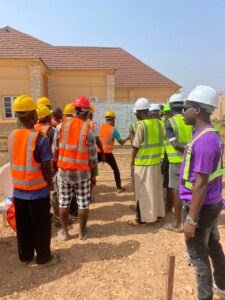
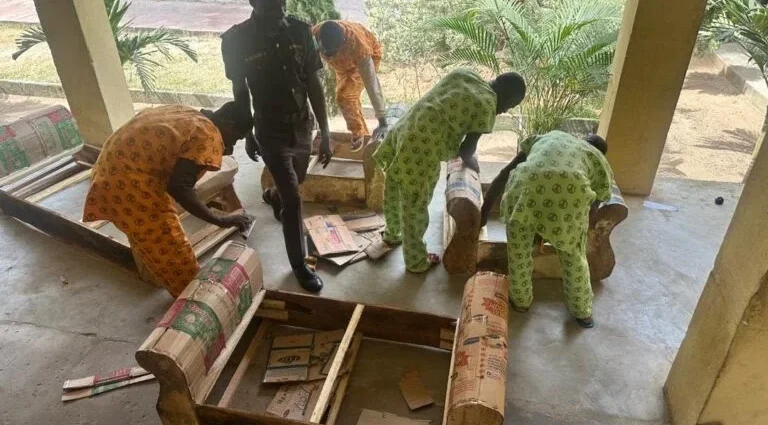
Beyond academics, the NCoS runs vocational training in tailoring, carpentry, welding, agriculture, fisheries, poultry farming, information technology and other trades aimed at enhancing employability upon release.
In the Federal Capital Territory (FCT), the NCoS has partnered with non-governmental organisations to strengthen rehabilitation initiatives.
Mr Christopher Jen, Controller of Corrections, FCT Command, said the command had trained over 800 inmates through expanded vocational and educational programmes.
“These partnerships have equipped inmates with practical skills and are paving the way for true rehabilitation and reduced recidivism,” he said.
He added that hundreds of inmates were currently enrolled in secondary education and degree programmes across custodial centres in the FCT.
The Controller-General of NCoS, Sylvester Nwakuche, recently empowered 24 ex-offenders with starter packs after completing vocational training.
He described the initiative as central to restoring dignity and strengthening communities.
“If we truly want to reduce crime, this is one of the most effective places to invest. Support for reformed individuals is support for national security,” he said.
Traditional leaders have also commended the reforms.
The Aguma of Gwagwalada, Muhammad Magaji, said correctional programmes had positively impacted members of his community.
“I am aware of individuals who returned from custodial centres, established businesses using the skills they acquired and have remained responsible citizens,” he said.
Albeit the progress, reintegration remains challenging.
Civil society organisations provide counselling, legal aid and post-release support, but stigma persists.
Osahon acknowledged that societal acceptance is not automatic.
“The stigma is real, but excellence speaks louder than labels,” he said.
Since his release about four years ago, he has continued his PhD studies and mentors young people, warning them against shortcuts.
“Desperation should never override integrity. Shortcuts often lead to long consequences,” he said.
Justice sector analysts observe that Nigeria’s gradual shift towards rehabilitation aligns with global best practices emphasising restorative justice and reintegration.
Although challenges such as overcrowding and funding constraints remain, stakeholders argue that sustained reforms can strengthen long-term outcomes.
For Osahon, the transformation he experienced stands as living proof that correction can indeed redefine justice.
“I entered broken, but I left purposeful. The correctional system changed my thinking and redirected my destiny,” he said.
Ultimately, stakeholders maintain that behind the imposing walls and steel gates of Nigeria’s custodial centres, a different story is taking shape; one where incarceration serves as a moment of reflection and redirection rather than a lifelong stigma.
In this emerging landscape, justice is now viewed not simply as retribution for wrongdoing, but as a deliberate and structured process aimed at restoration, accountability and renewed purpose. (NANFeatures)
***If used, please credit the writer and the News Agency of Nigeria.