






By Felicia Imohimi
The Federal Government says it will collaborate with the Dairy Sub-sector Group of the Manufacturers Association of Nigeria (MAN) to scale-up investment in the dairy sector to meet local demands.
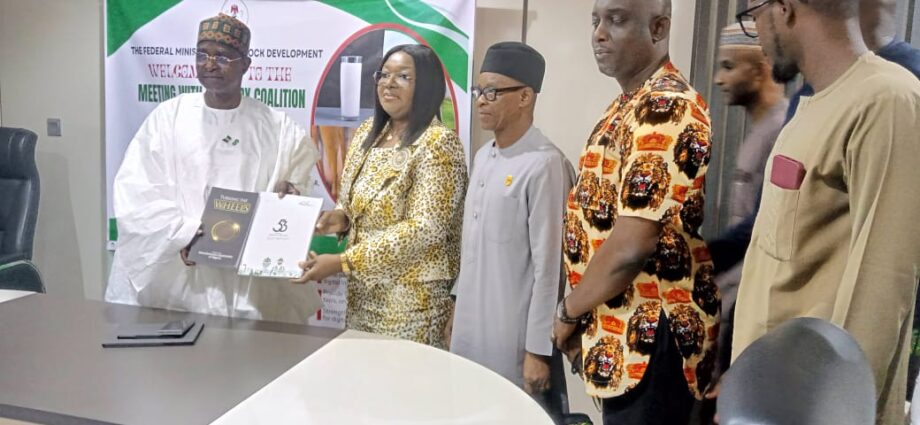
The Minister of Livestock Development, Alhaji Idi Maiha, said this when a delegation from MAN paid courtesy visit on the ministry in Abuja.
Maiha said that strategic partnerships with industries were critical to revitalise the dairy sector and unlock Nigeria’s vast livestock potential.
The minister who identified Nigeria as the largest market in Africa for vaccines and dairy products said that dairy production like milk and others were grossly inadequate to meet local demand.
“If you look at the statistics today, we spend $1.5 billion to import milk and dairy product, we also spend $1.5 billion to import vaccines into the country in spite having the largest market for the products in Africa,” he said.
According to him, there are huge opportunities for public private partnership for the revival of the sector.
He said areas of investment opportunities to included revitalisation of the 38 moribund livestock facilities across the country; milk collection centres; breed multiplication, goat, pig, cattle breeding centres.
According to him, working with MAN is the shortest possible way of reviving the sector.
“The ministry is working to attract investors into the sector through strategic public-private partnerships.
“We have 417 grazing reserves that we are going to rehabilitate, and each of them is available for investors who are willing to work with us.
“This is one of the ways to revive the dairy sector and increase local production.
“Other areas of investment opportunities are feed and fodder, milk production, seed multiplication among others,” he said.
Maiha also urged MAN to focus on breed improvement, milk collection centres and aggregation.
He said the country was yet to exhaust its inherent capacity of milk.
“We are challenged by the poor rural infrastructure. At the peak of the rainy season farmers drain their milk because women cannot cross rivers to supply milk.
“So these are areas we need milk collection centres. Capacity building is another area we need to up our games.
“We are out and ready to work with you to make sure we revive the dairy sector because that is where the money is,” he said.
Earlier, Ore Famurewa, Chairperson, Dairy Sub-sector Group of MAN and Executive Director, Corporate Affairs of FrieslandCampila WAMCO Nigeria, said that current estimates indicated that the country consume 1.6 million to 1.7 million metric tonnes of milk annually.
Famurewa however said that the country produces about 600,000 to 700,000 metric tonnes locally, leaving a significant supply deficit.
She said that the gap presented both a challenge and a tremendous opportunity.
“Nigeria possesses substantial assets for dairy development including an estimated 20 million cattle population, vast grazing and agricultural land resources, a large and growing consumer market and dynamic food and beverage manufacturing sector,” she said.
She said some challenges in the sector were low milk productivity per animal, inadequate dairy infrastructure, limited access to finance for farmers, security and grazing challenges and weak value chain integration challenge.
Famurewa said that addressing the challenges required a coordinated approach involving government, private sector investors, development partners and local farming communities.
Famurewa said the visit was to reaffirm the group’s commitment to Nigeria’s organised dairy industry and strengthen collaboration with the ministry in implementing the National Dairy Policy..
According to her, although Nigeria has a strong demand for dairy products, local milk production remains significantly below national consumption levels, creating a substantial supply gap. (NAN)(www.nannews.ng)
Edited by Uche Anunne