





Feature by Ijeoma Olorunfemi, News Agency of Nigeria (NAN)
Omolola Danielle, a student of Coronation Preparatory Academy, Kuje, FCT, faces an arduous routine getting to her school daily.
The daily walk to school requires an unusual precaution: a nose mask worn not for disease prevention, but to survive the overpowering stench of a nearby waste site.
Danielle recounts that whenever she walks past the refuse collection point close to her school, she instinctively covers her nose to shield herself from the suffocating odour.
“I usually cover my nose with a nose mask that I got for that purpose because the smell from the waste is very strong,” she said.
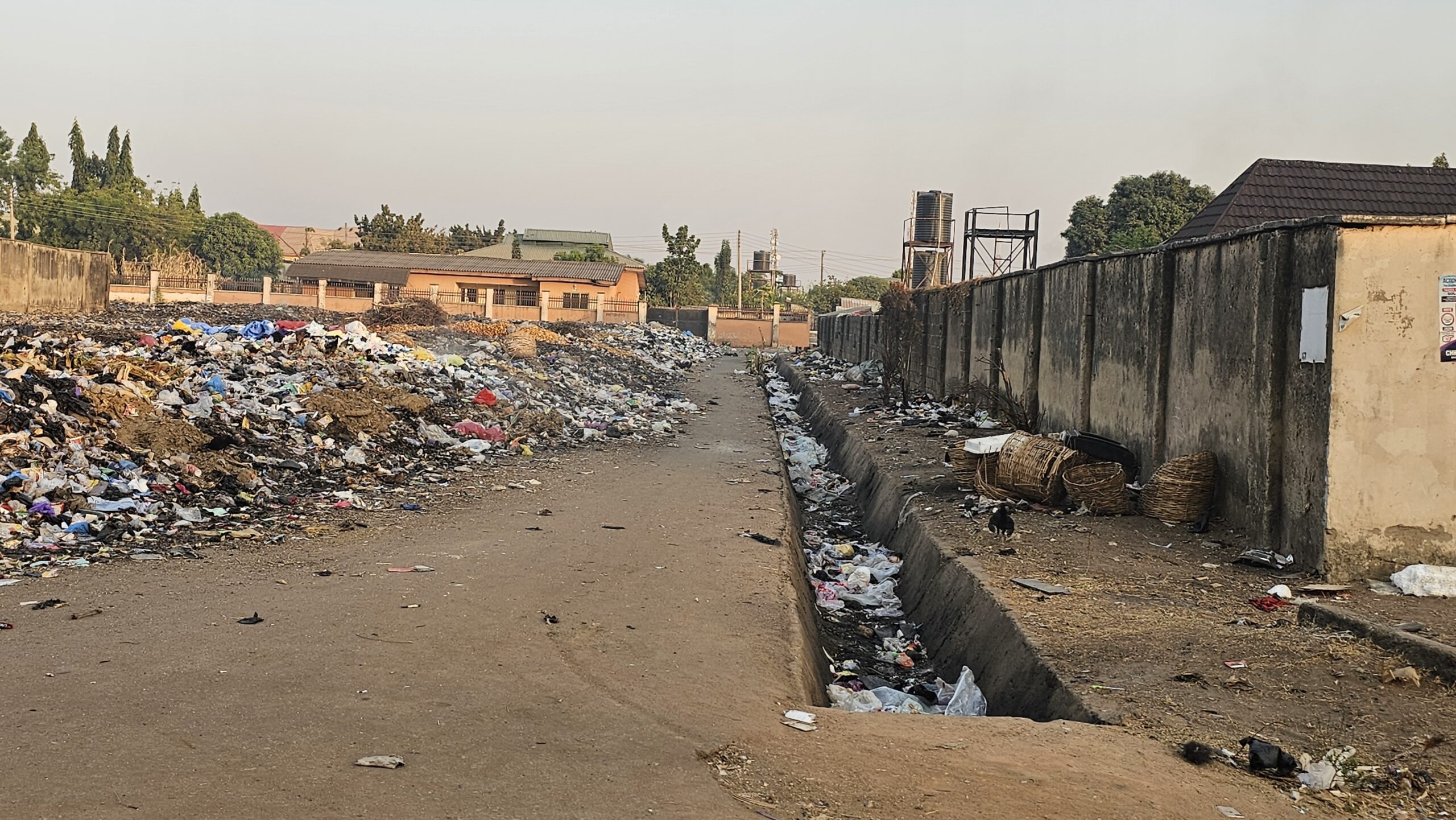
The collection point sits within the residential area of Kuje Quarters, near the abandoned stadium project and just a few metres away from key facilities including a private hospital, the Federal Road Safety Corps office, the General Hospital and several businesses.
What was once designated as a refuse collection point has gradually turned into a growing environmental challenge affecting residents, businesses and public health.
Residents say the waste, which is meant to be evacuated regularly, has remained unattended for long periods, leaving the community exposed to pollution and potential health risks.
Silas Ojigbe, a resident of Kayarda who frequently disposes waste at the site, said the situation had become troubling.
“I usually come here to throw waste, but it has been a concern because whenever I come here, I have to cover my nose before going inside.’’
Ojigbe expressed frustration that the refuse had been left unattended for a long time, leaving residents confused about why authorities had not taken action.
According to him, a tractor belonging to the company previously responsible for the waste disposal can still be seen around the site, yet nothing appears to be happening.
“Sometimes you see scavengers, popularly called ‘Baban Bola’, setting fire to the refuse and the smoke spreads across the entire area,” he said.
Sani Haruna, one of the athletes who regularly trains at the nearby stadium, said the smoke and stench from the refuse had made training difficult.
“The stench from the waste is affecting us seriously and we inhale the smoke when the refuse is burning.”
Haruna said residents and athletes had repeatedly complained to local authorities but nothing substantial had been done.
“So many times we have reported it and they promise to do something, but nothing happens and we are now waiting for the next Area Council administration that will resume by April and hoping they will address the issue,” he said.
Mr James Emmanuel, Manager of Golden Lits Hotel located close to the site, said the situation had begun to affect patronage.
“People used to come here in the evening to relax, but they cannot stay anymore because of the smoke, smell and you cannot blame customers for not coming again because if I go to a place and it is not conducive, I will not return.’’
Emmanuel noted that although the location was originally designated as a waste site years ago, the rapid development of the surrounding area made it unsuitable.
“If you look around now, the area is developed, there is the stadium, school, hotel, hospitals and many children pass through here to school.
“We are appealing to the relevant authorities to relocate the dumpsite,” he said.
Mr Suleiman Olorundare recalled a recent incident when a fire broke out at the site late at night.
“About two weeks ago, the refuse was set on fire and residents had to come out to put it out.
“The smoke affected many of us and I could not sleep throughout that night because the fumes filled the air,” he said.
Another resident, Joseph, last name withheld, said the situation was particularly worrying for families with children.
He recounted how a recent fire at the dumpsite filled his home with thick fumes despite having a six-month-old baby in the house.
“The whole house was filled with smoke and this is not just normal smoke; it is thick, dirty and toxic.”
Joseph also alleged that medical waste from nearby health facilities was sometimes dumped at the site, increasing the potential health danger.
“The General Hospital waste is dumped here, market waste is brought here, everything ends up here and this is a residential area.’’
Apart from health implications, he warned that the dumpsite had gradually become a gathering point for scavengers and suspected criminal elements.
“It has become a safe haven for scavengers and all kinds of people, the place is gradually turning into a mini ‘pantaker’ area where people gather to smoke and take drugs,” he said.
Meanwhile, Abdulrasheed Dada, an acclaimed head of scavengers around the dumpsite, alleged that the problem could be linked to non-payment of contractors for the job.
He said scavengers devised a means of removing materials they considered valuable before burning the remaining refuse to reduce the volume of waste.
An official from Lakewood Development Company Limited—the firm that previously managed the site—anonymously stated that the situation stems from the expired waste management contract.
According to him, the contract ended in April 2025 and the company could no longer continue operations without government approval and payment.
He explained that although the company still had its machines at the site, it could not continue work without financial commitment from the authorities.
“Our contract expired in April last year and we have not been paid since then and waste management involves a lot of money, so we cannot just continue intervention work.
“When the contract expired, the authorities were supposed to renew it, advertise for new contractors or give an extension, but that was not done,” he said.
The official said they are still ready to work with the government, but there should be some level of commitment from the government.
Also speaking, Mr Nakoto Dami, Assistant Director and Environmental Health Officer at the Kuje Area Council Secretariat, explained that the site was originally created as a temporary waste collection point.
According to him, residents are expected to deposit their refuse there before it is transported to a final dumpsite located in the outskirts of the town.
“This place is a collection point where residents bring their waste before the government evacuates it to the final dumpsite outside Kuje.’’
Dami noted that the problem began when contractors previously engaged to manage the waste site were disengaged between late 2024 and early 2025.
“When their services were terminated, the system stopped and the waste started accumulating and the area council occasionally tried to intervene, but financial constraints had made regular evacuation difficult.
“As long as people live in a place, waste will always be generated daily and without the contractors, it has been difficult for the Area Council to evacuate the waste regularly,” he said.
Dami described the situation as an environmental hazard affecting residents and appealed for urgent intervention from relevant authorities.
Mr Philip Japkor, Executive Director, Renevlyn Development Initiative (RDI) and Environmental Advocate, warned that exposure to poorly managed waste, especially medical waste, could pose serious health risks to residents living close to dumpsites.
Jakpor said decomposing waste and pollutants at landfill sites could irritate the respiratory system and expose people to illnesses.
According to him, burning waste at dumpsites, common in many Nigerian cities, releases fumes that can worsen respiratory conditions such as asthma and lead to other health complications.
Dr Oladoyin Odubanjo, a Public Health Physician, warned that residents could be exposed not only to respiratory illnesses but also to waterborne diseases.
He added that exposure to decomposing refuse, toxic gases, and burning waste could have both direct and indirect effects on human health.
Odubanjo said that foul odours and air pollutants from dumpsites could cause stress, anxiety and sleep disruption among residents, while prolonged inhalation might worsen asthma and trigger other respiratory conditions.
“People living around such environments may experience persistent coughing, eye irritation and skin rashes due to constant exposure to gases and pollutants.”
According to him, disease-carrying organisms such as flies and rodents can transfer contaminants from dumpsites to nearby homes, exposing residents to infections.
“These vectors can carry harmful substances and deposit them on food or surfaces, leading to illnesses such as cholera, typhoid and even hepatitis,” he said.
He also warned that liquid waste from dumpsites could seep into the ground and contaminate nearby water sources, posing additional public health risks.
The physician stressed that waste collection points in residential areas should not be left unattended for more than one week, noting that prolonged accumulation reflects a failure in waste evacuation systems.
Odubanjo recommended practical measures such as proper waste containment, regular evacuation, adequate number of covered bins and periodic cleaning and fumigation of disposal areas.
However, efforts to reach Mr Abdulkadir Zulkiflu, Coordinator, Satellite Towns Development Department (STDD) of the FCT Administration to react to the situation were not successful.
For residents like Danielle and others who must pass the dumpsite daily, hope remains that swift action will be taken before the environmental challenge escalates into a larger public health crisis, even as the rains are around the corner.(NANFeatures)
True i have breathing difficulties and the fumes makes it difficult for me to breath.this is in d middle of people houses cos u have to pass through the dirts to other places around the area