





By Angela Atabo
The Nigerian Institution of Civil Engineers (NICE) has stressed that sustained infrastructure development remains the most critical driver of economic growth, trade expansion and investment.
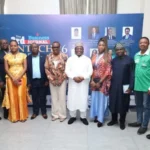
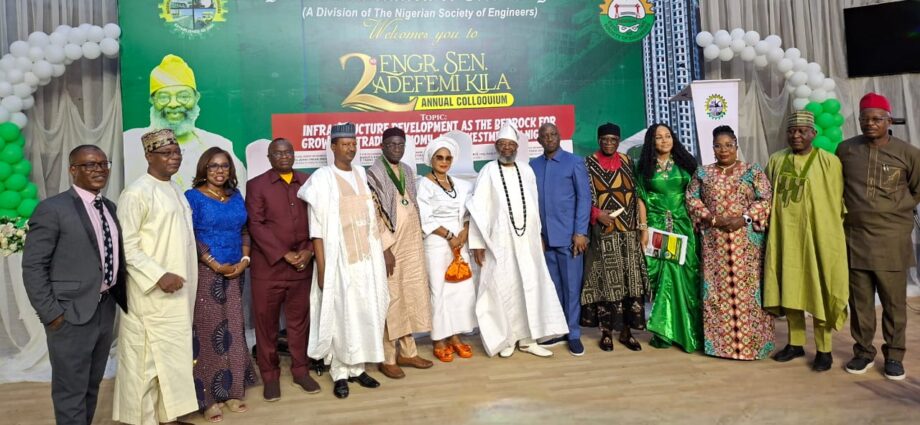
The National Chairman of NICE, Mr Tokunbo Ajanaku, said this on Saturday at the 2nd Sen. Adefemi Kila Annual Colloquium in Abuja.
The colloquium was with the theme ‘Infrastructure Development as the Bedrock for Growth in Trade, Economy, and Investment in Nigeria’.
Ajanaku said global studies consistently showed a strong correlation between infrastructure development and economic performance.
“Every major economy is founded on infrastructural growth. If infrastructure does not grow, the economy, trade and business sector will not grow.
“You will recall that in 2000, GSM was introduced into Nigeria. Today, businesses are better because of that single infrastructure.
“Consider roads. When you connect point A to point B, businesses naturally emerge along the corridor.
“Infrastructure is an injection, an elixir for economic growth. We must prioritise its expansion to strengthen the economy,” he said.
Ajanaku cited studies indicating that each new infrastructure project could generate at least a five per cent increase in local economic growth.
He urged policymakers to adopt a systematic approach to infrastructure expansion to maximise national economic benefits.
He said the colloquium honoured Sen. Adefemi Kila, highlighting his legacy of leadership and commitment to national development.
The keynote speaker, Dr Dakuku Peterside, warned that Nigeria’s economic ambitions would remain a mirage without urgent infrastructure reforms.
“No nation can grow its economy, sustain trade, or attract investment on borrowed infrastructure or wishful thinking.
“That is our reality. We want to be a first-world nation without fixing infrastructure. Wishful thinking is not a strategy,” he said.
Peterside, a former Director-General of Nigerian Maritime Administration and Safety Agency, said infrastructure extended beyond roads, bridges, airports, seaports and power.
“It is more than concrete and steel. It is the invisible platform that turns potential into productivity and local activity into global trade.
“When we connect infrastructure to trade and investment, we begin to realise our full potential,” he said.
He urged government to treat infrastructure as a national priority rather than an afterthought.
“Let us build not for the next election, but for the next generation,” he said.
The guest speaker, Dr Kayode Opeifa, Managing Director of the Nigerian Railway Corporation, emphasised the importance of rail transport.
“As long as mobility is neglected, we will remain underdeveloped. Without efficient movement of goods, the economy will stagnate,” he said.
Opeifa said rail would reduce logistics costs, cut transit times and unlock agricultural and industrial value chains.
“We need to invest more in critical national infrastructure,” he added.
The President of the Nigerian Society of Engineers, Ali Rabiu, urged political leaders to prioritise competence over patronage in contract awards.
“Nigerian engineers are among the best globally and should be fully involved in infrastructure delivery.
“Rather than engage local contractors, political leaders often prefer foreign firms for unclear reasons,” he said.
Responding, Sen. Adefemi Kila thanked NICE for organising the colloquium in his honour.
Highlights included the unveiling of NICE’s website and membership portal, awards presentation, fundraising for its headquarters and conferment of fellowship on over 60 members. (NAN) (www.nannews.ng)
Edited by Kamal Tayo Oropo