


By Mark Longyen
China has called on developing countries to emulate its experience in giant developmental strides over the past four decades and enhance their capacity for transformational economic growth and sustainable development.
Mr Hao Wu, Deputy Director of the Executive Department, China Aid Training Programme, made this known in Beijing, the Chinese capital city, on Wednesday.
He was speaking at a joint opening ceremony of a two-week seminar organised by China’s Ministry of Commerce (MOFCOM) and the Academy for International Business Officials (AIBO).
The News Agency of Nigeria (NAN) reports that the events are themed: “China’s Reform and Opening-up Experience for Developing Countries,” and “Global Value Chains for Developing Countries,” respectively.
Hao explained that over the past 40 years of pragmatic reform and opening up, China has eliminated absolute poverty, undergone profound industrialisation, manufacturing and global value chain transformation.
He said that the efforts had also culminated in China’s achievement of extraordinary milestones of rapid economic growth and enduring social stability, which developing countries should emulate.
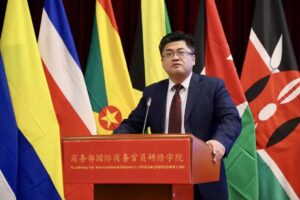
Mr Hao Wu speaking at the seminar(NAN).
“To date, China’s manufacturing sector has become the largest in the world in terms of scale. Its industrial structure has achieved major upgrades, and its capacity for scientific and technological innovation has continued to impress.
“In the future, we aim to contribute to sustainable global economic development by jointly facilitating the global value chains, enhancing development, and ensuring that the shared benefits of mutual beneficial cooperation reach organisations,” he said.
Hao said that, in light of its desire to achieve such targeted economic development initiative within the framework of South-South cooperation, China deliberately initiated a policy on international human resource development training.
According to him, the initiative aims at teaching people “how to fish” by sharing China’s development experience and solutions with them, to facilitate and enhance their sustainable development capacities.
“As we in China often say, give a man a fish, you feed him for a day. And teach a man to fish, you feed him for a lifetime.
“Over the years, the Chinese government has carried out about 20,000 international training or seminar programmes, covering 17 fields and 120 topics for nearly 160 countries and international organisations.
“This training and seminar programme has benefited more than 50,000 participants worldwide, and MOFCOM is the headquarters best known for international development cooperation in human resource,” he said.
Hao noted that profound changes in the international system required countries to jointly promote the establishment of cooperation, which promotes shared development that is predicated on “win-win” approach.
He added that AIBO had become a window for development, experience sharing, mutual learning, and a bridge of enhanced mutual friendship and practical cooperation between China and other countries.
Mr Harold Rosales, Vice President of the Republic of Costa Rica’s Vazquez de Coronado Municipality, lauded China’s initiative of creating spaces and opportunities from which developing countries could learn and succeed.
According to him, the training offers a special opportunity to share practical experiences and solutions, such as smart city, digital transformation, industry and integration, among others.
“These models and experiences can be imported to our regions, adapted to our contents, and implemented with the age changes and mindset of our program,” he said.
Speaking on “Global Value Chains for Developing Countries,” Ms Narine Suleymanyan from the Republic of Armenia, described global value chains as key components of the world economy, which carry direct security and communication elements.
She expressed confidence that through joint efforts like the seminar, participating countries would build a more inclusive and sustainable economic system, and achieve stronger, more competitive positions and new opportunities.
“It is evident that this seminar provides an important opportunity for all of us to jointly discuss the challenges in this field, exchange experiences, and identify effective solutions,” Suleymanyan added(NAN)(www.nannews.ng)
Edited by Abiemwense Moru
Comments